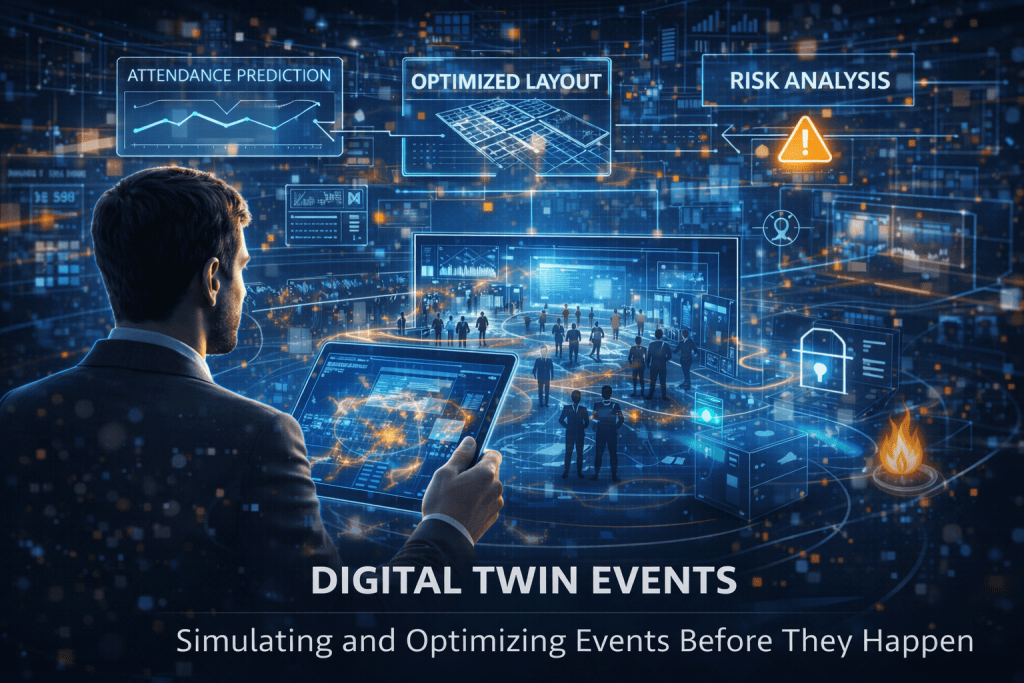
Digital Twin Events: Simulating and Optimizing Events Before They Happen
Introduction: From Static Planning to Predictive Event Engineering
Event planning has traditionally relied on historical data, manual expertise, and static assumptions. Floor plans are designed based on past attendance, session schedules are optimized using limited insights, and logistics are coordinated with built-in buffers to handle uncertainty. While effective to a degree, this approach lacks precision and adaptability.
Digital twin technology introduces a fundamentally different paradigm. By creating a dynamic, data-driven virtual replica of an event—encompassing venues, attendees, systems, and interactions—organizers can simulate, test, and optimize events before they occur. Originally developed in industries such as manufacturing and smart infrastructure, digital twins are now entering the event technology domain as a powerful tool for predictive planning and real-time optimization.
Rather than reacting to issues during an event, organizers can proactively identify inefficiencies, predict outcomes, and continuously refine event design.
What Is a Digital Twin in the Event Context?
A digital twin of an event is a virtual representation that mirrors both the physical and behavioral aspects of the event environment. It integrates multiple data sources to simulate:
- Physical spaces (venues, layouts, infrastructure)
- Attendee movement and behavior
- Session dynamics and engagement patterns
- Operational workflows (staffing, logistics, security)
Unlike static models, digital twins are continuously updated with real-time data, enabling both pre-event simulation and live optimization.
Core Components of Event Digital Twins
1. Spatial Modeling and Venue Digitization
The foundation of a digital twin is an accurate representation of the physical environment:
- 3D models of venues and floor layouts
- Entry/exit points, pathways, and bottlenecks
- Booth placements and session rooms
Technologies used include:
- CAD-based modeling
- LiDAR scanning
- Photogrammetry and volumetric capture
This spatial layer enables simulation of movement, density, and environmental conditions.
2. Behavioral Modeling
Digital twins incorporate behavioral intelligence to simulate how attendees interact with the event:
- Movement patterns and dwell times
- Session preferences and switching behavior
- Networking interactions
Behavioral models are built using:
- Historical event data
- Real-time tracking inputs
- Machine learning models (clustering, sequence prediction)
This allows the twin to simulate realistic attendee flows and engagement scenarios.
3. Data Integration Layer
A digital twin aggregates data from multiple systems:
- Registration and CRM platforms
- Event apps and engagement tools
- IoT sensors (RFID, BLE, Wi-Fi tracking)
- Content and session analytics
Data is ingested through:
- Streaming pipelines
- API integrations
- Event-driven architectures
A unified data model ensures consistency across simulations.
4. Simulation and Prediction Engine
At the core of the digital twin is a simulation engine that can:
- Model crowd movement and congestion
- Predict session attendance توزيع
- Evaluate scheduling conflicts
- Simulate resource allocation scenarios
Advanced systems use:
- Agent-based modeling (each attendee as an autonomous agent)
- Reinforcement learning for optimization
- Monte Carlo simulations for uncertainty analysis
5. Visualization and Interaction Layer
Digital twins are accessed through interactive interfaces:
- 3D dashboards for spatial visualization
- Heatmaps for crowd density and engagement
- Scenario controls for simulation testing
These interfaces allow organizers to:
- Explore “what-if” scenarios
- Adjust parameters dynamically
- Visualize outcomes in real time
System Architecture
Data Layer
- Historical datasets
- Real-time streaming inputs
- Unified event data schema
Modeling Layer
- Spatial models (3D environments)
- Behavioral models (attendee agents)
- Environmental variables (time, capacity, constraints)
Simulation Layer
- Scenario engines
- Predictive analytics models
- Optimization algorithms
Integration Layer
- APIs connecting event platforms
- IoT systems and venue infrastructure
- External data sources
Experience Layer
- Visualization dashboards
- Control interfaces
- Reporting tools
This layered architecture enables scalability and modularity, allowing digital twins to evolve alongside event complexity.
Pre-Event Applications
Layout Optimization
Organizers can simulate:
- Foot traffic across different floor plans
- Booth placement impact on visibility
- Queue formation at entry points
This helps reduce congestion and improve attendee flow.
Agenda and Scheduling Design
By modeling attendee preferences:
- Session overlaps can be minimized
- Room capacities can be optimized
- High-demand sessions can be identified מראש
Resource Planning
Digital twins can optimize:
- Staffing allocation
- Security positioning
- Equipment distribution
This reduces over-provisioning while maintaining service quality.
Risk Assessment
Simulations can identify:
- Emergency evacuation bottlenecks
- نقاط failure in infrastructure
- Crowd safety risks
This enables proactive mitigation strategies.
Real-Time Event Optimization
Digital twins are not limited to pre-event planning. When connected to live data streams, they enable:
Dynamic Crowd Management
- Real-time density tracking
- Predictive congestion alerts
- Automated rerouting suggestions
Adaptive Scheduling
- Adjusting session timings based on attendance
- Reallocating rooms dynamically
- Managing speaker delays
Operational Decision Support
- Reassigning staff based on demand
- Managing queue lengths
- Responding to incidents بسرعة
Continuous Feedback Loops
The digital twin updates continuously:
- Refining models based on actual behavior
- Improving prediction accuracy
- Enabling real-time optimization
Operational and Business Impact
Improved Event Efficiency
Digital twins reduce inefficiencies by:
- Optimizing layouts and schedules
- Minimizing congestion and delays
- Improving resource utilization
Enhanced Attendee Experience
Attendees benefit from:
- Smoother navigation
- Better session availability
- Reduced wait times
Increased ROI for Sponsors
Optimized layouts and engagement patterns lead to:
- Higher booth visibility
- Better lead generation
- Improved sponsor satisfaction
Data-Driven Decision Making
Organizers gain:
- Predictive insights
- Scenario-based planning capabilities
- Continuous improvement across events
Challenges and Considerations
Data Availability and Quality
Accurate simulations depend on:
- High-quality historical data
- Real-time data integration
- Consistent data models
Modeling Complexity
Human behavior is inherently unpredictable:
- Simplified models may reduce accuracy
- Overly complex models increase computational cost
Infrastructure Requirements
Digital twins require:
- High-performance computing
- Real-time data pipelines
- Scalable storage and processing systems
Integration Challenges
Connecting multiple systems introduces:
- API inconsistencies
- Data silos
- Synchronization issues
Cost and Accessibility
High implementation costs may limit adoption for smaller events.
Future Trends
AI-Driven Autonomous Optimization
Digital twins will increasingly integrate with autonomous systems:
- Real-time decision-making without human intervention
- Continuous optimization loops
- Self-learning event environments
Integration with Spatial Computing
Digital twins will merge with AR/VR systems:
- Real-time overlays for organizers
- Immersive planning environments
- Enhanced operational visibility
Standardization of Event Data Models
Industry-wide standards will:
- Improve interoperability
- Reduce integration complexity
- Accelerate adoption
Persistent Event Twins
Digital twins will persist beyond individual events:
- Continuous learning across event portfolios
- Long-term optimization strategies
- Reusable simulation environments
Conclusion: Engineering Events Before They Exist
Digital twin technology transforms event planning from a reactive process into a predictive, engineering-driven discipline. By simulating events before they happen, organizers can identify inefficiencies, mitigate risks, and optimize experiences with unprecedented precision.
While challenges remain—particularly around data integration and modeling complexity—the trajectory is clear. As event ecosystems become more data-rich and interconnected, digital twins will play a central role in how events are designed, executed, and evolved.
For event technology leaders, the adoption of digital twins represents not just a technological upgrade, but a strategic shift toward intelligent, data-driven event operations.