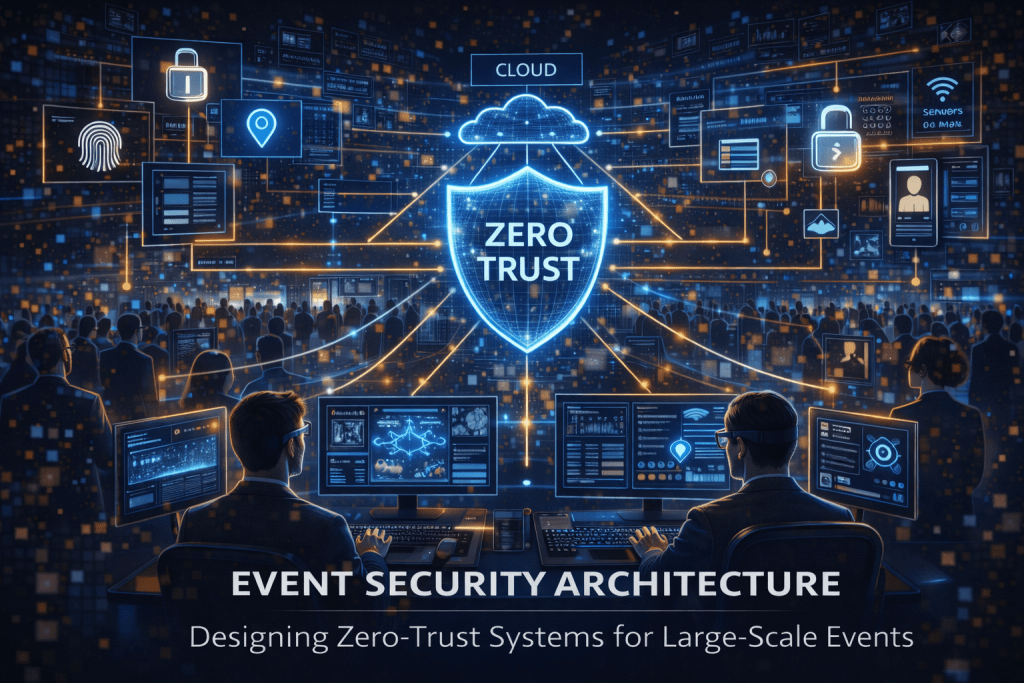
Event Security Architecture: Designing Zero-Trust Systems for Large-Scale Events
Introduction: Security as a System, Not a Layer
Event technology has evolved rapidly, but security architectures have often lagged behind. Historically, event systems have relied on perimeter-based security models—trusted internal networks, controlled access points, and implicit trust once users or devices are inside the environment. This approach is increasingly inadequate.
Modern events operate across distributed infrastructures: cloud platforms, mobile devices, IoT systems, third-party integrations, and on-site networks. Attendees connect through personal devices, vendors access shared systems, and operational tools span multiple environments. In this context, the notion of a secure perimeter dissolves.
Zero-trust architecture offers an alternative. Rather than assuming trust based on location or network boundaries, it requires continuous verification of every user, device, and interaction. Applied to event environments, zero-trust principles redefine how identity, access, and data security are managed at scale.
Rethinking Trust in Event Ecosystems
Zero-trust is built on a simple premise: trust nothing, verify everything. In practice, this means that no entity—whether an attendee, staff member, device, or application—is inherently trusted. Every request must be authenticated, authorized, and validated based on context.
In an event setting, this has profound implications. Attendees may access mobile apps, networking platforms, and digital services. Staff interact with operational systems, while vendors integrate external tools. Each interaction represents a potential attack surface.
Zero-trust shifts the focus from securing the perimeter to securing individual interactions. Identity becomes the primary control plane, and access is granted dynamically based on context, rather than static roles.
Identity as the Core Security Primitive
At the center of zero-trust architecture is identity. Every user and device must be uniquely identifiable and continuously authenticated. This goes beyond simple login mechanisms.
Modern identity systems incorporate multiple factors, including device posture, behavioral signals, and contextual information. For example, access to sensitive operational systems may depend not only on user credentials but also on device security status and location within the venue.
In event environments, identity systems must handle high volumes of transient users. Attendees join and leave within short timeframes, often across multiple platforms. This requires scalable, flexible identity frameworks that can adapt to dynamic conditions.
The integration of privacy-first authentication methods—such as token-based credentials and decentralized identity systems—aligns naturally with zero-trust principles, reducing reliance on static identifiers and centralized data stores.
Device and Network Trust Boundaries
Events introduce a diverse array of devices into the network: attendee smartphones, staff tablets, IoT sensors, access control systems, and vendor المعدات. Each device represents a potential نقطة vulnerability.
Zero-trust architectures treat devices as untrusted by default. Before granting access, systems evaluate device posture—whether it meets security requirements such as updated software, secure configurations, and absence of known vulnerabilities.
Network segmentation plays a critical role in limiting risk. Instead of a single, shared network, event environments are divided into isolated segments based on function. For example, attendee Wi-Fi, operational systems, and IoT networks operate independently, reducing the potential impact of a breach.
Micro-segmentation extends this concept further, isolating individual services and applications. Even within the same network, access is restricted based on specific policies, preventing lateral movement in case of compromise.
Access Control and Policy Enforcement
In a zero-trust model, access is governed by granular policies that consider multiple factors. These policies are enforced continuously, not just at the point of entry.
For example, an event staff member accessing a scheduling system may be granted permissions based on role, location, and time. If any of these conditions change—such as accessing the system from an unauthorized device or outside designated ساعات—access can be restricted or revoked.
Policy engines evaluate these conditions in real time, ensuring that access decisions remain aligned with current context. This dynamic approach contrasts with traditional role-based access control, which often relies on static permissions.
Application-level security further reinforces this model. Instead of exposing entire systems, access is limited to specific functions and data आवश्यक for the task at hand.
Securing Data Flows Across Systems
Event ecosystems involve continuous data exchange between systems: registration platforms, mobile apps, analytics engines, and third-party integrations. Securing these data flows is a central concern in zero-trust architecture.
Encryption is a baseline requirement, ensuring that data remains protected both in transit and at rest. However, zero-trust extends beyond encryption by enforcing strict validation of data exchanges.
APIs, which serve as the primary integration mechanism, must be secured באמצעות authentication, authorization, and rate limiting. Each API call is treated as an independent interaction, subject to verification.
Data access is also governed by least-privilege principles. Systems and users are granted only the minimum access necessary, reducing the risk of exposure.
Real-Time Monitoring and Threat Detection
Zero-trust systems rely heavily on continuous monitoring. Every interaction generates telemetry that can be analyzed to detect anomalies and potential threats.
In event environments, this includes monitoring user behavior, device activity, network traffic, and system interactions. Machine learning models can identify patterns that deviate from expected behavior, such as unusual access requests or rapid data transfers.
Real-time detection enables rapid response. Automated systems can isolate affected components, revoke access, or trigger alerts for further investigation. This reduces the time between detection and mitigation, which is critical in high-impact environments.
Operational Implications for Event Management
Implementing zero-trust architecture changes how event operations are structured. Security is no longer a separate function but an integral part of system design and execution.
Operational workflows must incorporate security considerations at every stage. Access provisioning, system integration, and data management are all governed by security policies.
For event organizers, this requires collaboration between technology teams, security specialists, and operational staff. Training and awareness are essential to ensure that security practices are understood and followed consistently.
The benefits extend beyond risk reduction. A well-implemented zero-trust system enhances reliability and resilience, ensuring that critical operations remain functional even تحت adverse conditions.
Challenges in Adoption
Transitioning to zero-trust architecture is not without challenges. Legacy systems may not support the required level of granularity or integration, necessitating upgrades or replacements.
Complexity is another factor. Designing and managing dynamic policies across multiple systems requires advanced capabilities and careful coordination.
User experience must also be considered. While security measures are essential, they should not introduce excessive friction. Balancing security with usability is a key design challenge.
Finally, cost and resource requirements can be significant, particularly for large-scale events with complex infrastructures.
Future Outlook: Security as Adaptive Infrastructure
The future of event security lies in adaptive systems that continuously evolve in response to changing conditions. Advances in AI and behavioral analytics will enable more precise detection of threats and more nuanced access control decisions.
Integration with broader event technologies—such as behavioral intelligence and autonomous orchestration—will further enhance capabilities. Security systems will not only protect events but actively contribute to operational efficiency and experience quality.
As events become more interconnected and data-driven, zero-trust architecture will move from a best practice to a necessity.
Conclusion: Building Trust Through Verification
Zero-trust architecture redefines how security is approached in event environments. By eliminating implicit trust and enforcing continuous verification, it provides a robust framework for managing complex, distributed systems.
For event technology leaders, adopting zero-trust principles is not simply about mitigating risk. It is about building systems that are resilient, scalable, and capable of supporting the next generation of event experiences.
In an environment where every interaction matters, trust must be earned continuously. Zero-trust architecture provides the foundation for doing so.