Event Observability: Monitoring, Debugging, and Optimizing Complex Event Systems
Introduction: When Events Become Distributed Systems
Modern events are no longer مجرد physical gatherings supported by a few digital tools. They are complex, distributed systems composed of interconnected services—registration platforms, mobile applications, access control systems, personalization engines, streaming infrastructure, and analytics pipelines. Each component generates data, performs actions, and interacts with others in real time.
As this complexity increases, so does the difficulty of understanding what is happening within the system. Failures are rarely isolated; they propagate across components, often manifesting as degraded user experiences rather than स्पष्ट system errors.
Traditional monitoring approaches—focused on individual systems and static metrics—are insufficient in this environment. What is required is a holistic approach that captures the behavior of the entire system.
Event observability provides this capability. It enables operators to understand, diagnose, and optimize event systems by analyzing their internal states through telemetry data.
Defining Observability in Event Contexts
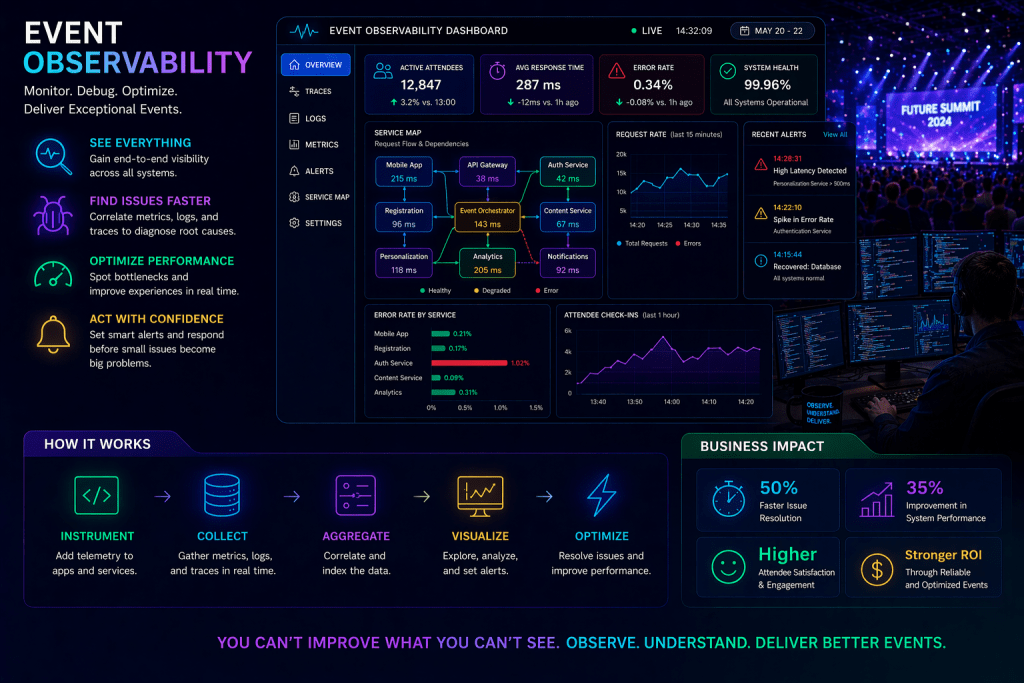
Observability is the ability to infer the internal state of a system based on the data it produces. In event technology, this involves collecting and analyzing telemetry from across the ecosystem.
This telemetry typically includes three primary categories:
- Metrics: Quantitative measurements such as system performance, latency, and usage levels
- Logs: Structured or unstructured records of events and system activities
- Traces: End-to-end records of requests as they propagate through multiple systems
Together, these signals provide a comprehensive view of how the system operates, enabling operators to identify issues, understand behavior, and optimize performance.
The Observability Stack
Implementing observability in event environments requires a dedicated stack that integrates data collection, processing, and visualization.
Instrumentation Layer
The first step is instrumenting systems to generate telemetry. This involves embedding code or configurations that capture relevant data at key points within applications and infrastructure.
Instrumentation must be consistent across systems to ensure that data can be correlated. This often requires standardized frameworks and protocols.
Data Collection and Aggregation
Telemetry data is collected from multiple sources and aggregated into centralized systems. This may involve agents, collectors, or streaming pipelines that handle high volumes of data in real time.
Scalability is critical, as large events can generate significant amounts of telemetry, particularly when tracking user interactions and system performance simultaneously.
Storage and Indexing
Collected data must be stored in a way that supports efficient querying and analysis. Different types of data may require different storage solutions—for example, time-series databases for metrics and distributed log systems for event records.
Indexing mechanisms enable rapid retrieval of relevant data, which is essential for real-time debugging and analysis.
Visualization and Analysis Tools
The final layer provides interfaces for exploring and analyzing telemetry data. Dashboards, query tools, and alerting systems allow operators to monitor system health, investigate issues, and identify trends.
Visualization is key to making sense of complex data. Heatmaps, timelines, and dependency graphs help reveal patterns that are not immediately obvious.
Distributed Tracing: Understanding System Interactions
One of the most powerful aspects of observability is distributed tracing. In event systems, a single user action—such as checking in or accessing a session—may trigger multiple interactions across different services.
Tracing captures this sequence, providing a detailed view of how requests flow through the system. This enables operators to identify bottlenecks, latency issues, and failure points.
For example, if attendees experience delays during check-in, tracing can reveal whether the issue originates in the registration system, the access control service, or the network layer.
This level of insight is essential for diagnosing complex issues بسرعة and accurately.
Real-Time Monitoring and Alerting
Observability systems support real-time monitoring, enabling operators to detect and respond to issues as they occur.
Metrics and logs are analyzed continuously, with thresholds and anomaly detection mechanisms triggering alerts when conditions deviate from expected patterns.
In event environments, where timing is critical, rapid detection is essential. Delays in identifying issues can lead to cascading failures and degraded experiences.
Automated alerting ensures that operators are notified तुरंत, enabling quick intervention.
Integration with Event Operations
Observability is not an isolated function; it is deeply integrated with event operations.
Event operating systems can incorporate observability data into their control interfaces, providing a unified view of system health and performance. Orchestration layers can use observability signals to trigger automated responses, such as scaling resources or rerouting traffic.
Digital twins can incorporate telemetry data to enhance simulations and predictions, while personalization engines can adjust behavior based on system conditions.
This integration transforms observability from a diagnostic tool into an active component of event management.
Operational and Business Impact
The adoption of observability has significant benefits for both operations and outcomes.
Operationally, it improves reliability. Issues can be detected and resolved more quickly, reducing downtime and disruptions.
It also enhances performance optimization. By analyzing telemetry data, teams can identify inefficiencies and सुधार system behavior.
From a business perspective, observability contributes to better attendee experiences. Smooth, reliable systems increase satisfaction and engagement.
For organizers, it provides actionable insights into system performance, enabling data-driven decision-making and continuous improvement.
Challenges and Considerations
Implementing observability in event environments involves several challenges.
Data volume can be substantial, requiring scalable infrastructure and efficient processing. Without proper management, telemetry systems can become overwhelming.
Correlation is another challenge. Linking data across multiple systems requires consistent identifiers and synchronization.
There is also the risk of information overload. Without effective filtering and visualization, operators may struggle to extract meaningful insights.
Finally, observability must be balanced with privacy considerations. Telemetry data should be collected and used responsibly, ensuring compliance with regulations and user expectations.
Future Outlook: Toward Self-Observing Systems
The evolution of observability is closely tied to advancements in AI and automation. Future systems will not only monitor themselves but also interpret and respond to conditions autonomously.
Machine learning models can analyze telemetry data to predict issues before they occur, enabling proactive intervention. Automated systems can adjust configurations, scale resources, or reroute traffic without human input.
This shift toward self-observing systems aligns with the broader trend of autonomous event operations, where systems manage themselves based on real-time data.
Conclusion: Visibility as a Foundation for Control
Event observability provides the visibility needed to manage complex, distributed systems effectively. By capturing and analyzing telemetry data, it enables operators to understand system behavior, diagnose issues, and optimize performance.
In modern event environments, where multiple systems interact in real time, this capability is essential. Without observability, complexity becomes opacity; with it, complexity becomes manageable.
For event technology leaders, observability is not just a technical enhancement—it is a foundational capability that supports reliability, performance, and continuous improvement.