Event Middleware Layers: Orchestrating Communication Across Disconnected Systems
Introduction: The Hidden Bottleneck in Event Technology
Modern event ecosystems are composed of numerous specialized systems—registration platforms, mobile apps, engagement tools, access control systems, analytics engines, and more. Each system is designed to perform a specific function, yet they must work together to deliver a cohesive experience.
In practice, this integration is often fragile. Systems communicate through point-to-point integrations, custom APIs, or manual data transfers. As the number of systems grows, these connections become increasingly complex, difficult to maintain, and prone to failure.
The result is a hidden bottleneck. While individual components may perform efficiently, the overall system struggles with latency, inconsistency, and operational rigidity. Real-time coordination becomes difficult, and the ability to adapt to changing conditions is limited.
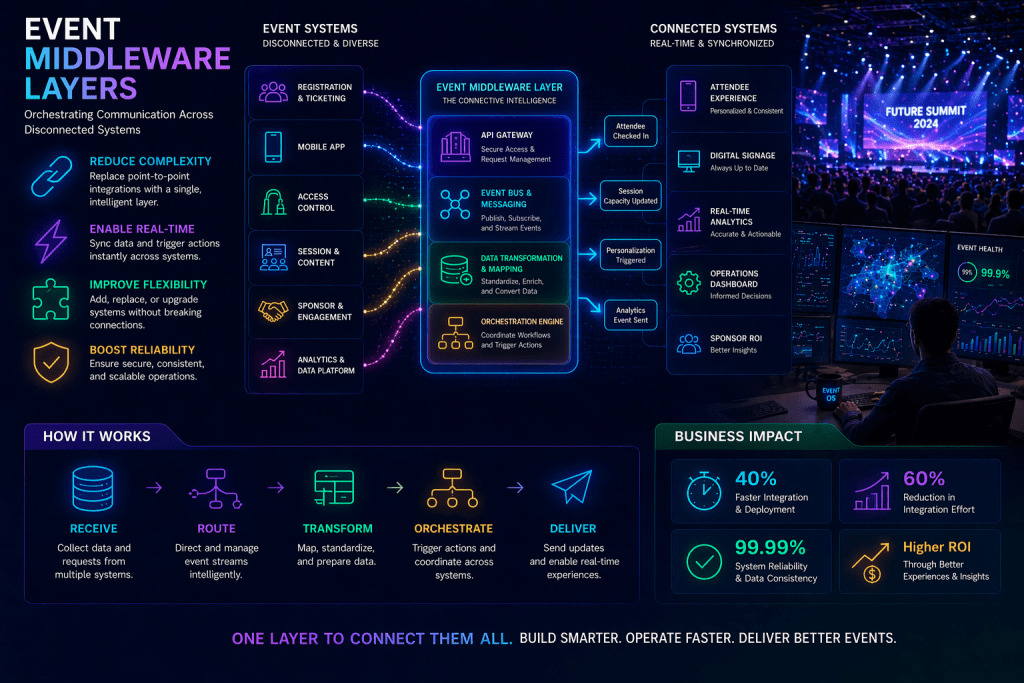
Event middleware layers address this challenge by introducing a dedicated integration and orchestration layer. They decouple systems, standardize communication, and enable scalable, real-time interactions across the event technology stack.
Defining Middleware in Event Contexts
Middleware is a software layer that sits between applications, enabling them to communicate and exchange data. In event technology, middleware acts as the intermediary that connects disparate systems and manages how they interact.
Unlike direct integrations, where systems communicate with each other individually, middleware provides a centralized communication framework. Systems interact with the middleware rather than with each other, reducing complexity and improving scalability.
This abstraction allows event architectures to evolve without requiring extensive reconfiguration of existing integrations.
Core Functions of Event Middleware
Event middleware performs several critical functions that enable interoperability and coordination.
It handles data transformation, ensuring that information exchanged between systems is consistent and compatible. Different systems often use different data formats and schemas, and middleware standardizes these differences.
It manages communication patterns, supporting both synchronous interactions (such as API requests) and asynchronous messaging (such as event streams). This flexibility allows systems to operate efficiently under different conditions.
It also provides routing and orchestration capabilities, directing data and actions to the appropriate systems based on defined rules or real-time conditions.
These functions collectively enable middleware to act as the backbone of event system integration.
Architectural Patterns
Event middleware is typically implemented using a combination of architectural patterns that support scalability and flexibility.
API Gateway Layer
The API gateway serves as the entry point for system interactions. It manages incoming requests, handles authentication, and routes traffic to appropriate services.
By centralizing API management, the gateway simplifies integration and provides a consistent interface for external systems.
Event Bus and Messaging Systems
An event-driven architecture is central to modern middleware implementations. An event bus enables systems to publish and subscribe to events, such as “attendee checked in” or “session started.”
This decouples systems, allowing them to react to events without direct dependencies. It also supports real-time processing, as events are propagated immediately across the system.
Messaging systems ensure reliable delivery, even under high load, and can handle scenarios such as retries and failure recovery.
Data Transformation and Mapping
Middleware includes transformation engines that map data between different formats and schemas. This ensures that systems can exchange information without requiring changes to their internal structures.
Transformation rules can be defined declaratively, enabling flexibility and adaptability as systems evolve.
Orchestration Engine
The orchestration engine coordinates workflows across multiple systems. It defines how actions are triggered, sequenced, and executed.
For example, when an attendee checks in, the middleware can trigger updates to the event app, notify analytics systems, and adjust access permissions. These actions are coordinated through predefined workflows.
Real-Time Coordination Across Systems
One of the key advantages of middleware is its ability to enable real-time coordination. In event environments, timing is critical. Delays in data propagation can lead to inconsistencies and degraded experiences.
Middleware ensures that updates are distributed तुरंत across systems. When a change occurs—such as a session reaching capacity—the information is propagated to all relevant systems simultaneously.
This synchronization enables consistent experiences across touchpoints, from mobile apps to digital signage.
Integration with Event Data and Intelligence Layers
Middleware plays a central role in connecting data and intelligence systems within the event ecosystem.
Event data platforms rely on middleware to ingest and distribute data from multiple sources. Behavioral intelligence systems receive real-time signals through middleware, enabling accurate intent modeling.
Personalization engines depend on timely data to deliver relevant experiences, while orchestration systems use middleware to execute actions across components.
This integration positions middleware as a critical enabler of advanced event capabilities.
Operational and Business Impact
The adoption of middleware has significant operational benefits. It reduces integration complexity, enabling faster deployment of new systems and features.
By decoupling systems, it enhances flexibility. Organizations can replace or upgrade components without disrupting the entire architecture.
From a performance perspective, middleware improves reliability and scalability. Messaging systems handle high volumes of data, ensuring consistent operation even under peak loads.
For event organizers, this translates into more resilient operations, better user experiences, and the ability to innovate more rapidly.
Challenges and Considerations
Implementing middleware introduces its own set of challenges. Designing a robust architecture requires careful planning and expertise in distributed systems.
Latency must be managed carefully. While middleware enables real-time communication, inefficient configurations can introduce delays.
Governance is critical. Without clear standards and policies, middleware can become a source of complexity rather than a solution.
Monitoring and observability are also essential. With multiple systems interacting through middleware, visibility into data flows and system performance is necessary to ensure reliability.
Future Outlook: Toward Event Fabric Architectures
The evolution of middleware points toward more advanced integration models, often referred to as event fabrics. These architectures provide a unified layer for data, communication, and orchestration across distributed systems.
In event environments, this could enable seamless integration across venues, platforms, and external systems, creating a continuous event ecosystem.
Advances in automation and AI will further enhance middleware capabilities, enabling dynamic routing, adaptive workflows, and self-healing systems.
Conclusion: The Invisible Backbone of Event Systems
Event middleware layers may not be visible to attendees, but they are essential to the functioning of modern event technology. By enabling communication, coordination, and scalability, they transform fragmented systems into cohesive ecosystems.
As events continue to evolve into complex, real-time environments, the importance of middleware will only grow. It provides the infrastructure needed to support integration, innovation, and adaptability.
For event technology leaders, investing in robust middleware is not just a technical decision—it is a strategic foundation for building resilient and future-ready event systems.