Event Workflow Automation: Orchestrating Processes Across the Event Lifecycle
Introduction: The Shift from Manual Coordination to System-Driven Execution
Event operations have traditionally relied on manual coordination—teams managing registrations, schedules, access control, communications, and on-site logistics through a combination of tools, spreadsheets, and human intervention. While effective at smaller scales, this approach becomes increasingly fragile as events grow in size, complexity, and real-time demands.
Modern event environments generate continuous streams of data and require immediate responses. Attendee actions, system states, and environmental conditions evolve rapidly, creating a need for coordinated, timely execution across multiple systems.
Event workflow automation addresses this challenge by transforming operational processes into programmable workflows. Instead of relying on manual intervention, systems execute tasks automatically based on predefined rules, real-time data, and adaptive logic.
Defining Workflow Automation in Event Contexts
Workflow automation refers to the use of software systems to execute sequences of tasks based on triggers, conditions, and logic. In event environments, workflows span the entire lifecycle—from pre-event planning to post-event follow-up.
These workflows may include:
- Registration and onboarding processes
- Session scheduling and updates
- Access control and credential management
- Communication and notifications
- Sponsor engagement and lead handling
The key distinction is that workflows are not مجرد static sequences. They are dynamic processes that adapt to real-time conditions and system states.
Core Components of an Event Workflow System
Event workflow automation systems are built on several foundational components that enable orchestration and execution.
Trigger Mechanisms
Workflows begin with triggers—events or conditions that initiate a process. These triggers can be:
- User actions, such as registration or check-in
- System events, such as session capacity updates
- External inputs, such as schedule changes or environmental data
Triggers ensure that workflows are responsive and aligned with real-time conditions.
Rule and Decision Engines
Once triggered, workflows are governed by rules and decision logic. These engines evaluate conditions and determine the appropriate actions.
Rules may be simple—such as sending a confirmation email—or complex, involving multiple conditions and dependencies. Advanced systems incorporate AI models to make decisions based on patterns and predictions.
Task Orchestration
The orchestration layer coordinates the execution of tasks across multiple systems. It ensures that actions occur in the correct sequence and that dependencies are respected.
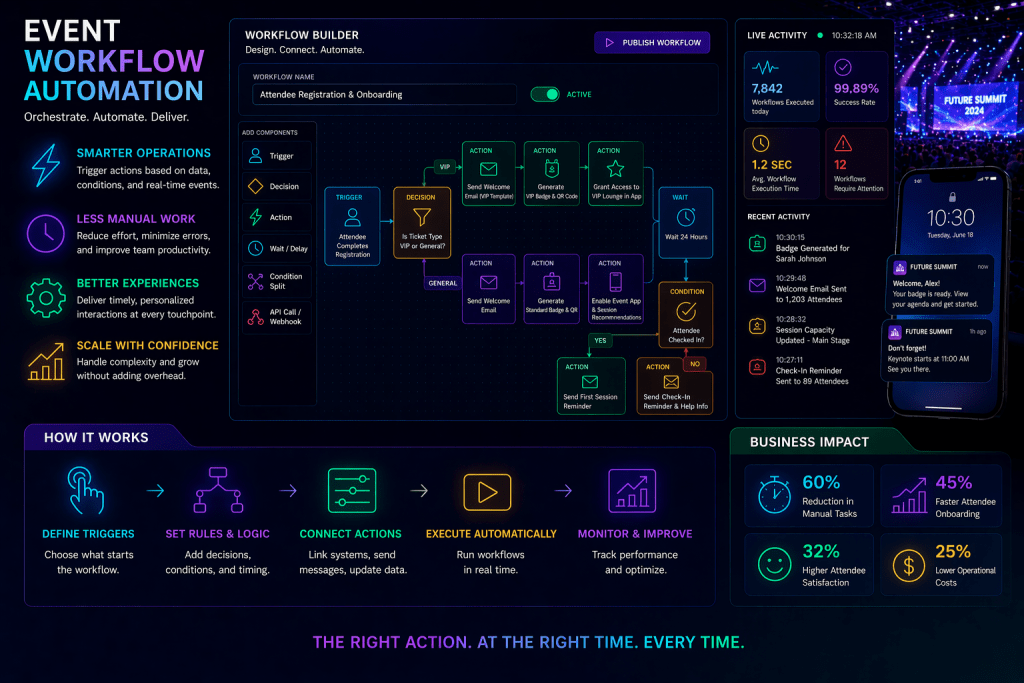
For example, a workflow triggered by attendee registration may involve updating the event database, generating credentials, sending notifications, and integrating with personalization systems.
Integration Layer
Workflow systems rely on integration with other event technologies. APIs and middleware enable communication between systems, allowing workflows to interact with registration platforms, mobile apps, analytics engines, and more.
This integration ensures that workflows operate across the entire ecosystem rather than within isolated components.
Monitoring and Feedback
Automated workflows must be monitored to ensure reliability and effectiveness. Observability systems provide insights into workflow execution, identifying failures, delays, or inefficiencies.
Feedback loops enable continuous improvement, allowing workflows to be refined based on performance data.
Pre-Event Automation: Streamlining Preparation
Before the event begins, workflow automation simplifies planning and preparation.
Registration workflows can automate attendee onboarding, including confirmation emails, credential issuance, and data validation. Scheduling workflows can coordinate session creation, speaker assignments, and updates across systems.
Logistics workflows can manage tasks such as resource allocation, vendor coordination, and setup timelines. By automating these processes, organizations reduce manual effort and minimize errors.
Real-Time Automation: Adaptive Event Operations
During the event, workflow automation becomes a critical component of real-time operations.
When an attendee checks in, workflows can update system records, trigger personalized recommendations, and notify relevant systems. If a session reaches capacity, workflows can redirect attendees, update availability, and communicate changes.
In crowd management, workflows can respond to real-time data by adjusting access points, deploying staff, or modifying schedules.
This adaptability enables events to operate as responsive systems rather than static environments.
Post-Event Automation: Extending Engagement
After the event, workflows continue to operate, supporting follow-up and analysis.
Automated processes can distribute feedback surveys, generate reports, and initiate sponsor follow-ups. Data collected במהלך the event can be processed and integrated into analytics systems, providing insights for future planning.
These workflows ensure that the value of the event extends beyond its duration.
Integration with Event Intelligence Systems
Workflow automation is closely integrated with other components of the event technology ecosystem.
Event data platforms provide the data foundation for triggering and informing workflows. Behavioral intelligence systems contribute insights into attendee intent, enabling more relevant actions.
Personalization engines use workflows to deliver targeted experiences, while orchestration systems coordinate complex interactions across components.
This integration creates a cohesive system where workflows act as the execution layer for event intelligence.
Operational and Business Impact
The adoption of workflow automation has significant benefits for both operations and outcomes.
Operationally, it reduces manual effort and increases efficiency. Tasks are executed consistently and reliably, minimizing the risk of errors.
From an experience perspective, automation enables faster and more responsive interactions. Attendees receive timely information and personalized guidance, improving engagement.
For organizers, it provides greater control and visibility over processes. Workflows can be monitored, analyzed, and optimized, supporting continuous improvement.
Strategically, workflow automation enables scalability. Events can grow in size and complexity without proportional increases in operational overhead.
Challenges and Considerations
Implementing workflow automation requires careful design and governance.
Defining workflows can be complex, particularly in dynamic environments with multiple dependencies. Overly rigid workflows may fail to adapt to changing conditions, while overly flexible systems may become difficult to manage.
Integration remains a challenge, as workflows must interact with diverse systems and data sources.
There is also the need for transparency. Operators must understand how workflows operate and be able to intervene when necessary.
Finally, reliability is critical. Automated systems must handle failures gracefully, ensuring that disruptions do not propagate across the system.
Future Outlook: Toward Autonomous Workflow Systems
The evolution of workflow automation points toward increasing autonomy. As AI capabilities advance, workflows will become more adaptive and context-aware.
Systems will not only execute predefined processes but also generate and optimize workflows dynamically based on data and objectives.
Integration with event operating systems and digital twins will enable more sophisticated orchestration, aligning workflows with real-time conditions and predictive insights.
Conclusion: Automation as the Execution Layer of Event Systems
Event workflow automation transforms how processes are managed and executed. By shifting from manual coordination to system-driven execution, it enables more efficient, reliable, and scalable operations.
This transformation is essential for modern events, where complexity and real-time demands require coordinated action across multiple systems.
For event technology leaders, workflow automation is not just a tool—it is the execution layer that brings event intelligence to life.