Real-Time Event Orchestration: Coordinating Systems, People, and Experiences
Introduction: From Static Schedules to Dynamic Execution
Events have traditionally been executed according to predefined plans—fixed schedules, static room allocations, and manual coordination between teams. While planning remains essential, this model assumes that conditions will unfold as expected. In reality, events are dynamic environments shaped by attendee behavior, operational constraints, and external factors.
As event technology ecosystems expand, the ability to respond in real time becomes a critical capability. Systems must not only monitor conditions but also coordinate actions across multiple components—adjusting schedules, reallocating resources, and guiding attendees dynamically.
Real-time event orchestration provides this capability. It transforms event execution from a static process into a continuously adaptive system, where decisions are made and actions are executed in response to live data.
Defining Real-Time Orchestration
Real-time orchestration refers to the coordinated management of systems, workflows, and interactions based on continuously updated data. It operates as a control layer that aligns multiple components of the event ecosystem.
Unlike automation, which focuses on predefined workflows, orchestration emphasizes coordination. It ensures that actions across systems are synchronized and aligned with current conditions.
This distinction is important. Automation executes tasks; orchestration manages how those tasks interact and evolve in real time.
Architectural Foundations
Real-time orchestration systems are built on several key architectural principles that enable responsiveness and scalability.
Event-Driven Architecture
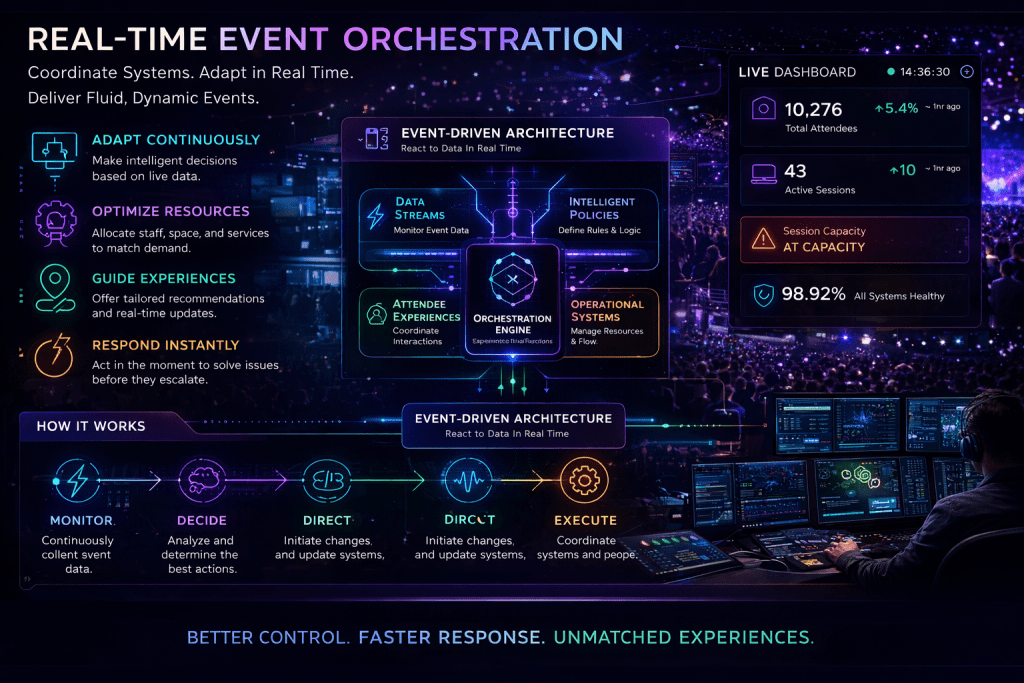
At the core is an event-driven model, where systems communicate through events rather than direct requests. Events represent changes in state, such as:
- An attendee checking in
- A session reaching capacity
- A change in crowd density
These events are published to a central system and consumed by relevant components, enabling immediate реакции.
Streaming Data Pipelines
Continuous data streams provide the input for orchestration decisions. These pipelines process data in real time, ensuring that the system operates on current information.
Streaming architectures enable low-latency processing, which is essential for timely decision-making.
Decision and Policy Engines
Orchestration systems rely on decision engines that evaluate conditions and determine appropriate actions. These engines may combine rule-based logic with machine learning models.
Policies define constraints and priorities, ensuring that decisions align with operational goals and requirements.
Execution Layer
Once decisions are made, actions are executed across systems through APIs, middleware, or direct integrations. This layer ensures that changes are applied consistently and reliably.
Execution must be coordinated to avoid conflicts and ensure that all systems reflect the updated state.
Coordinating Attendee Experiences
One of the primary applications of real-time orchestration is managing attendee experiences.
As attendees move through the event, their behavior generates data that can be used to guide interactions. Orchestration systems can adjust recommendations, update schedules, and trigger notifications based on current context.
For example, if a session becomes overcrowded, the system can redirect attendees to alternative sessions, update the event app, and adjust signage simultaneously. This coordinated response ensures a seamless experience.
Operational Coordination and Resource Management
Beyond attendee interactions, orchestration plays a critical role in operational management.
Resource allocation can be adjusted dynamically based on demand. Staff can be deployed to areas experiencing high traffic, and facilities can be reconfigured in response to changing conditions.
Logistics workflows can be coordinated across teams and systems, ensuring that operations remain aligned. This reduces the need for manual intervention and improves efficiency.
Integration with Event Technology Systems
Real-time orchestration acts as a central layer that connects and coordinates other event technologies.
Event data platforms provide the data foundation, while middleware systems enable communication between components. Workflow automation systems execute tasks, and personalization engines deliver tailored experiences.
Observability systems provide visibility into system performance, enabling orchestration engines to respond to issues proactively. Digital twins can inform decisions by simulating potential outcomes.
This integration creates a cohesive system where data, decisions, and actions are aligned.
Latency, Consistency, and Reliability
Operating in real time introduces technical challenges related to latency, consistency, and reliability.
Latency must be minimized to ensure that actions are timely. Distributed systems and edge computing can help reduce delays.
Consistency must be maintained across systems. When changes are made, all components must reflect the updated state to avoid discrepancies.
Reliability is critical. Orchestration systems must handle failures gracefully, ensuring that disruptions do not propagate across the ecosystem.
Operational and Business Impact
The adoption of real-time orchestration has significant implications for event outcomes.
Operationally, it improves efficiency by reducing manual coordination and enabling faster responses. Systems operate cohesively, reducing friction and errors.
From an experience perspective, it enhances engagement. Attendees receive timely, relevant interactions that adapt to their context.
For organizers, it provides greater control and visibility. Decisions are informed by real-time data, enabling proactive management.
Strategically, orchestration enables scalability. Events can handle increased complexity without proportional increases in operational overhead.
Challenges in Implementation
Implementing real-time orchestration requires advanced infrastructure and expertise. Designing event-driven architectures, managing data streams, and coordinating distributed systems are complex tasks.
Governance is essential. Policies and rules must be defined clearly to ensure consistent behavior across systems.
There is also the challenge of balancing automation with human oversight. While systems can handle many tasks, operators must retain the ability to intervene and guide decisions.
Future Outlook: Toward Autonomous Event Execution
The evolution of real-time orchestration points toward increasing autonomy. As AI capabilities advance, systems will be able to make more complex decisions and execute actions with minimal human intervention.
Integration with digital twins and predictive models will enable proactive orchestration, where systems anticipate conditions and adjust accordingly.
This progression aligns with the broader trend toward autonomous event operations, where events function as self-managing systems.
Conclusion: Orchestration as the Core of Adaptive Events
Real-time event orchestration represents a fundamental shift in how events are executed. By coordinating systems, people, and experiences based on live data, it enables events to adapt continuously to changing conditions.
This capability transforms events from static environments into dynamic systems, capable of delivering more efficient operations and more engaging experiences.
For event technology leaders, orchestration is not just an enhancement—it is the core mechanism that enables modern, adaptive event ecosystems.