Event Data Contracts: Standardizing Data Exchange Across Event Systems
Introduction: The Hidden Cost of Inconsistent Data
Modern event ecosystems depend on continuous data exchange between multiple systems—registration platforms, mobile apps, access control systems, analytics engines, personalization layers, and more. Each of these systems generates and consumes data, forming a complex network of interactions.
Despite this interdependence, data exchange is often loosely defined. Schemas vary, field definitions differ, and assumptions are implicit rather than explicit. As a result, integrations become fragile, requiring constant maintenance and manual intervention.
These inconsistencies introduce operational risk. Data mismatches can lead to failed workflows, inaccurate analytics, and degraded attendee experiences. In real-time environments, even minor discrepancies can propagate بسرعة across systems.
Event data contracts address this challenge by formalizing how data is structured, validated, and exchanged. They provide a shared understanding between systems, enabling reliable and scalable integration.
Defining Data Contracts in Event Contexts
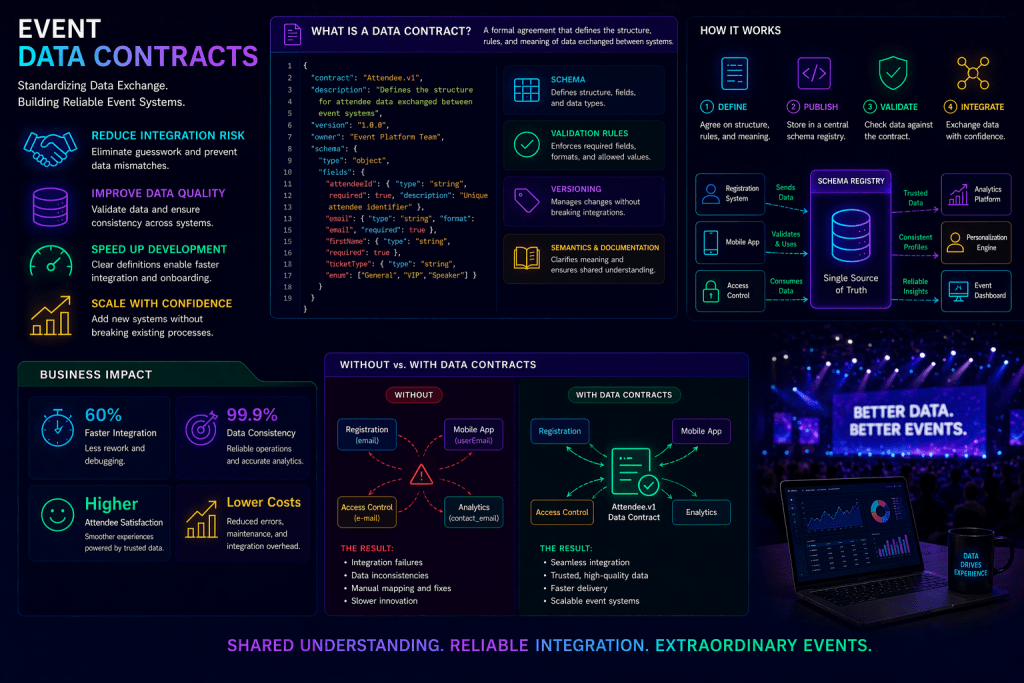
A data contract is a formal agreement that defines the structure, format, and semantics of data exchanged between systems. It specifies what data is expected, how it is represented, and how changes are managed.
In event technology, data contracts apply to key entities such as:
- Attendees and profiles
- Sessions and schedules
- Transactions and registrations
- Interactions and engagement data
These contracts ensure that all systems interpret data consistently, reducing ambiguity and improving interoperability.
Core Components of a Data Contract
A well-defined data contract includes several key elements that ensure clarity and reliability.
Schema Definition
The schema defines the structure of the data, including fields, data types, and relationships. For example, an attendee object may include fields such as name, email, ticket type, and preferences.
Schemas must be precise and unambiguous, enabling systems to validate incoming data and ensure compatibility.
Validation Rules
Validation rules enforce constraints on data, such as required fields, acceptable values, and formats. These rules ensure that data meets quality standards before it is processed.
For example, an email field must follow a valid format, and a session ID must correspond to an existing entity.
Versioning and Change Management
Data contracts evolve over time as systems and requirements change. Versioning mechanisms ensure that updates can be introduced without breaking existing integrations.
Backward compatibility is critical. Systems must be able to handle multiple versions of a contract during transitions, ensuring continuity of operations.
Semantics and Documentation
Beyond structure, data contracts define the meaning of data. Clear documentation ensures that all stakeholders understand how data should be interpreted.
For example, defining whether a “check-in time” represents the first entry or the latest access prevents ambiguity.
Architectural Role in Event Systems
Data contracts serve as a foundational layer within event architectures, particularly in API-first and event-driven systems.
In API-based integrations, contracts define the payloads exchanged between services. This ensures that APIs remain consistent and predictable, even as systems evolve.
In event-driven architectures, contracts define the structure of events published to messaging systems. This enables systems to subscribe and react to events reliably.
Middleware layers often enforce data contracts, validating and transforming data as it moves between systems. This centralizes governance and reduces the risk of inconsistencies.
Integration with Event Data Platforms
Event data platforms rely heavily on standardized data to provide a unified view of the event ecosystem. Data contracts ensure that data ingested from multiple sources is consistent and compatible.
This consistency enables advanced capabilities such as real-time analytics, personalization, and behavioral intelligence. Without standardized data, these systems would struggle to produce accurate insights.
Data contracts also facilitate interoperability between different vendors and platforms, enabling organizations to build flexible, composable technology stacks.
Operational and Business Impact
The adoption of data contracts has significant operational benefits. It reduces integration complexity by providing clear expectations for data exchange. This simplifies development and maintenance, enabling faster deployment of new systems and features.
From a reliability perspective, data contracts improve system stability. Validation mechanisms catch errors early, preventing issues from propagating across the system.
For event organizers, this translates into more consistent operations and better attendee experiences. Data-driven processes become more dependable, supporting real-time decision-making.
Strategically, data contracts enable scalability. As event ecosystems grow, standardized data exchange ensures that new components can be integrated without disrupting existing systems.
Challenges in Implementation
Implementing data contracts requires coordination across multiple stakeholders. Different systems may have varying requirements and constraints, making standardization challenging.
Designing schemas that are both comprehensive and flexible is another challenge. Overly rigid contracts can limit adaptability, while overly flexible ones may fail to enforce consistency.
Version management must be handled carefully to avoid breaking changes. This requires robust governance and clear communication between teams.
There is also the need for tooling. Effective implementation often requires tools for schema management, validation, and monitoring.
Governance and Best Practices
Successful adoption of data contracts depends on strong governance practices.
Centralized schema registries can serve as the source of truth for data contracts, ensuring consistency across systems. Automated validation ensures that data conforms to defined standards.
Clear documentation and communication are essential. All stakeholders must understand the contracts and how they evolve.
Testing and monitoring play a critical role. Contracts should be validated in development and continuously monitored in production to detect deviations.
Future Outlook: Toward Self-Describing Event Systems
The evolution of data contracts is moving toward more dynamic and self-describing systems. Technologies such as schema registries and contract-driven development enable systems to adapt more easily to changes.
Integration with AI and automation will further enhance capabilities. Systems may be able to detect inconsistencies, suggest schema improvements, and manage version transitions automatically.
As event ecosystems become more interconnected, data contracts will play a central role in enabling seamless interoperability and shared intelligence.
Conclusion: Consistency as a Foundation for Integration
Event data contracts provide the structure and clarity needed to manage complex data exchanges. By standardizing how data is defined and shared, they enable reliable integration and scalable architectures.
In modern event environments, where multiple systems interact in real time, this consistency is essential. It ensures that data flows smoothly, processes operate reliably, and insights remain accurate.
For event technology leaders, data contracts are not merely technical artifacts—they are a foundational element of system design, enabling the integration, flexibility, and intelligence required for next-generation events.