UK music plan backs Green Event Code and climate action
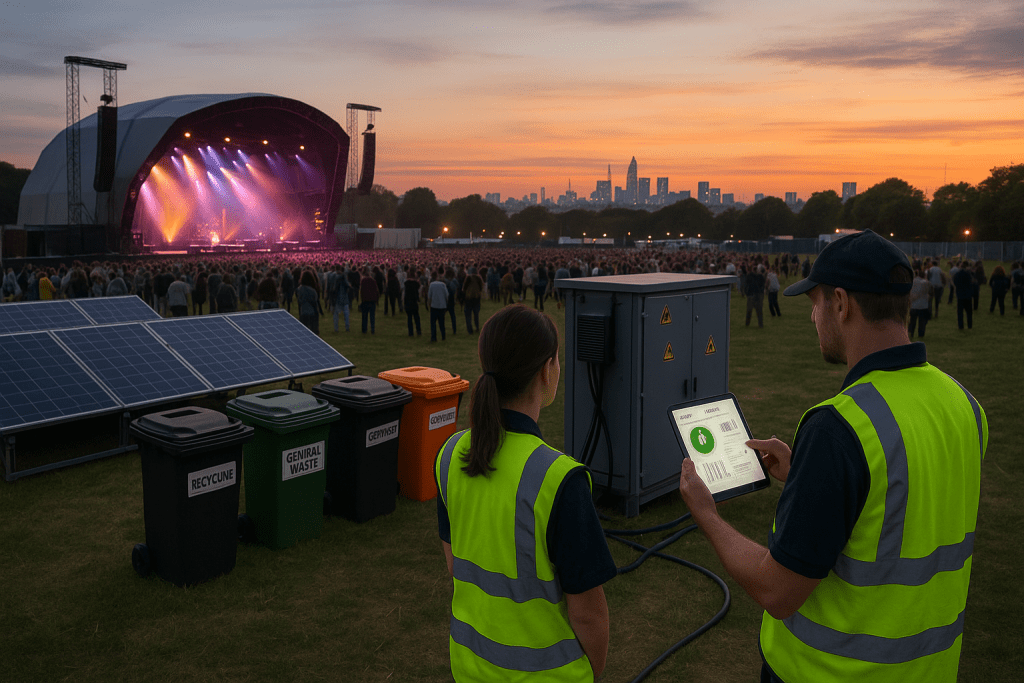
The UK Government’s new music plan has formally highlighted two industry-led sustainability initiatives as core reference points for the future of the live music and events ecosystem. The Show Must Go On Report and the Green Event Code of Practice, both developed by Vision for Sustainable Events, are cited as foundational tools for guiding lower-carbon growth across the sector.
Announced on 13 July 2026 by Culture Secretary Lisa Nandy, the plan outlines a long-term policy direction for music in the UK and places environmental performance firmly within its strategic priorities. While the document covers a broad range of issues for the music economy, its explicit recognition of specialist sustainability frameworks is being viewed as a significant validation of ongoing climate action work in festivals, concerts and large-scale events.
Background and industry context
The live music and events industry has faced increasing pressure to measure and reduce its environmental impact, from energy use and transport emissions to waste, water and procurement. Over the past decade, operators, promoters and suppliers have responded with a mix of voluntary standards, reporting tools and collaborative initiatives aimed at aligning commercial growth with climate objectives.
Vision for Sustainable Events, an organisation focused on helping events transition to more sustainable models, has been among the leading contributors to this landscape. Its Show Must Go On Report set out evidence, guidelines and practical measures for cutting the environmental footprint of live events, while the Green Event Code of Practice offers a framework of commitments and benchmarks that organisers can work towards in areas such as energy sourcing, materials, logistics and audience engagement.
Until now, much of this activity has operated in parallel with policy, driven by industry coalitions, campaign groups and individual operators. The government’s decision to signpost these specific tools in a national music plan signals a closer alignment between public policy and the sector’s technical work on climate mitigation.
Key developments in the new music plan
The new music plan is framed as a long-term strategy for supporting the UK’s music ecosystem, from grassroots venues and emerging talent through to large festivals, arenas and international touring. Within this wider brief, environmental performance is identified as a central pillar of sustainable sector growth.
In this context, the plan acknowledges the Show Must Go On Report and the Green Event Code of Practice as cornerstones that can help shape how the industry reduces emissions and resource use while continuing to develop commercially. Their inclusion gives event organisers, venues and suppliers a clearer sense of which frameworks the government views as credible reference points for climate action.
While full implementation details and timelines across all policy areas will be developed over time, the plan’s language indicates that future guidance, funding criteria or partnership programmes may look to recognised sustainability codes and reporting standards as part of their expectations for responsible practice.
Industry impact and implications for events
For event organisers and technology providers, the explicit endorsement of the Green Event Code and associated research can help reduce uncertainty around which standards are likely to gain widest adoption. Promoters and venues that have already engaged with these frameworks may find themselves better positioned to respond to emerging policy requirements or funding conditions.
The move could also accelerate convergence around common metrics and methodologies for tracking environmental performance. Where different stakeholders have previously worked with diverse tools and benchmarks, the government’s reference to a small number of recognised frameworks may encourage greater interoperability between data systems, reporting platforms and operational practices.
Suppliers of event technology — including power and energy systems, temporary structures, ticketing platforms, audience analytics, logistics tools and production technologies — may see increased demand for solutions that can feed into or align with the indicators set out in the Green Event Code. This could encompass everything from real-time energy monitoring and emissions calculation to tools that help optimise transport routes, reduce waste streams or support circular procurement models.
Why this matters for event professionals and technology providers
For production teams, venue managers and festival organisers, the government’s stance reinforces that environmental performance is no longer a peripheral issue but a structural factor in long-term sector planning. Aligning with recognised codes of practice can move from being a reputational benefit to a practical necessity, particularly where future licensing, funding or partnership decisions start to reflect sustainability criteria more explicitly.
Operationally, this could influence how projects are scoped and budgeted, with greater emphasis on carbon measurement, renewable power, efficient transport planning, modular staging, and low-impact materials. Digital tools that offer scenario planning — for example, comparing different power configurations or transport options — may become more central to pre-production workflows.
For technology companies and service providers, the recognition of established sustainability frameworks offers a clearer roadmap for product development. Integrations that allow event operators to automatically collect, standardise and report data in ways compatible with the Show Must Go On Report and the Green Event Code are likely to be in higher demand. Features such as automated environmental reporting dashboards, emissions calculators connected to ticketing and travel data, and sensors or IoT devices measuring on-site resource use could become differentiating capabilities in bids and tenders.
The new policy context may also encourage closer collaboration between event operators, technology vendors and sustainability specialists. Pilot projects that demonstrate measurable progress against recognised standards will be better placed to secure institutional support and industry attention, particularly as the sector seeks scalable models for low-carbon touring, hybrid formats and large-scale gatherings.
Conclusion
The UK Government’s new music plan marks a step change in how environmental sustainability is framed within national policy for the music and live events sector. By explicitly naming the Show Must Go On Report and the Green Event Code of Practice as central references for sustainable growth, it provides the industry with clearer signposts around which to organise climate action.
For event professionals, the message is that alignment with credible, data-driven standards is likely to shape future expectations from policymakers, audiences and commercial partners. For technology providers, the announcement underlines a growing market for tools that can both improve operational efficiency and support robust, standardised environmental reporting.
As the plan moves from strategy to implementation, the interplay between policy, industry-led codes of practice and technology innovation will be critical in determining how the UK’s live music and events sector delivers on its climate commitments while continuing to evolve its formats and business models.