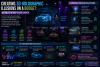
3D-Projection vs. Kinetic LED Sculptures: Which Drives Higher Attendee Engagement?
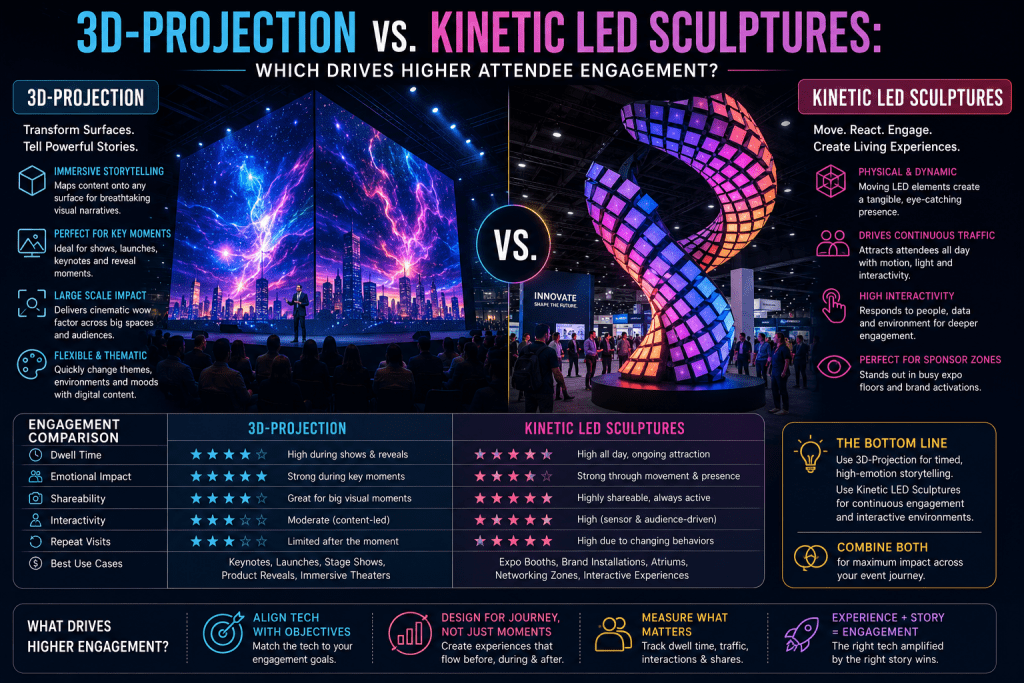
3D-Projection vs. Kinetic LED Sculptures: Which Drives Higher Attendee Engagement?
Introduction
Immersive visual design has become one of the most visible battlegrounds in experiential events. As brands, trade shows, conferences, and product launches compete for attendee attention, scenic technology is increasingly expected to do more than decorate a stage or make a room look expensive. It is being asked to create dwell time, social sharing, emotional impact, sponsor visibility, and measurable engagement. Two formats are appearing more often in that conversation: 3D projection-based environments and kinetic LED sculptures.
Both promise spectacle, but they do so through very different technical and behavioral mechanisms. 3D projection environments use mapped light, surfaces, and motion graphics to transform architecture or scenic builds into dynamic visual storytelling canvases. Kinetic LED sculptures use physical movement, programmable light, and three-dimensional form to create living installations that occupy space and change in real time. Each can become the visual centerpiece of an event, yet their impact on attendee engagement depends less on visual novelty alone and more on how they fit the event’s content model, traffic patterns, interaction design, and measurement strategy.
For event technology teams, the question is not simply which looks more impressive. It is which medium is more likely to produce the kind of engagement the event actually values—longer dwell time, stronger recall, more social amplification, deeper sponsor interaction, better content absorption, or increased movement through a specific zone. The answer is rarely universal. It depends on how the technology behaves inside the event system.
Defining the Two Formats Beyond Visual Aesthetics
The comparison often begins at the level of visual impact, but that framing is too shallow for event decision-making. Projection and kinetic LED installations differ not only in appearance, but in physical footprint, operational logic, environmental dependencies, and interaction potential.
What 3D projection does well
3D projection mapping uses projectors, media servers, content animation, and calibrated spatial mapping to cast visuals onto architectural surfaces, custom scenic elements, products, or stage environments. The effect can simulate depth, motion, deconstruction, transformation, or impossible physical behaviors on static surfaces. It is especially powerful when the event wants to tell a narrative, reveal a product dramatically, or synchronize scenic visuals with a keynote, performance, or launch sequence.
Projection is inherently surface-driven. It turns something else—a wall, a structure, a product shell, a stage build—into a visual object. Its engagement power often comes from narrative transformation and scale.
What kinetic LED sculptures do well
Kinetic LED sculptures are physical installations composed of moving or suspended LED elements, light modules, panels, rods, cubes, or custom shapes that change position, brightness, and color over time. Some systems incorporate motors, winches, sensors, and generative control systems to create motion-responsive environments.
Unlike projection, kinetic LED installations are not dependent on a host surface. They are spatial objects in their own right. Their engagement power often comes from material presence, depth, movement through physical space, and the sense that the installation is an active object rather than an image cast onto something else.
This distinction matters because attendees respond differently to immersive media that surrounds a surface versus media that occupies the room as a sculptural system.
What “Higher Attendee Engagement” Actually Means
The comparison becomes meaningless if engagement is left undefined. Event teams often use the term to describe very different outcomes. A projection sequence on a main stage may generate high emotional response during a keynote but little post-session interaction. A kinetic sculpture in an expo hall may drive sustained foot traffic and photo-taking but contribute little to educational content absorption.
To evaluate which format drives higher engagement, organizers need to specify the engagement model. In practice, relevant metrics usually fall into several categories:
- dwell time: how long attendees remain in a zone or interact with the installation
- traffic conversion: whether the installation pulls attendees into a sponsor booth, content theater, or activation area
- participation behavior: whether attendees scan, touch, post, ask questions, or move through adjacent content because of the installation
- social amplification: photo/video capture, reposting, hashtag use, or UGC volume
- content reinforcement: whether the technology improves comprehension, recall, or emotional resonance for a presentation or story
- repeat visitation: whether attendees return to the installation at different times during the event
Once engagement is framed this way, the comparison becomes less about artistic preference and more about event mechanics.
Where 3D Projection Tends to Perform Better
Projection-based environments are especially effective when engagement is tied to timed content moments. A product launch, keynote opener, awards reveal, or sponsor story sequence can benefit from projection because the medium excels at controlled narrative delivery. It can synchronize with music, speaker cues, motion graphics, and scenography in a way that feels cinematic and high stakes.
Projection also performs well when the event already has strong architectural surfaces or scenic builds that can be transformed without adding major floor footprint. A general session room with a custom set, an immersive tunnel, a façade reveal, or a branded installation wall can become far more dynamic through mapped content than through static scenic design alone.
From an attendee behavior standpoint, projection is often strongest in these scenarios:
Stage-centered emotional engagement
In keynote or launch environments, projection can intensify audience focus, create dramatic reveal moments, and support narrative comprehension through synchronized visuals. Engagement here is less about attendee movement and more about collective attention and memory.
High-impact shareable moments
Large-scale projection can generate strong social capture if the visual moment is timed, surprising, and visually legible from the audience perspective. This is especially true for opening sequences, architectural transformations, and immersive branded walk-throughs.
Rapid thematic transformation
Projection allows one physical environment to become many environments over the course of a program. That can be valuable in multi-session events where stage identity needs to shift between brands, topics, or audience moods without rebuilding the set.
The limitation is that projection engagement is often time-bound. Once the sequence ends, the surface may lose much of its attraction unless it remains dynamic and accessible.
Where Kinetic LED Sculptures Tend to Perform Better
Kinetic LED sculptures often outperform projection when the goal is continuous spatial engagement rather than scheduled narrative impact. Because the installation is physically present and active over time, it can attract attention even outside formal programming windows. It becomes part of the environment rather than a moment within it.
This makes kinetic LED particularly strong in expo halls, networking spaces, atriums, brand activations, and sponsor zones where attendees move freely and engagement depends on curiosity, discovery, and repeat exposure.
Sustained dwell and environmental magnetism
A kinetic sculpture can function as a visual anchor in a room, drawing people in repeatedly because its motion, light state, or generative behavior changes over time. Unlike a projection wall that may require a fixed viewing angle or a timed sequence, a sculpture can create interest from multiple positions and distances.
Spatial differentiation for sponsors and activations
For exhibitors and sponsors, a kinetic LED installation can define territory in a crowded hall more effectively than a flat screen or projection wall. It creates vertical presence, architectural identity, and a sense of premium production value that helps a booth stand out.
Better integration with interactive systems
Kinetic installations often pair well with sensor-driven experiences. Motion, proximity, sound, gesture, RFID, or app-triggered inputs can change the sculpture’s behavior, making the attendee’s presence feel consequential. This can increase active participation rather than passive observation.
The tradeoff is that kinetic LED rarely delivers the same large-scale cinematic storytelling power as projection for a keynote reveal or scripted content sequence.
Environmental and Operational Factors That Shape Engagement
Attendee engagement is not driven by medium alone. The environment can significantly favor one format over the other.
Projection is highly sensitive to ambient light, surface quality, viewing angles, and alignment precision. In bright expo halls or daylight-heavy venues, its impact may degrade unless the environment is carefully controlled. It also depends on unobstructed projection paths and sufficient rigging or throw distance.
Kinetic LED systems are generally more resilient in brighter environments because they emit light directly rather than reflecting it. They are often easier to preserve visually in open expo spaces, atriums, and mixed-use event zones. However, they can introduce rigging complexity, weight-loading considerations, motor maintenance requirements, and higher physical transport demands.
Budget structure also differs. Projection may require substantial content production and calibration labor but can leverage existing scenic surfaces. Kinetic LED may require custom fabrication, control programming, and logistics tied to physical motion systems. Engagement outcomes should therefore be assessed against not only creative goals but also deployment realities.
Which One Drives Higher Engagement in Practice?
If the event’s core engagement objective is collective emotional impact during scheduled content, 3D projection often has the advantage. It is better at orchestrating attention, supporting storytelling, and transforming a stage or environment for a specific reveal moment.
If the event’s objective is continuous foot traffic, booth magnetism, ambient discovery, or repeat interaction in open environments, kinetic LED sculptures often drive stronger engagement. Their physicality and persistence make them more effective as all-day attention systems rather than one-time visual events.
In many event environments, the highest-performing strategy is not choosing one universally, but assigning each to the engagement job it does best. Projection can own the narrative moment. Kinetic LED can own the environmental engagement layer.
Measuring the Winner Instead of Guessing
The most useful comparison happens after the event, not before it. Organizers should instrument immersive installations the same way they instrument other engagement assets. This can include:
- dwell-time analysis via computer vision or zone analytics
- QR or NFC conversion rates tied to the installation area
- sponsor lead volume before and after scenic deployment
- UGC volume associated with the installation
- traffic heatmaps comparing adjacent zones
- post-event survey recall tied to scenic elements
- session sentiment and audience feedback for projection-driven keynotes
Without measurement, scenic technology decisions default to aesthetics and stakeholder preference rather than evidence.
Conclusion
3D projection and kinetic LED sculptures are not interchangeable immersive technologies, and they do not produce the same kind of attendee engagement. Projection is strongest when the event needs narrative transformation, synchronized stage impact, and memorable timed visual moments. Kinetic LED sculptures are stronger when engagement depends on spatial presence, all-day visibility, repeat curiosity, and activation-driven foot traffic. For event technology teams, the more useful question is not which medium is inherently better, but which one aligns with the event’s actual engagement objective, venue conditions, content structure, and measurement model. The organizations that get the best results are not the ones chasing spectacle in the abstract. They are the ones matching immersive technology to a clearly defined behavioral outcome.