Flexible LED Screens: Wrapping Columns and Creating Curved Digital Architecture
3 months ago Timothy Myres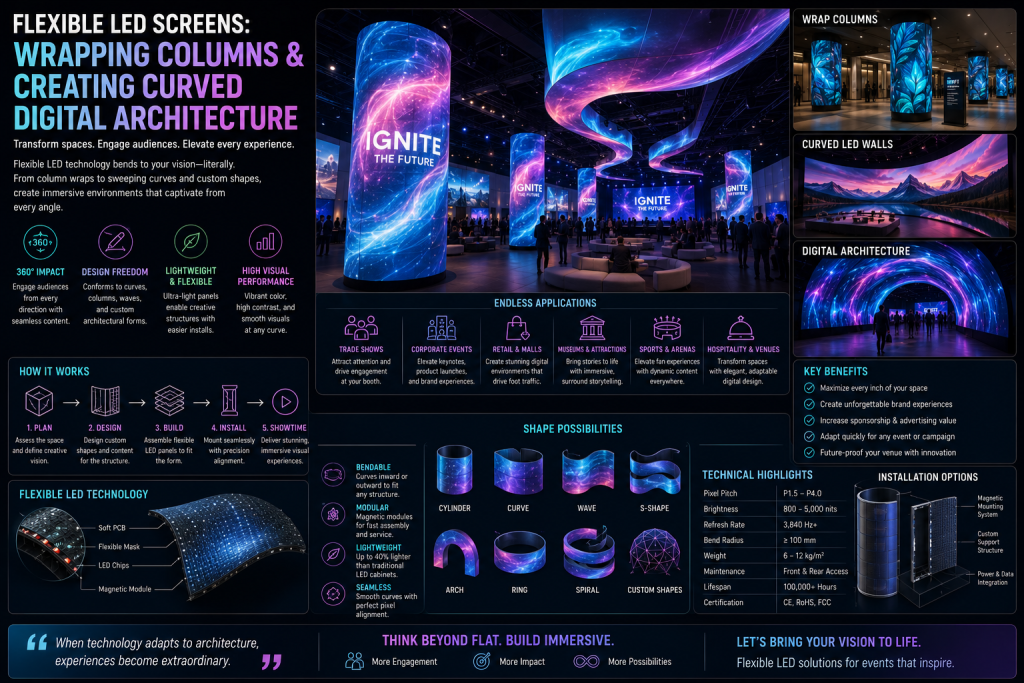
The event industry has entered an era where screens are no longer confined to flat rectangles. As attendee expectations evolve and immersive environments become central to event design, organizers are increasingly looking beyond traditional display formats to create more engaging, integrated, and visually dynamic spaces. One of the most significant developments driving this transformation is the rise of flexible LED screen technology.
Unlike conventional LED panels that require flat installations, flexible LED displays can bend, curve, wrap around structures, and conform to unconventional architectural shapes. This capability is enabling event designers to transform columns, walls, ceilings, stages, and entire venue environments into digital surfaces that blend seamlessly with physical architecture.
From trade shows and product launches to sports arenas, luxury brand activations, and immersive corporate events, flexible LED screens are redefining how digital content interacts with space. Rather than treating displays as standalone components, event planners can now incorporate digital storytelling directly into the venue itself.
The result is a new form of digital architecture where content, structure, and experience become tightly integrated.
Why Traditional Flat Displays Are Limiting Event Design
Table of Contents
ToggleFor decades, event display strategies have revolved around flat screens and rectangular video walls.
While these systems remain highly effective for presentations and content delivery, they present several design limitations:
- Restricted installation options
- Visual separation from architecture
- Limited spatial creativity
- Underutilized venue surfaces
- Predictable attendee experiences
As experiential marketing and immersive environments become increasingly important, organizers are seeking display technologies that offer greater creative flexibility.
Modern event environments demand visual systems capable of adapting to architectural forms rather than forcing architecture to adapt to screens.
Flexible LED technology addresses this challenge directly.
What Are Flexible LED Screens?
Flexible LED screens are display systems built using specialized LED modules mounted on bendable substrates.
Unlike traditional rigid LED cabinets, flexible modules can conform to curved surfaces while maintaining image quality and structural stability.
These systems typically consist of:
- Flexible LED panels
- Soft circuit boards
- Magnetic mounting systems
- Lightweight structural frameworks
- Modular control systems
Depending on the design, flexible screens can bend inward, outward, or around cylindrical structures.
This allows designers to create display surfaces that were previously impossible using conventional LED technology.
The Technology Behind Flexible LED Displays
Several engineering innovations make flexible LED installations possible.
Flexible Circuit Design
Traditional LED displays rely on rigid circuit boards.
Flexible systems instead use bendable printed circuit boards capable of maintaining electrical connectivity while conforming to curved surfaces.
This enables screens to adapt to varying shapes without interrupting signal transmission.
Lightweight Construction
Weight is a major consideration in event production.
Flexible LED systems are often significantly lighter than conventional video walls because they use:
- Thin substrates
- Lightweight materials
- Reduced structural requirements
This simplifies installation while expanding deployment possibilities.
Modular Architecture
Most flexible LED solutions use modular panel designs.
Individual sections can be assembled into:
- Cylinders
- Waves
- Curves
- Spheres
- Arches
- Custom geometric structures
This modularity provides substantial creative freedom for designers.
Wrapping Architectural Columns with Digital Content
One of the most common applications of flexible LED technology involves transforming venue columns into digital storytelling elements.
Turning Structural Obstacles into Assets
In many venues, support columns create visibility challenges and interrupt attendee flow.
Traditional event design often attempts to hide these structures through:
- Fabric wraps
- Temporary cladding
- Decorative elements
Flexible LED screens offer a more powerful alternative.
Columns can become:
- Brand showcases
- Information displays
- Interactive installations
- Sponsor activations
- Artistic features
Rather than being obstacles, columns become high-value engagement points.
360-Degree Content Experiences
Because content wraps completely around cylindrical surfaces, attendees can engage with displays from multiple angles.
This creates:
- Greater visibility
- Increased audience reach
- Enhanced immersion
- Better space utilization
For trade shows and exhibitions, this can significantly increase sponsor exposure.
Dynamic Wayfinding Applications
Column-mounted LED systems can also support navigation functions.
Content may display:
- Directional information
- Session schedules
- Crowd guidance
- Emergency messaging
Because the displays remain visible from multiple directions, they are highly effective for large venue environments.
Creating Curved Digital Architecture
The most transformative application of flexible LED technology extends beyond individual structures.
Entire architectural environments can now become digital experiences.
Curved LED Walls
Unlike traditional flat video walls, curved installations create more immersive visual experiences.
Benefits include:
- Wider viewing angles
- Improved audience engagement
- Enhanced spatial perception
- Reduced visual fatigue
Curved displays are increasingly used for keynote stages, product launches, and immersive brand experiences.
Digital Tunnels and Passageways
Flexible LED technology allows organizers to create fully immersive pathways where attendees move through animated environments.
Applications include:
- Entry experiences
- Brand journeys
- Product showcases
- Themed environments
These installations often become highly photographed and shared event features.
Ceiling and Overhead Installations
Flexible displays are also being deployed across ceilings and overhead structures.
Examples include:
- Wave-like visual canopies
- Dynamic sky simulations
- Floating digital sculptures
- Immersive environmental effects
These installations expand storytelling beyond traditional eye-level displays.
Content Design for Curved Environments
Curved digital architecture requires different content strategies than conventional screens.
Spatial Storytelling
Designers must account for:
- Viewing angles
- Audience movement
- Surface curvature
- Environmental context
Content should complement architectural form rather than simply filling screen space.
Motion Design Considerations
Curved surfaces naturally enhance movement-based visuals.
Popular content approaches include:
- Flowing animations
- Environmental effects
- Data visualizations
- Generative art
- Interactive experiences
Motion can appear more organic when integrated into curved architectural structures.
Multi-Surface Synchronization
Large installations often involve multiple connected display surfaces.
Synchronization systems ensure content flows seamlessly across:
- Columns
- Walls
- Ceilings
- Stage elements
This creates unified visual environments rather than isolated display components.
Business and Operational Benefits
Flexible LED technology provides advantages beyond aesthetics.
Increased Sponsorship Value
Curved installations create premium advertising inventory.
Sponsors benefit from:
- Higher visibility
- Unique placements
- Greater audience engagement
- Enhanced memorability
These factors can justify premium sponsorship pricing.
Better Space Utilization
Flexible displays transform previously underutilized architectural features into valuable communication assets.
This increases the functional value of venue infrastructure.
Stronger Attendee Engagement
Immersive environments generally produce:
- Longer dwell times
- Higher interaction rates
- Greater social sharing
- Improved brand recall
These outcomes directly support event objectives.
Enhanced Venue Differentiation
Unique digital architecture helps events stand out in increasingly competitive markets.
Distinctive visual environments often become signature event features.
Challenges and Considerations
Despite its advantages, flexible LED deployment involves several challenges.
Higher Installation Complexity
Curved structures require careful planning involving:
- Structural engineering
- Power distribution
- Content alignment
- Mounting systems
Installation often requires specialized expertise.
Content Production Costs
Custom environments demand bespoke content.
Creating effective visuals for curved surfaces typically requires more advanced design workflows than standard screen content.
Budget Requirements
Flexible LED systems generally involve higher costs than traditional flat displays due to:
- Specialized hardware
- Custom fabrication
- Complex installation
Organizers must evaluate expected ROI carefully.
Maintenance and Reliability
Curved systems often involve more intricate configurations, increasing maintenance requirements and operational planning.
The Future of Digital Architecture
Flexible LED technology continues evolving rapidly.
Emerging innovations include:
- Transparent flexible LEDs
- Interactive touch-enabled surfaces
- AI-generated visual environments
- Adaptive content systems
- Integrated sensor networks
- Dynamic architectural facades
- Smart venue synchronization
As display technologies become thinner, lighter, and more adaptable, the distinction between architecture and media infrastructure will continue to blur.
Future venues may increasingly be designed with digital surfaces integrated directly into their structural DNA.
Conclusion
Flexible LED screens are transforming how event professionals think about display technology. By enabling screens to wrap columns, curve around structures, and integrate seamlessly into architecture, these systems are creating entirely new possibilities for immersive storytelling and venue design.
Their impact extends far beyond aesthetics. Flexible LED installations improve space utilization, increase sponsorship opportunities, enhance attendee engagement, and support more sophisticated experiential environments.
Most importantly, they represent a broader shift within the event industry. Displays are no longer separate components added to a venue after construction. They are becoming integral architectural elements that shape how attendees experience space itself.
As flexible display technologies continue advancing, digital architecture is likely to become one of the defining characteristics of next-generation event environments.