How Transformer Models are Revolutionizing Real-Time Event Data Pipelines
Introduction
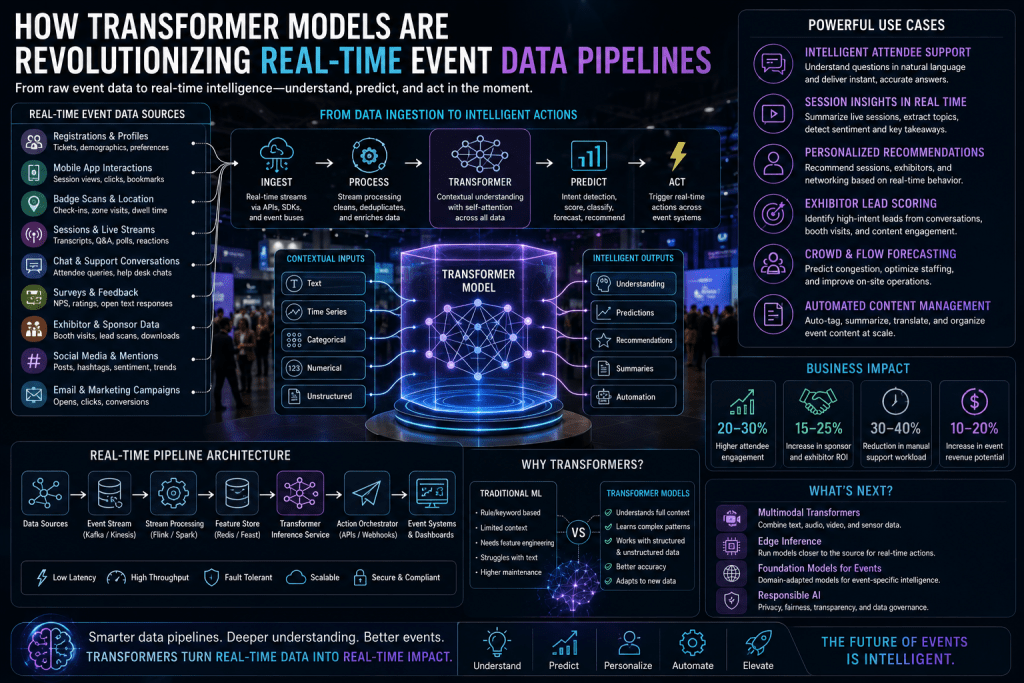
Modern events generate an unprecedented volume of real-time data. Registration platforms process thousands of attendee check-ins, mobile applications record session selections and networking activity, badge scanners capture movement across exhibition halls, live polls collect audience opinions, exhibitors log customer interactions, social media platforms amplify attendee conversations, and support teams respond to continuous inquiries. Together, these systems create an event data pipeline that is both rich in insight and challenging to manage.
Traditional event analytics architectures were designed primarily for structured transactional data. They perform well when aggregating registrations, attendance counts, or booth visits but struggle to interpret the growing volume of unstructured information generated throughout an event. Chat conversations, Q&A sessions, survey responses, speaker feedback, social media posts, customer support requests, and live transcripts all contain valuable operational intelligence that conventional rule-based systems often fail to process effectively.
Transformer models have fundamentally changed this landscape. Originally developed for natural language processing (NLP), transformer architectures can process vast amounts of structured and unstructured data simultaneously while identifying contextual relationships that earlier machine learning approaches frequently overlooked. For event technology providers, transformers are enabling real-time intelligence that improves attendee experiences, supports exhibitors, enhances operational decision-making, and automates workflows across the event lifecycle.
Why Traditional Event Data Pipelines Are Under Pressure
Event platforms have historically relied on Extract, Transform, Load (ETL) processes combined with relational databases and business intelligence dashboards. These architectures remain effective for reporting historical metrics but often introduce latency that limits real-time decision-making.
Several challenges have become increasingly significant:
- Continuous data streams from multiple platforms
- Large volumes of unstructured text
- Rapid changes in attendee behavior
- High expectations for personalized experiences
- Operational decisions requiring immediate action
Rule-based systems typically require predefined logic to classify interactions or trigger workflows. However, attendee conversations rarely follow predictable formats. Questions about schedules, transportation, exhibitors, or networking opportunities may be expressed in countless different ways. Traditional keyword matching struggles to capture intent accurately, reducing automation quality.
Transformer models address this limitation by understanding semantic meaning rather than relying solely on predefined rules or isolated keywords.
Understanding Transformer Architecture
Transformers introduced a significant departure from earlier sequential language models such as Recurrent Neural Networks (RNNs) and Long Short-Term Memory (LSTM) networks.
Instead of processing words one at a time, transformers evaluate relationships between all elements of an input simultaneously through a mechanism known as self-attention. This enables the model to understand context across entire sentences, documents, conversations, or event transcripts while supporting highly parallel computation.
For event technology applications, this architectural advantage translates into faster processing, improved contextual understanding, and better scalability across multiple real-time data streams.
Modern transformer families—including encoder-only, decoder-only, and encoder-decoder architectures—can be adapted to tasks such as classification, summarization, recommendation, question answering, translation, and conversational AI.
Real-Time Data Sources Within Event Ecosystems
Transformer models become most valuable when connected to diverse event data sources.
Common inputs include:
- Registration records
- Mobile application activity
- Live session transcripts
- Q&A submissions
- Survey responses
- Exhibitor conversations
- Customer support chats
- Networking messages
- Social media discussions
- Speaker presentations
- Email communications
Unlike traditional analytics pipelines that often separate structured and textual information, transformer-based architectures can analyze both simultaneously, producing richer operational insights.
Practical Applications in Event Technology
Intelligent Attendee Support
Virtual event assistants increasingly rely on transformer models to understand attendee intent rather than matching predefined keywords.
Whether attendees ask:
- “Where is tomorrow’s cybersecurity keynote?”
- “Which session discusses AI security?”
- “How do I reach Hall C?”
the system can recognize semantic similarity and deliver accurate responses despite different wording.
This significantly improves chatbot effectiveness while reducing support workloads.
Real-Time Session Intelligence
Large conferences generate thousands of spoken words every hour.
Transformer models can process live captions and transcripts to:
- Generate session summaries
- Extract discussion topics
- Identify frequently asked questions
- Detect audience sentiment
- Recommend related sessions
Instead of waiting until the event concludes, organizers gain actionable insights while sessions are still underway.
Personalized Content Recommendations
Recommendation engines traditionally relied on collaborative filtering or manually defined attendee segments.
Transformers enhance personalization by analyzing:
- Registration profiles
- Session history
- Mobile behavior
- Survey feedback
- Search queries
- Conversation context
The resulting recommendations evolve continuously as attendee interests change throughout the event.
Exhibitor Lead Intelligence
Transformer models analyze visitor conversations, product interests, downloaded materials, and meeting notes to identify purchasing intent more accurately than keyword-based lead scoring systems.
This enables exhibitors to prioritize high-value prospects before the event concludes rather than relying exclusively on post-event CRM analysis.
Integrating Transformers into Event Data Pipelines
Successful deployment requires more than selecting a pretrained language model.
Streaming Data Architecture
Real-time event platforms typically ingest information through technologies such as Apache Kafka, cloud messaging services, or event streaming platforms.
These streams deliver continuous updates from:
- Badge scanners
- Mobile applications
- Registration systems
- Chat platforms
- Polling tools
- IoT devices
Transformer inference services consume this information as it arrives, enabling immediate analysis.
Feature Enrichment
Raw event data often requires contextual enhancement before model inference.
For example, attendee identifiers may be enriched with:
- Professional role
- Organization
- Industry
- Historical participation
- Session preferences
- Geographic region
Additional context significantly improves prediction accuracy.
Model Serving Infrastructure
Because transformer models require substantial computational resources, organizations increasingly deploy optimized inference architectures using:
- GPU acceleration
- Quantized models
- Edge inference
- Distributed serving frameworks
- Model caching
These optimizations reduce latency while supporting thousands of concurrent event interactions.
Operational Benefits
Transformer-powered pipelines deliver measurable operational improvements.
Faster Decision-Making
Instead of waiting hours for dashboard updates, organizers receive continuous insights regarding:
- Crowd sentiment
- Session popularity
- Support demand
- Emerging issues
- Sponsor engagement
This enables proactive operational adjustments during the event.
Better Personalization
Understanding attendee intent rather than isolated actions produces more relevant:
- Session recommendations
- Networking suggestions
- Exhibitor matches
- Educational resources
- Promotional offers
Improved personalization generally increases attendee satisfaction and engagement.
Automated Content Management
Transformers can automatically:
- Categorize documents
- Generate summaries
- Translate multilingual content
- Tag session recordings
- Organize knowledge bases
These capabilities significantly reduce manual administrative effort.
Challenges and Governance
Despite their capabilities, transformer models introduce important implementation challenges.
Large models require considerable computing resources, particularly when processing live data streams at scale. Organizations must balance prediction quality with inference latency and infrastructure costs.
Privacy is equally important. Event platforms frequently process attendee communications, registration information, and behavioral data. Organizations should establish clear governance policies regarding data collection, retention, consent, and model usage.
Bias mitigation is another priority. Training data should represent diverse attendee populations to reduce unintended disparities in recommendations or automated decisions.
Finally, explainability remains valuable for operational trust. While transformer models are highly effective, organizers should understand why significant recommendations or classifications are generated, particularly when supporting business-critical workflows.
Future Directions
Transformer models continue to evolve rapidly.
Multimodal transformers increasingly combine text, images, audio, video, and sensor data within unified architectures, enabling richer understanding of event environments.
Large Language Models (LLMs) built upon transformer foundations are also becoming orchestration engines capable of coordinating multiple event systems simultaneously. Rather than simply answering attendee questions, future platforms may autonomously recommend staffing changes, adjust digital signage, optimize exhibitor placement, summarize executive briefings, and generate personalized attendee itineraries in real time.
Federated learning and privacy-preserving AI techniques are also expected to enable collaborative model improvement across multiple events without exposing sensitive attendee information.
Conclusion
Transformer models are redefining real-time event data pipelines by enabling contextual understanding across the diverse streams of information generated throughout modern events. Unlike traditional analytics architectures that emphasize historical reporting and structured transactions, transformer-based systems process conversations, transcripts, attendee interactions, survey responses, and operational signals as they occur, producing actionable intelligence in real time. From intelligent attendee support and personalized recommendations to exhibitor lead scoring and automated content management, these architectures are becoming foundational components of next-generation event technology platforms. As multimodal AI, scalable inference infrastructure, and responsible governance continue to mature, transformer models will play an increasingly central role in helping organizers deliver smarter, more responsive, and highly personalized event experiences.