Vertical Video Integration: Optimizing Live Event Feeds for TikTok and Reels
The rapid rise of short-form video platforms has fundamentally changed how audiences discover, experience, and share live events. While large LED walls, livestream broadcasts, and professionally edited highlight reels continue to play an important role, platforms such as TikTok, Instagram Reels, and YouTube Shorts have shifted audience attention toward vertical, mobile-first content that is immediate, authentic, and highly shareable.
For event organizers, this evolution represents more than another marketing channel. Vertical video has become an integral part of event production itself. Rather than cropping traditional horizontal footage after an event concludes, leading production teams now plan, capture, edit, and distribute vertical content simultaneously with the main broadcast.
In 2026, vertical video integration is no longer an afterthought. It is a dedicated production workflow supported by AI-powered cameras, cloud editing platforms, automated graphics, real-time analytics, and multi-platform publishing systems. Conferences, concerts, trade shows, sporting events, product launches, and corporate experiences increasingly design their productions around both widescreen and vertical audiences from the outset.
The result is greater audience reach, stronger social engagement, improved sponsor visibility, and longer-lasting digital impact.
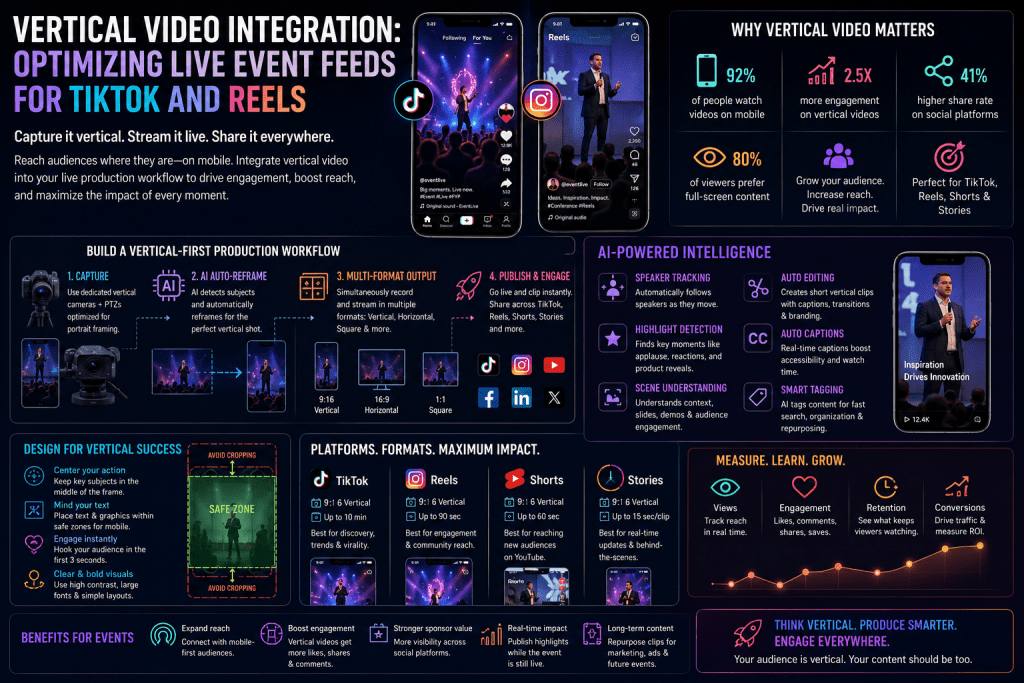
Why Vertical Video Has Become Essential
Consumer viewing habits have shifted dramatically toward smartphones.
Most social media engagement now occurs through vertically oriented mobile devices, making portrait video the preferred format across major platforms.
For event organizers, vertical content offers several advantages:
- Higher mobile engagement
- Increased organic reach
- Faster content sharing
- Improved discoverability
- Stronger audience participation
Rather than competing with traditional broadcasts, vertical video complements them by extending event visibility to new audiences.
From Horizontal Broadcasting to Dual-Format Production
Traditional event production focused almost exclusively on 16:9 widescreen broadcasts.
While suitable for television and desktop viewing, horizontal framing often performs poorly on mobile-first platforms.
Modern production workflows increasingly support multiple output formats simultaneously.
These include:
- Horizontal livestreams
- Vertical social feeds
- Square promotional assets
- Digital signage
- Mobile applications
Capturing content specifically for each format preserves visual quality and storytelling effectiveness.
Building a Vertical Video Workflow
Successful vertical integration begins during production planning rather than post-production.
Dedicated Vertical Cameras
Many production teams now deploy cameras designed specifically for portrait capture.
These cameras focus on:
- Speakers
- Demonstrations
- Audience reactions
- Product showcases
- Influencer content
without compromising the primary broadcast.
AI-Based Auto Reframing
Artificial intelligence automatically detects subjects within widescreen footage and intelligently crops scenes into vertical compositions.
Computer vision algorithms track:
- Facial positions
- Body movement
- Presentation materials
- Stage activity
This minimizes manual editing while preserving important visual elements.
Simultaneous Multi-Format Recording
Modern production switchers increasingly generate multiple video outputs simultaneously.
A single event can produce:
- Broadcast feeds
- Social media clips
- On-demand recordings
- Sponsor content
without requiring separate productions.
AI-Powered Content Selection
Artificial intelligence is transforming how vertical content is created.
Automatic Highlight Detection
AI continuously analyzes live video to identify moments such as:
- Audience applause
- Speaker emphasis
- Product reveals
- Demonstrations
- Standing ovations
- Emotional reactions
These clips can be prepared for immediate publication.
Speaker Tracking
Computer vision automatically keeps presenters centered within vertical frames as they move across the stage.
This improves visual consistency without manual camera adjustments.
Intelligent Editing
AI can automatically perform:
- Scene transitions
- Clip trimming
- Caption generation
- Brand placement
- Audio balancing
allowing rapid publication during live events.
Optimizing Stage Design for Vertical Capture
Event production increasingly considers portrait framing during stage design.
Presenter Positioning
Speakers are encouraged to remain within areas optimized for both widescreen and vertical cameras.
This simplifies automated tracking.
Graphic Placement
Presentation graphics should remain readable after vertical cropping.
Critical information is positioned within safe framing zones.
LED Wall Design
Some productions create adaptable visual assets that function effectively across multiple aspect ratios.
This ensures consistent branding across platforms.
Enhancing Sponsor Visibility
Vertical video creates valuable sponsorship opportunities.
Mobile-First Branding
Sponsors can appear within:
- Vertical overlays
- Intro sequences
- Branded captions
- Product demonstrations
- Interactive content
These placements often receive significant engagement on social platforms.
Influencer Collaboration
Dedicated vertical production teams support creators producing content directly from event venues.
This expands sponsor reach through authentic audience-generated media.
Shoppable Content
Integrated commerce platforms enable viewers to purchase featured products directly from vertical videos.
This creates measurable sponsor ROI.
Hybrid Events and Vertical Streaming
Hybrid events increasingly combine professional broadcasting with mobile-first content.
Parallel Distribution
Content can simultaneously reach audiences through:
- Event platforms
- TikTok
- Instagram Reels
- YouTube Shorts
- Corporate social channels
This expands audience accessibility.
Behind-the-Scenes Coverage
Vertical formats are particularly effective for:
- Speaker preparation
- Production insights
- Venue tours
- Networking moments
These perspectives strengthen audience connection.
Audience Participation
Interactive features including polls, comments, and live responses increase engagement during hybrid broadcasts.
Technical Infrastructure Requirements
Vertical production depends on integrated technology platforms.
Cloud-Based Editing
Cloud editing systems enable production teams to prepare and publish clips within minutes.
This supports near real-time social media distribution.
High-Speed Connectivity
Reliable upload bandwidth is essential for:
- Live streaming
- Cloud rendering
- AI processing
- Multi-platform publishing
Private 5G and enterprise Wi-Fi increasingly support these workflows.
Metadata Management
Automated tagging improves:
- Content organization
- Searchability
- Clip retrieval
- Sponsor reporting
AI-generated metadata accelerates post-event content production.
Measuring Performance
Vertical content generates valuable analytics beyond traditional broadcast metrics.
Common performance indicators include:
- View duration
- Completion rates
- Shares
- Saves
- Comments
- Engagement rate
- Follower growth
- Click-through conversions
These metrics help organizers evaluate content strategy and sponsor performance.
Challenges and Considerations
Despite its advantages, vertical production introduces several operational challenges.
Additional Production Planning
Vertical workflows require dedicated creative planning rather than simple cropping.
Production teams should define mobile-first objectives early.
Platform Differences
Each social platform favors different content lengths, editing styles, and engagement strategies.
Publishing workflows should account for these variations.
Rights Management
Music licensing, speaker permissions, and broadcast rights should include provisions for social media distribution.
This prevents legal complications after publication.
The Future of Vertical Event Content
Several innovations are expected to further expand vertical production capabilities.
Emerging developments include:
- AI-generated personalized highlight reels
- Automated multilingual captions
- Augmented reality overlays
- Interactive shopping experiences
- Real-time audience sentiment analysis
- Wearable creator cameras
- Mixed-reality social broadcasting
These technologies will further integrate vertical content into mainstream event production.
Conclusion
Vertical video integration has become an essential component of modern event production. Rather than adapting horizontal broadcasts after an event concludes, organizers are increasingly designing workflows that produce high-quality vertical content alongside traditional livestreams.
Artificial intelligence, computer vision, cloud editing platforms, and multi-format production systems enable efficient creation of mobile-first experiences that expand audience reach while improving sponsor visibility and social engagement.
As smartphone consumption continues to dominate digital media, vertical video is no longer simply a promotional format—it is a core broadcasting strategy. Event organizers that embrace vertical-first production will be better positioned to engage modern audiences, maximize content value, and extend the impact of live experiences far beyond the venue itself.