Ultra-Low Latency Streaming: Achieving Sub-Second Delays for Global Hybrid Events
Hybrid events have evolved from simple livestreams into fully interactive experiences where virtual attendees expect to participate as naturally as those attending in person. Audiences ask questions during keynote sessions, vote in live polls, join networking discussions, participate in workshops, and collaborate with speakers across continents. These interactions depend on one critical technical requirement: minimal streaming delay.

Traditional internet streaming often introduced delays of 15 to 45 seconds, creating noticeable gaps between live venue activity and what remote participants experienced. While acceptable for passive viewing, such latency severely limits meaningful interaction. A question submitted by a remote attendee may reach the presenter long after the discussion has moved on, while live audience reactions and collaborative sessions lose their sense of immediacy.
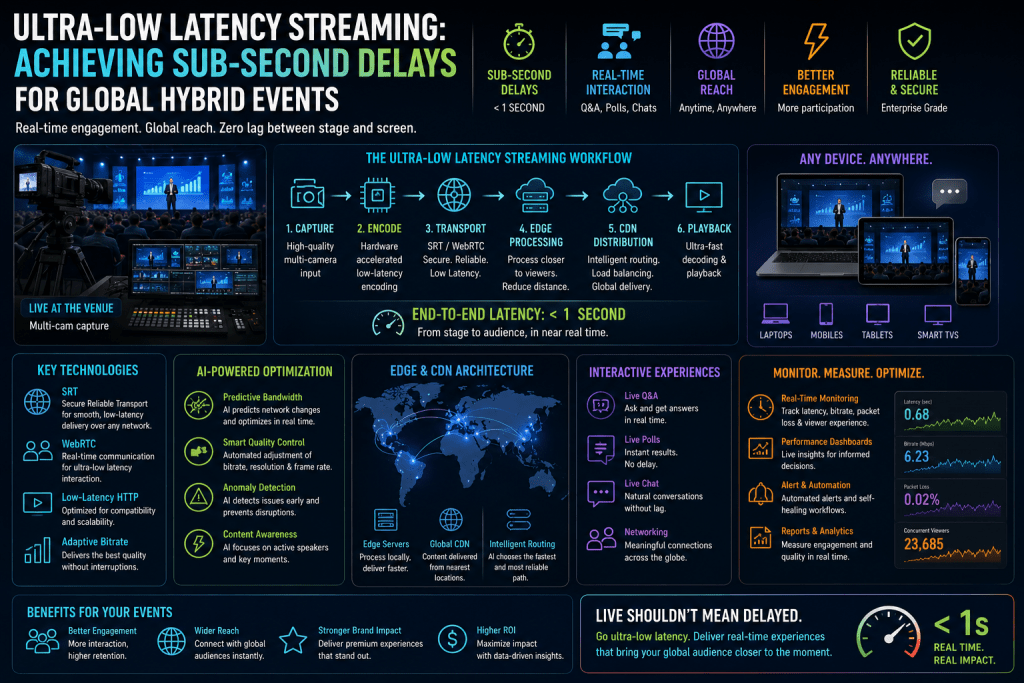
Ultra-low latency streaming is addressing this challenge. Through advanced video transport protocols, edge computing, adaptive content delivery networks (CDNs), artificial intelligence, and modern encoding technologies, event organizers are now capable of delivering global live streams with delays of less than one second.
In 2026, ultra-low latency streaming is becoming a foundational technology for conferences, corporate events, product launches, esports tournaments, financial broadcasts, and large-scale hybrid summits that require seamless interaction between physical and virtual audiences.
Why Latency Matters in Hybrid Events
Latency refers to the time required for video and audio to travel from cameras at an event venue to viewers’ devices.
Even small delays can significantly affect audience engagement.
High latency creates problems such as:
- Delayed audience questions
- Poor presenter interaction
- Unsynchronized discussions
- Reduced networking quality
- Slower audience participation
For highly interactive events, minimizing latency is essential to preserving a truly live experience.
Understanding the Streaming Pipeline
Every livestream passes through multiple processing stages before reaching viewers.
These typically include:
- Video capture
- Encoding
- Compression
- Network transmission
- CDN distribution
- Device decoding
- Playback buffering
Each stage contributes to overall latency.
Optimizing every component is necessary to achieve sub-second performance.
Modern Streaming Protocols
The choice of transport protocol plays a major role in latency.
Secure Reliable Transport (SRT)
SRT improves live video delivery across unpredictable internet connections.
Key advantages include:
- Low latency
- Packet loss recovery
- Secure encryption
- Stable long-distance transmission
SRT has become widely adopted for professional event production.
Web Real-Time Communication (WebRTC)
WebRTC enables extremely low-latency communication directly between browsers and applications.
It is particularly valuable for:
- Interactive conferences
- Virtual networking
- Live workshops
- Remote collaboration
Many hybrid event platforms rely on WebRTC for participant interaction.
Low-Latency HTTP Streaming
Modern implementations of HTTP-based streaming reduce traditional buffering delays while maintaining compatibility across large audiences.
These technologies balance scalability with responsiveness.
Advanced Video Encoding
Encoding directly influences streaming performance.
Hardware Acceleration
Dedicated encoding hardware reduces processing time while maintaining high video quality.
This decreases latency compared to software-only encoding.
Efficient Video Compression
Modern codecs deliver higher image quality using lower bandwidth.
Benefits include:
- Faster transmission
- Reduced buffering
- Improved mobile performance
- Better global accessibility
Encoding settings should balance compression efficiency with real-time delivery requirements.
Adaptive Bitrate Streaming
Adaptive streaming automatically adjusts video quality based on viewer network conditions.
This minimizes interruptions while preserving low latency.
Edge Computing and Distributed Processing
Cloud computing alone cannot always deliver the fastest response times.
Edge computing addresses this challenge by moving processing closer to viewers.
Local Processing
Edge servers perform:
- Video transcoding
- Content caching
- Stream optimization
- Traffic management
closer to audience locations.
This significantly reduces transmission delays.
Geographic Distribution
Global events often distribute processing across multiple regional edge locations.
Remote viewers receive content from nearby infrastructure rather than distant centralized servers.
Content Delivery Networks (CDNs)
CDNs remain essential for worldwide event distribution.
Intelligent Routing
Modern CDNs continuously evaluate network conditions.
Traffic is automatically routed through the fastest available paths.
Load Balancing
Large hybrid events frequently attract thousands of simultaneous viewers.
CDNs distribute traffic efficiently across multiple servers, preventing overload.
Redundancy
Multiple delivery paths improve reliability while supporting uninterrupted broadcasts.
Artificial Intelligence in Streaming Optimization
AI is increasingly responsible for real-time performance improvements.
Predictive Bandwidth Management
Machine learning models analyze network conditions and anticipate bandwidth fluctuations before they affect viewers.
Streaming parameters are adjusted proactively.
Automated Quality Optimization
AI balances:
- Resolution
- Bitrate
- Frame rate
- Compression
to maximize viewing quality while maintaining ultra-low latency.
Intelligent Error Recovery
Rather than waiting for significant failures, AI detects transmission anomalies early and initiates corrective actions automatically.
This reduces interruptions.
Private 5G and High-Speed Connectivity
Network infrastructure remains fundamental to ultra-low latency streaming.
Private 5G Networks
Many convention centers now deploy private 5G infrastructure supporting:
- Broadcast cameras
- Mobile production units
- Wireless contribution feeds
- Remote presenters
Private networks provide lower latency than congested public cellular systems.
High-Capacity Fiber
Fiber connectivity continues serving as the primary backbone for large-scale event production.
Redundant fiber paths improve both performance and resilience.
Synchronizing Global Hybrid Experiences
Low latency enables more natural interaction across geographically distributed audiences.
Live Q&A Sessions
Remote participants can ask questions with virtually no noticeable delay.
Conversations become significantly more fluid.
Interactive Workshops
Hands-on demonstrations and collaborative sessions benefit from synchronized communication.
Participants experience discussions almost as though they are physically present.
Multi-Site Broadcasts
Organizations increasingly connect multiple event venues through ultra-low latency infrastructure.
Presenters can interact naturally across different countries in real time.
Monitoring Streaming Performance
Maintaining sub-second latency requires continuous monitoring.
Important operational metrics include:
- End-to-end latency
- Packet loss
- Network jitter
- Bitrate stability
- Viewer buffering
- Playback quality
Real-time dashboards help engineers identify emerging issues before audiences notice them.
Challenges and Considerations
Ultra-low latency streaming introduces several technical challenges.
Infrastructure Costs
Advanced encoding systems, private networking, and distributed cloud infrastructure require significant investment.
Organizations should evaluate requirements based on event objectives.
Global Network Variability
Internet conditions differ substantially across regions.
Maintaining consistent latency worldwide remains challenging.
Scalability Trade-Offs
Extremely low latency may reduce some buffering protection.
Production teams must balance responsiveness with playback stability for large audiences.
The Future of Ultra-Low Latency Streaming
Several emerging technologies are expected to further improve live event broadcasting.
These include:
- AI-managed global routing
- Edge-native production platforms
- 6G connectivity
- Cloud-native switching
- Predictive congestion avoidance
- Distributed rendering
- Immersive mixed-reality streaming
Together, these innovations will continue reducing latency while expanding audience participation.
Conclusion
Ultra-low latency streaming is transforming hybrid events by eliminating the delays that have historically separated remote audiences from live venue experiences. Through modern streaming protocols, AI-powered optimization, edge computing, advanced encoding, private 5G, and intelligent CDN architectures, organizers can now deliver interactive broadcasts with delays measured in fractions of a second.
The benefits extend beyond technical performance. Faster streaming enables richer audience participation, more engaging presentations, stronger collaboration, and a more authentic sense of shared presence across global audiences.
As hybrid events continue evolving, latency will become an increasingly important measure of production quality. Organizations that invest in ultra-low latency infrastructure will be better positioned to deliver immersive, responsive, and globally connected event experiences where distance is no longer a barrier to meaningful participation.