Sentiment Analysis Micro-Polling: Taking the Emotional Pulse of Your Audience in Real-Time
The modern event experience is no longer measured solely by attendance numbers or session completion rates. Organizers increasingly recognize that the emotional state of attendees plays a significant role in determining whether an event is engaging, memorable, and successful. An audience may remain seated throughout a keynote presentation, yet their attention, enthusiasm, or confidence could fluctuate dramatically from one moment to the next.
Traditional post-event surveys offer valuable feedback, but they capture opinions only after the experience has ended. By then, opportunities to improve live sessions, adjust presentations, or respond to audience concerns have already passed.
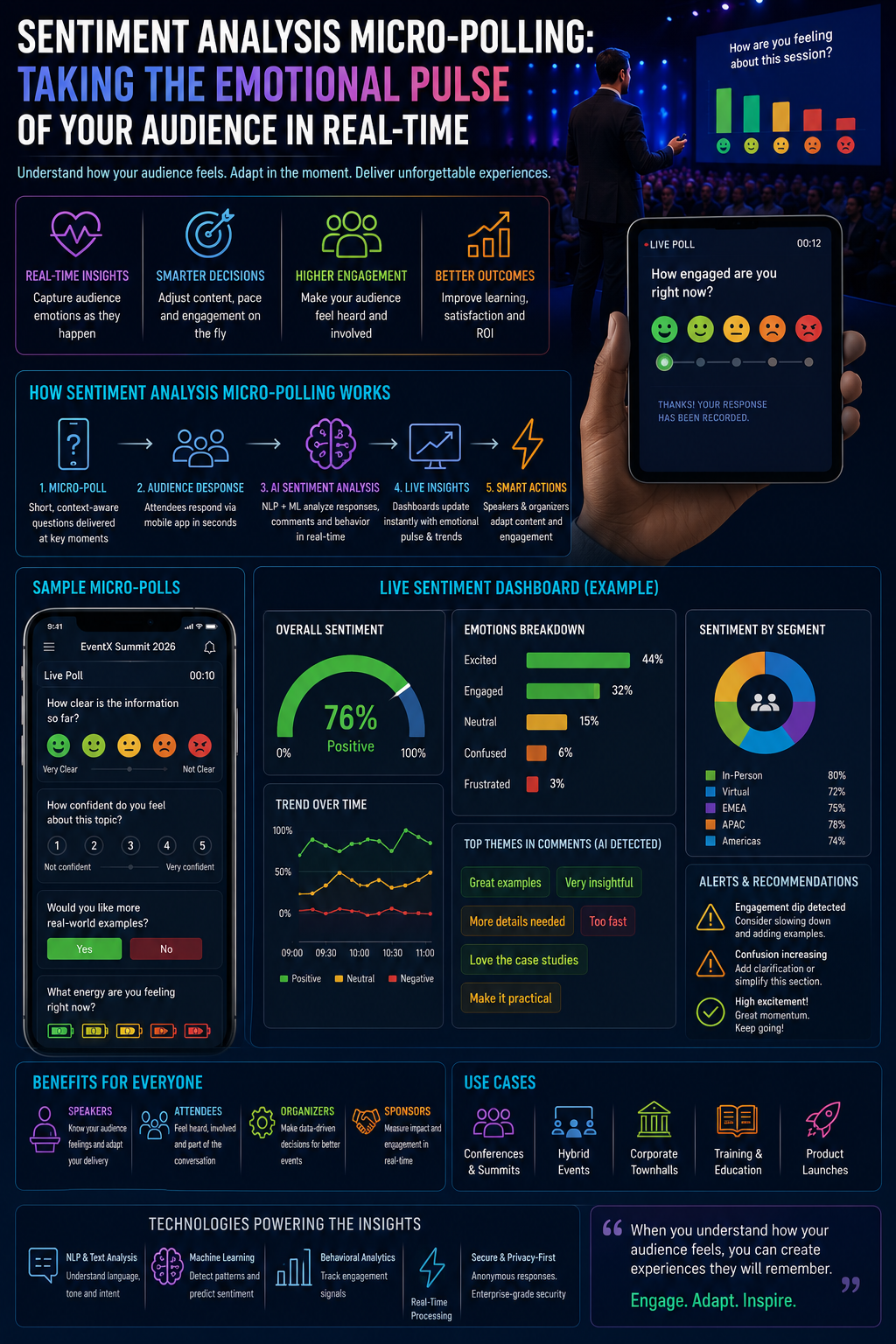
Sentiment analysis micro-polling is changing this approach. By combining artificial intelligence, natural language processing (NLP), live polling platforms, behavioral analytics, and real-time dashboards, organizers can continuously monitor audience sentiment during live events. Instead of asking lengthy questionnaires, attendees respond to quick, context-aware prompts that provide an ongoing picture of engagement, understanding, excitement, and satisfaction.
In 2026, sentiment analysis micro-polling is becoming an essential component of intelligent event management, enabling organizers to make informed decisions while an event is still taking place rather than waiting until it is over.
Why Emotional Insights Matter
Successful events create emotional connections as well as educational value.
Audience emotions influence:
- Knowledge retention
- Participation levels
- Networking behavior
- Session satisfaction
- Sponsor engagement
- Event loyalty
A presentation that is technically accurate but emotionally flat may fail to inspire attendees, while an engaging speaker who connects emotionally often generates stronger learning outcomes and lasting impressions.
Understanding these emotional shifts allows organizers to improve experiences in real time.
What Is Sentiment Analysis Micro-Polling?
Sentiment analysis micro-polling combines brief audience interactions with artificial intelligence to evaluate emotional responses throughout an event.
Instead of lengthy questionnaires, attendees answer simple prompts such as:
- How engaged are you right now?
- Was this explanation clear?
- How confident do you feel about this topic?
- Would you like more examples?
- Is the presentation moving too quickly?
Responses are analyzed immediately, producing live sentiment indicators for speakers and organizers.
The objective is not simply to collect opinions but to understand how audience emotions evolve throughout the event.
How AI Interprets Audience Sentiment
Artificial intelligence transforms individual responses into meaningful insights.
Natural Language Processing
When attendees submit written comments, NLP models analyze language patterns to identify emotional signals.
The system detects indicators such as:
- Enthusiasm
- Curiosity
- Confusion
- Frustration
- Agreement
- Skepticism
This provides a richer understanding than numerical ratings alone.
Behavioral Analytics
AI also evaluates engagement behavior, including:
- Poll participation
- Question submissions
- Session attendance
- Mobile app interactions
- Audience voting
Combined with survey responses, these behaviors provide a more complete picture of audience sentiment.
Continuous Learning
Machine learning models improve over time by identifying recurring engagement patterns across multiple events.
This increases prediction accuracy for future sessions.
Designing Effective Micro-Polls
The success of sentiment analysis depends on thoughtful question design.
Keep Questions Brief
Micro-polls should require only a few seconds to complete.
Examples include:
- One-click emoji responses
- Five-point rating scales
- Yes-or-no questions
- Quick confidence indicators
Short interactions encourage higher participation.
Ask at Natural Moments
Effective polling occurs during:
- Topic transitions
- Demonstrations
- Panel discussions
- Learning checkpoints
- Closing summaries
Poorly timed interruptions may reduce engagement rather than improve it.
Avoid Survey Fatigue
Excessive polling can overwhelm attendees.
AI platforms increasingly determine optimal polling frequency based on audience behavior and session length.
Supporting Speakers in Real Time
Live sentiment insights provide valuable guidance for presenters.
Adjusting Presentation Pace
If audience confidence begins declining, speakers can:
- Slow the presentation
- Provide additional examples
- Clarify terminology
- Answer questions
before confusion grows.
Measuring Engagement
Real-time dashboards reveal whether energy levels are increasing or decreasing throughout a session.
Presenters can adapt content dynamically.
Identifying High-Impact Topics
Sentiment analysis highlights which ideas generate the strongest audience response.
Future presentations can emphasize these areas.
Benefits for Hybrid Events
Hybrid audiences often behave differently from in-person participants.
Micro-polling helps bridge this gap.
Equal Participation
Remote attendees can express reactions just as easily as those seated in the venue.
This improves inclusivity.
Comparing Audience Segments
Organizers can compare sentiment between:
- In-person attendees
- Virtual participants
- Geographic regions
- Industry sectors
These insights support more personalized event experiences.
Maintaining Attention
Frequent but lightweight interactions help remote audiences remain engaged during longer sessions.
Enhancing Sponsor Value
Sponsors increasingly seek deeper engagement metrics than booth traffic or session attendance.
Measuring Brand Perception
Sentiment analysis reveals how attendees respond to:
- Product demonstrations
- Sponsored presentations
- Innovation showcases
- Brand messaging
This provides valuable marketing intelligence.
Evaluating Educational Sessions
Sponsors hosting technical presentations can assess whether attendees:
- Understood the content
- Found demonstrations valuable
- Want additional information
These insights improve future presentations.
Real-Time Campaign Optimization
If engagement declines during sponsored sessions, organizers can adjust formats or messaging while the event is still underway.
Operational Benefits for Organizers
Sentiment analytics supports continuous event improvement.
Session Performance Monitoring
Organizers gain visibility into:
- Audience enthusiasm
- Content clarity
- Participation rates
- Learning effectiveness
without waiting for post-event surveys.
Better Resource Allocation
Low engagement sessions may benefit from:
- Additional moderators
- Interactive demonstrations
- Q&A extensions
- Networking opportunities
Real-time insights enable faster operational decisions.
Stronger Event Planning
Historical sentiment data helps identify:
- Popular speakers
- Effective presentation styles
- Preferred session lengths
- High-impact topics
These findings improve future event design.
Privacy and Ethical Considerations
Emotional analytics should always respect attendee privacy.
Transparency
Participants should understand:
- What information is collected
- How responses are analyzed
- Whether comments are anonymous
- How data will be used
Clear communication builds trust.
Anonymous Reporting
Most dashboards should display aggregated sentiment rather than individual emotional profiles.
This protects participant privacy.
Responsible AI
AI-generated emotional interpretations should support—not replace—human judgment.
Organizers should avoid making important decisions based solely on automated analysis.
Challenges of Sentiment Analysis
Despite its advantages, sentiment analysis has limitations.
Cultural Differences
Emotional expression varies across cultures.
AI models should account for linguistic and regional differences whenever possible.
Participation Bias
Not every attendee responds to polls.
Sentiment dashboards should therefore be interpreted alongside other engagement metrics.
Context Matters
A decrease in enthusiasm may indicate:
- Presentation complexity
- Technical issues
- Audience fatigue
- External distractions
Human interpretation remains essential.
The Future of Emotional Event Intelligence
Several innovations are expected to expand sentiment analysis capabilities.
Emerging developments include:
- AI-generated engagement recommendations
- Voice sentiment analysis
- Computer vision emotion detection
- Wearable wellness integration
- Predictive audience behavior models
- Digital twin engagement simulation
- Personalized learning experiences
These technologies will enable increasingly adaptive and responsive event environments.
Conclusion
Sentiment analysis micro-polling is transforming audience feedback from a post-event evaluation tool into a real-time decision-making system. By combining artificial intelligence, natural language processing, behavioral analytics, and lightweight audience interactions, organizers gain continuous insight into how attendees think, feel, and engage throughout an event.
The technology empowers speakers to adjust presentations, helps organizers improve session quality, provides sponsors with meaningful engagement metrics, and enhances both in-person and hybrid experiences.
As live events become increasingly data-driven, understanding audience emotions will become just as important as measuring attendance or registration numbers. Organizations that embrace real-time sentiment analysis will be better equipped to create events that are not only informative but also emotionally engaging, responsive, and memorable. In the future of event technology, success will depend not only on knowing where attendees are—but also on understanding how they feel.