Creating 3D Holographic Illusions on a Budget: A Guide for Mid-Sized Events
Introduction
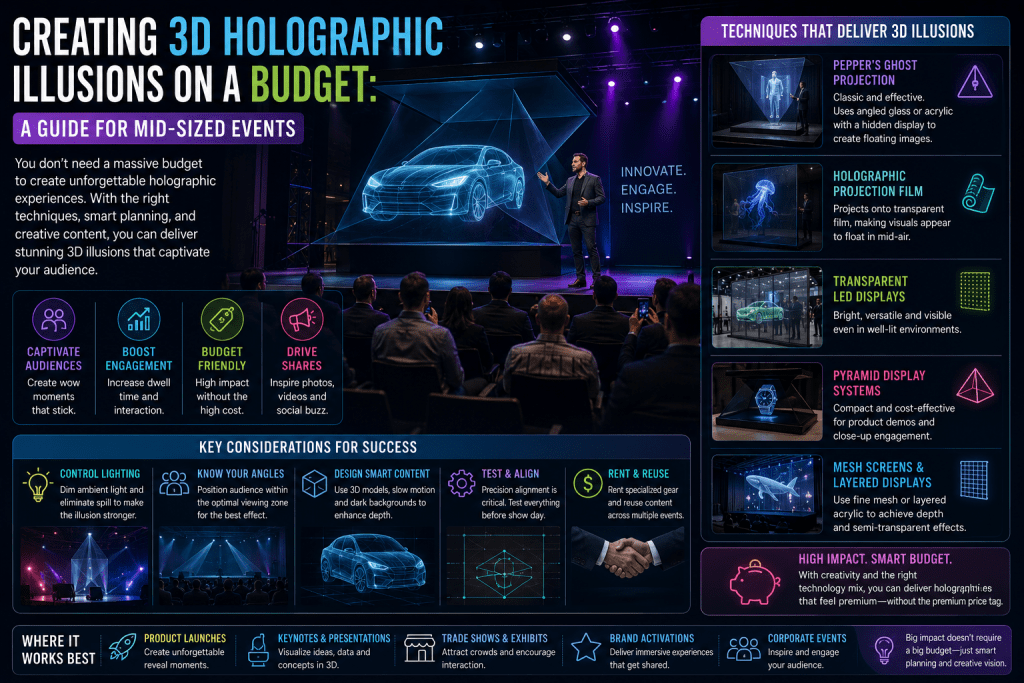
Immersive visual technology has become a defining element of modern conferences, product launches, trade shows, and brand activations. Audiences increasingly expect memorable visual experiences that extend beyond conventional LED walls and projection screens. True volumetric holographic displays remain prohibitively expensive for most event budgets, requiring specialized hardware, controlled environments, and significant production resources. However, many of the “holograms” seen at commercial events are not true holograms at all. They are carefully engineered visual illusions that create convincing three-dimensional effects using existing display technologies.
For mid-sized events, this distinction creates an important opportunity. Rather than investing hundreds of thousands of dollars in experimental display systems, organizers can achieve impressive holographic-style experiences by combining projection techniques, transparent display materials, LED technology, lighting control, and creative content design. The result is an illusion that delivers much of the audience impact associated with premium installations while remaining commercially practical.
Success depends less on purchasing expensive equipment than on understanding the optical principles behind holographic illusions and matching the production approach to the venue, audience size, and event objectives. When planned carefully, budget-conscious holographic effects can become effective tools for product storytelling, sponsor activation, keynote presentations, and experiential marketing.
Understanding the Difference Between True Holography and Event Illusions
One of the biggest misconceptions in event production is that every floating digital image is a hologram. In reality, true holography records and reconstructs light fields, requiring highly specialized optical systems that remain impractical for most live events.
Most event “holograms” instead rely on visual illusion techniques such as:
- Pepper’s Ghost reflections
- Transparent LED displays
- Projection onto holographic films
- Fine mesh projection screens
- Layered acrylic displays
- Volumetric lighting effects
- Mixed reality integration
The audience perceives floating objects because reflections, transparency, controlled lighting, and perspective work together to hide the physical display medium.
Recognizing this distinction allows event planners to allocate budgets toward technologies that maximize perceived impact instead of pursuing expensive systems that offer only marginal improvements for most audiences.
Budget-Friendly Technologies for Holographic Effects
Several technologies can produce convincing holographic illusions without enterprise-level budgets.
Pepper’s Ghost Projection
Pepper’s Ghost remains one of the most effective techniques for creating floating digital presenters and products.
A transparent angled film or acrylic sheet reflects images from a concealed display or projector, causing the audience to perceive a three-dimensional object suspended in space.
Advantages include:
- Relatively inexpensive materials
- High visual impact
- Works well for keynote reveals
- Suitable for medium-sized stages
- No wearable equipment required
Its primary limitation is viewing angle. The illusion works best when the audience faces the installation from a controlled direction.
Holographic Projection Film
Transparent holographic films can be applied to glass or acrylic surfaces and used with standard high-lumen projectors.
Unlike conventional projection screens, these films remain nearly invisible until illuminated, allowing presenters and physical objects to remain visible behind the projected content.
Applications include:
- Product showcases
- Interactive museum exhibits
- Sponsor displays
- Retail demonstrations
- Innovation zones
Compared to LED installations, holographic film typically offers lower equipment costs while requiring greater lighting control.
Transparent LED Displays
Transparent LED panels have become increasingly accessible for mid-sized productions.
These displays maintain partial visibility through the screen while presenting high-brightness digital content.
Compared with projection-based systems they provide:
- Better performance in brighter environments
- Higher image brightness
- Larger installation flexibility
- Improved reliability during long events
Although more expensive than projection films, transparent LEDs often reduce setup complexity and lighting restrictions.
Pyramid Display Systems
Small tabletop holographic pyramids remain useful for:
- Product demonstrations
- Trade show booths
- Museum exhibits
- Interactive kiosks
- Reception displays
Using four-sided reflective surfaces and specially formatted video content, these displays create convincing floating objects at relatively low cost.
While unsuitable for keynote stages, they deliver excellent value for close-range attendee engagement.
Designing Content for Maximum Illusion
Hardware alone rarely creates convincing holographic effects. Content design determines whether the illusion succeeds.
Three principles are especially important.
Dark Backgrounds
Black backgrounds effectively disappear within projection systems, allowing illuminated content to appear detached from its supporting surface.
Content should minimize unnecessary background graphics that reveal display boundaries.
Controlled Motion
Slow, deliberate movement enhances perceived depth.
Rapid motion often exposes the underlying projection geometry and reduces realism.
Animations should emphasize:
- Rotation
- Floating
- Layer separation
- Particle effects
- Depth transitions
Proper Perspective
Objects should be modeled specifically for the intended viewing angle.
A model designed for standard video presentation may appear distorted when projected through holographic illusion systems.
Three-dimensional rendering pipelines should account for audience position during content creation.
Venue Requirements and Environmental Considerations
The venue itself often determines whether holographic illusions succeed.
Ambient Lighting
Projection-based holographic systems require controlled lighting.
Bright exhibition halls can significantly reduce illusion quality.
Lighting designers should prioritize:
- Reduced front lighting
- Controlled spill
- Directional stage lighting
- Background separation
Transparent LED displays tolerate brighter environments but still benefit from careful lighting design.
Audience Positioning
Many holographic illusions depend on perspective.
Wide audience seating layouts may weaken the effect near the edges.
Organizers should evaluate:
- Viewing distance
- Horizontal viewing angles
- Audience elevation
- Screen height
- Sightline obstructions
Virtual renderings during pre-production can identify potential visibility issues before installation.
Stage Design
Simple stage environments generally produce stronger holographic effects than visually cluttered sets.
Dark scenic elements, hidden projector positions, and carefully integrated lighting help maintain the illusion.
Integrating Holographic Effects into Event Experiences
Budget-friendly holographic systems deliver the greatest value when integrated into broader event storytelling rather than used as isolated visual tricks.
Product Launches
Instead of unveiling a product physically, organizers can introduce:
- Floating product animations
- Exploded component views
- Interactive feature demonstrations
- Assembly visualizations
The physical product can then appear immediately afterward, reinforcing the illusion.
Keynote Presentations
Speakers can interact with:
- Floating charts
- Animated data
- Virtual prototypes
- Scientific models
- Architectural concepts
When synchronized correctly, these visuals increase audience attention without overwhelming the presentation.
Sponsor Activations
Sponsors increasingly seek immersive experiences that generate attendee interaction.
Budget holographic installations support:
- Product exploration
- Brand storytelling
- Interactive displays
- Photo opportunities
- Gamified experiences
Because attendees frequently photograph holographic displays, sponsors benefit from increased organic social media visibility.
Operational Planning and Cost Optimization
Creating a successful holographic illusion depends on disciplined production planning.
Mid-sized event organizers can reduce costs through several practical strategies.
Rent specialized equipment rather than purchasing rarely used systems.
Reuse existing high-lumen projectors whenever possible.
Design modular scenic structures that support multiple presentation segments.
Create reusable animation assets that can be adapted across future events.
Conduct extensive rehearsals before show day to refine projection alignment and presenter positioning.
The greatest production risks typically arise from calibration errors rather than equipment limitations.
Common Challenges
Budget holographic installations present several operational challenges.
Projection alignment may drift during installation or stage movement.
Transparent surfaces require careful cleaning because fingerprints become highly visible under stage lighting.
Presenters must rehearse movement carefully to avoid breaking the illusion by walking into projection paths.
Content creation timelines are often underestimated because holographic media requires specialized animation techniques rather than conventional presentation graphics.
Finally, audience expectations should be managed appropriately. Promotional language should emphasize immersive visual experiences rather than promising true holographic technology.
Future Trends
The cost of immersive display technology continues to decline as transparent LEDs, light-field displays, and spatial computing mature.
Artificial intelligence is beginning to accelerate holographic content production through automated animation generation and rapid three-dimensional asset creation.
At the same time, augmented reality and mixed reality devices are likely to complement stage-based holographic illusions by extending immersive experiences onto attendee smartphones and wearable devices.
Rather than replacing budget holographic techniques, these technologies will expand how organizers combine physical and digital storytelling throughout the event journey.
Conclusion
Creating convincing 3D holographic illusions no longer requires enterprise-level production budgets or experimental display technologies. By combining proven techniques such as Pepper’s Ghost projection, holographic films, transparent LED displays, thoughtful lighting, and purpose-built three-dimensional content, mid-sized event organizers can deliver visually memorable experiences that rival far more expensive installations. Success depends on understanding the underlying optical principles, designing specifically for the venue environment, and integrating holographic effects into the event narrative rather than treating them as standalone attractions. When implemented strategically, budget-conscious holographic illusions become practical tools for increasing audience engagement, enhancing brand storytelling, and delivering premium production value without exceeding financial constraints.