The Economics of Holographic Speakers: Costs, Logistics, and Attendee Impact
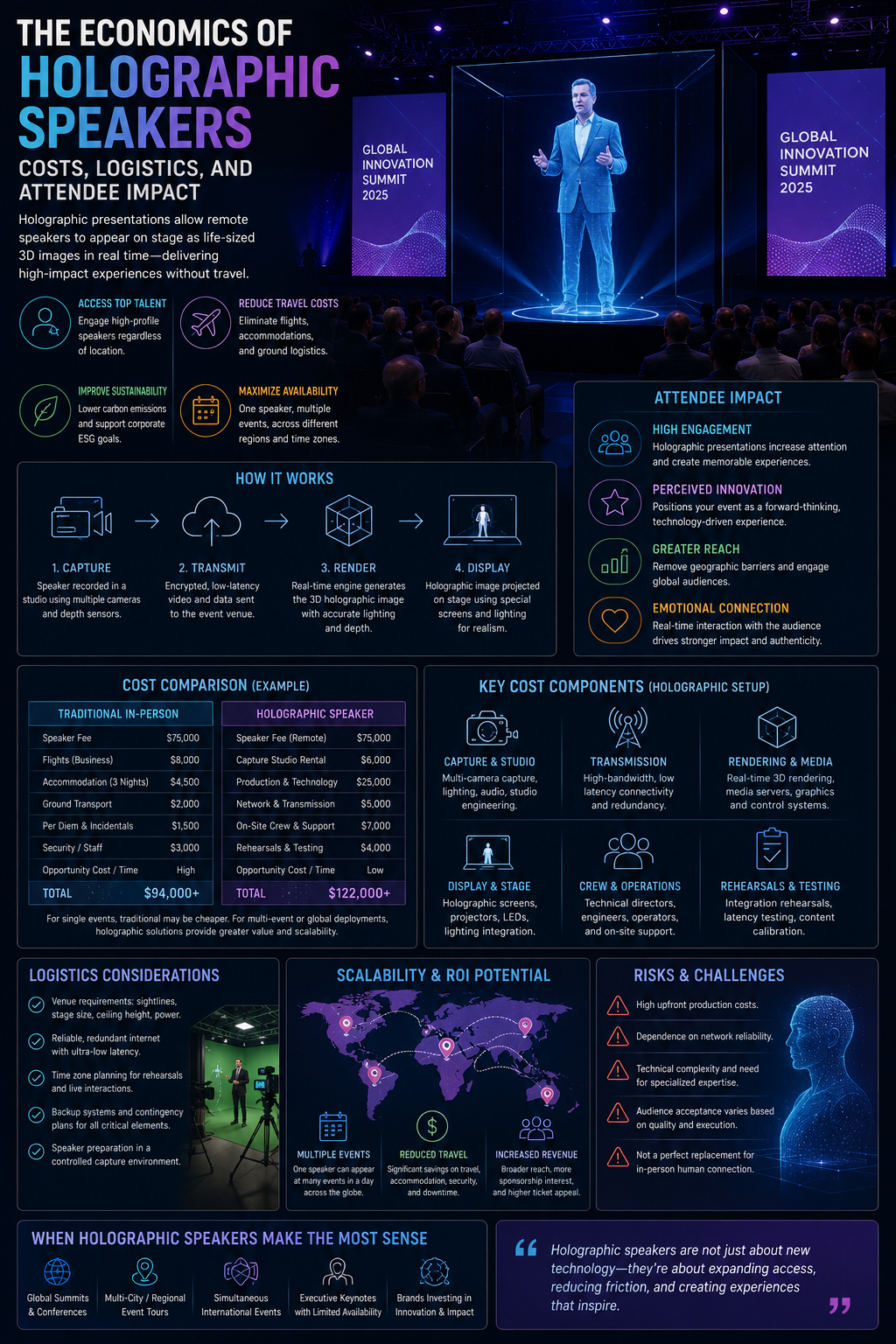
The concept of a speaker appearing on stage as a life-sized hologram once belonged primarily to science fiction. Today, holographic presentation technology is becoming an increasingly viable option for conferences, corporate events, product launches, trade shows, and global summits seeking to expand access to high-profile speakers while reducing travel complexity.
Driven by advances in volumetric capture, high-resolution projection systems, LED stage technologies, low-latency transmission networks, and real-time rendering platforms, holographic speakers are moving beyond novelty demonstrations and entering mainstream event production conversations. Event organizers are no longer asking whether holographic presentations are possible. Instead, they are evaluating whether the investment generates sufficient business value compared to traditional in-person or virtual appearances.
The answer depends on a combination of economics, logistics, audience expectations, and event objectives.
While holographic presentations can deliver significant advantages in flexibility and audience engagement, they also introduce unique production requirements and cost considerations that must be carefully evaluated. Understanding the true economics of holographic speakers requires looking beyond the visual spectacle and examining the operational realities behind the technology.
What Is a Holographic Speaker?
In the event industry, the term “holographic speaker” typically refers to a remote presenter who appears on stage as a three-dimensional visual representation.
Most deployments do not involve true free-space holograms. Instead, they rely on combinations of:
- Projection systems
- Transparent display surfaces
- LED stage environments
- Volumetric video technology
- Real-time rendering platforms
- Mixed reality production systems
The goal is to create the illusion that a remote speaker is physically present on stage.
Attendees see a life-sized representation capable of delivering presentations, participating in discussions, and interacting with on-site audiences in real time.
Why Organizations Are Considering Holographic Speakers
Several factors are driving interest in holographic presentation technologies.
Access to High-Profile Speakers
Many keynote speakers face significant scheduling limitations.
Travel requirements often prevent participation in:
- Regional conferences
- International events
- Multi-city event tours
- Simultaneous engagements
Holographic technology allows speakers to appear at events without physical travel, increasing availability and scheduling flexibility.
Reduced Travel Burden
Executive travel represents a significant cost component for many events.
Expenses often include:
- Airfare
- Accommodation
- Ground transportation
- Security arrangements
- Scheduling downtime
Remote holographic participation can eliminate many of these costs.
Sustainability Objectives
Organizations increasingly seek to reduce event-related carbon emissions.
Replacing some long-distance speaker travel with holographic appearances can contribute to broader sustainability initiatives while maintaining audience access to expertise.
Understanding the Cost Structure
One of the biggest misconceptions surrounding holographic speakers is that they automatically reduce event costs.
In reality, the economics are more nuanced.
Production Technology Costs
Holographic presentations require specialized infrastructure that may include:
- High-brightness projection systems
- LED stage components
- Transparent projection surfaces
- Media servers
- Real-time rendering software
- Capture equipment
- Dedicated network infrastructure
Depending on complexity, production costs can range from moderate investments to substantial six-figure deployments for large-scale events.
Capture and Transmission Costs
The remote speaker environment must also be equipped appropriately.
Requirements may include:
- Professional cameras
- Controlled lighting
- Audio capture systems
- Green screen environments
- Encoding systems
- Network redundancy
These costs are frequently overlooked during budgeting discussions.
Technical Staffing
Holographic presentations often require specialized personnel including:
- Projection specialists
- Broadcast engineers
- Media server operators
- Network technicians
- Stage production teams
Additional staffing can significantly affect overall economics.
Comparing Holograms to Traditional Speaker Costs
The financial comparison becomes more favorable under specific conditions.
Single Event Scenarios
For a single conference appearance, traditional travel may often remain less expensive than a full holographic deployment.
When evaluating:
- Speaker travel
- Accommodation
- Ground logistics
- Speaker fees
against holographic production infrastructure, physical attendance may still offer better value for smaller events.
Multi-Event Deployments
The economics change dramatically when a speaker appears at multiple events.
A single executive could potentially participate in:
- Several conferences in one day
- Global product launches
- Simultaneous regional events
- International partner meetings
without leaving a remote studio.
In these situations, holographic delivery can generate substantial operational savings.
Large Venue Economics
Mega-events often benefit more from holographic investments because infrastructure costs can be spread across larger audiences.
The cost per attendee decreases significantly as audience size increases.
Logistics: The Hidden Complexity
Technology costs are only part of the equation.
Successful holographic presentations require careful logistical planning.
Venue Requirements
Not every venue can accommodate holographic production environments.
Organizers must consider:
- Ceiling height
- Stage dimensions
- Projection distances
- Power availability
- Rigging capacity
- Audience sightlines
Venue limitations can influence both costs and presentation quality.
Network Reliability
Real-time holographic presentations depend heavily on stable connectivity.
Critical requirements often include:
- High-bandwidth connections
- Low latency
- Redundant network paths
- Backup transmission systems
Network failures can severely disrupt speaker experiences.
Rehearsal Demands
Holographic presentations typically require more technical rehearsal than conventional keynote sessions.
Teams must validate:
- Audio synchronization
- Visual alignment
- Camera positioning
- Stage interaction timing
- Content integration
This increases production planning requirements.
Measuring Attendee Impact
Ultimately, the success of holographic speakers depends on audience perception.
The Novelty Effect
Holographic appearances often generate significant audience curiosity.
Attendees frequently view holographic presentations as:
- Innovative
- Memorable
- Futuristic
- Premium experiences
This can improve event differentiation and media attention.
Engagement Levels
Audience engagement varies based on execution quality.
High-quality deployments can create experiences that feel remarkably close to physical presence.
Poorly executed presentations, however, may appear artificial or distracting.
Key success factors include:
- Image quality
- Realistic scale
- Natural movement
- Audio synchronization
- Speaker interaction design
Perceived Speaker Presence
Research across event experiences consistently shows that perceived authenticity matters.
Attendees respond more positively when speakers actively engage with:
- Live audience questions
- On-stage moderators
- Real-time discussions
- Interactive segments
rather than simply delivering pre-recorded content.
Sponsorship and Media Value
Holographic speakers can create indirect financial benefits.
Increased Publicity
Events featuring holographic presentations often attract:
- Media coverage
- Social media sharing
- Industry attention
- Influencer engagement
The novelty factor can increase earned media value significantly.
Premium Sponsorship Opportunities
Sponsors frequently seek association with innovative event technologies.
Holographic experiences can create premium sponsorship inventory and increase partnership appeal.
Brand Positioning Benefits
Organizations hosting holographic presentations may strengthen perceptions of innovation and technological leadership.
This can contribute to long-term brand value beyond the event itself.
Challenges and Limitations
Despite their advantages, holographic speakers are not suitable for every event.
Cost Justification
Smaller conferences may struggle to justify the required investment.
The technology tends to provide stronger ROI for:
- Large audiences
- Global events
- Premium conferences
- Enterprise gatherings
Technical Risk
More technology introduces more potential failure points.
Backup plans remain essential.
Audience Expectations
As holographic experiences become more common, novelty alone will no longer guarantee positive reactions.
Future success will depend increasingly on content quality rather than technological spectacle.
Human Connection Considerations
Many attendees still value spontaneous interactions, networking opportunities, and informal conversations that only physically present speakers can provide.
Holographic technology cannot fully replicate these experiences.
The Future of Holographic Event Presentations
The economics of holographic speakers are likely to improve as technology matures.
Emerging developments include:
- Higher-resolution volumetric capture
- AI-enhanced rendering
- Lower-latency transmission
- Portable capture studios
- More affordable display systems
- Spatial computing integration
- Interactive holographic environments
As costs decrease and quality improves, holographic participation may become a routine option rather than a premium novelty.
Conclusion
Holographic speakers occupy an increasingly important space between traditional in-person presentations and standard virtual appearances. While the technology can create highly engaging experiences and unlock new operational flexibility, its economic value depends heavily on event scale, audience size, deployment frequency, and production objectives.
For large conferences, global events, and organizations seeking access to high-profile speakers without travel constraints, holographic presentations can deliver compelling returns through increased flexibility, media attention, sponsorship opportunities, and audience engagement.
However, successful implementation requires careful consideration of infrastructure costs, technical logistics, network reliability, and attendee expectations.
As holographic technologies continue evolving, the question will shift from whether events can afford holographic speakers to whether audiences will increasingly expect them as part of the next generation of connected, global event experiences.