Hologram Technology in Events: Creating Spatial Visual Experiences Beyond Physical Presence
Introduction: Redefining Presence in Event Environments
Event experiences have traditionally depended on physical presence—speakers on stage, products in display areas, and performers within visible spaces. Hologram technology challenges this limitation by creating the illusion of three-dimensional presence without requiring the physical object or person to exist in the same location.
In modern event ecosystems, holograms are no longer viewed as experimental spectacle alone. They are evolving into sophisticated spatial media systems used for keynote presentations, product launches, entertainment, exhibitions, and hybrid experiences.
By combining advanced projection methods, volumetric visualization, and real-time rendering, holographic systems allow event organizers to transform how audiences perceive interaction, storytelling, and engagement.
Understanding Hologram Technology in Events
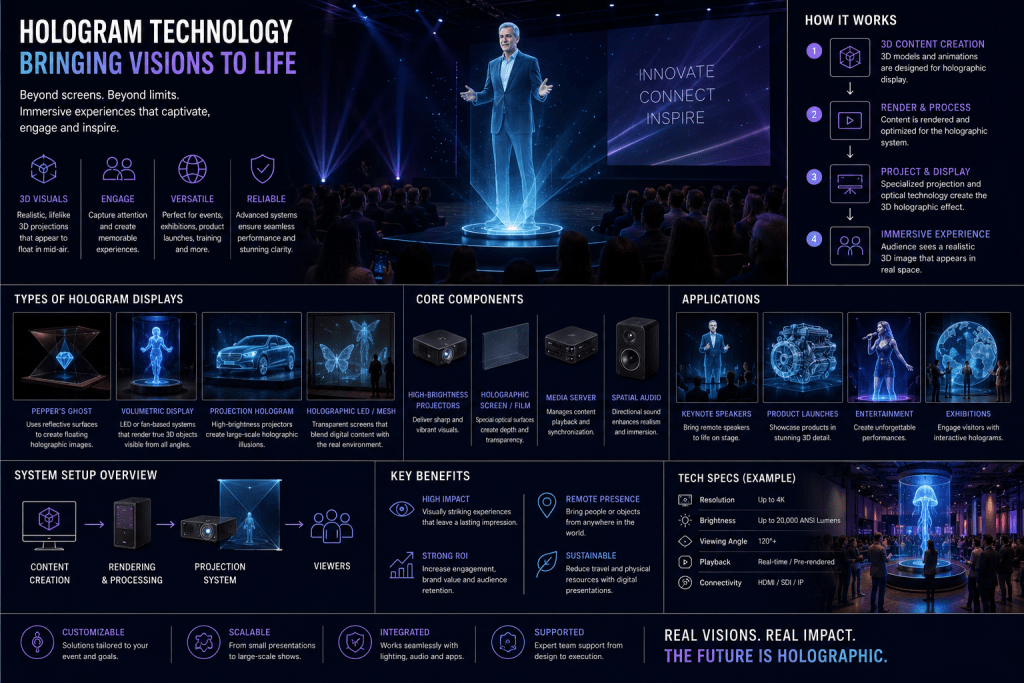
In event contexts, the term “hologram” often refers to a range of technologies that simulate three-dimensional visual presence.
These may include:
- Pepper’s Ghost-style reflective illusions
- Volumetric displays
- Projection-based holographic effects
- AR-assisted holographic experiences
- Transparent LED and mesh display systems
While true scientific holography exists, most event applications rely on engineered optical illusions designed for large-scale audience viewing.
Core Components of Holographic Event Systems
Display Surfaces and Optical Layers
Holographic effects require specialized surfaces or mediums such as:
- Transparent projection films
- Reflective foils
- Holographic mesh screens
- LED volumetric display systems
These materials create the illusion that visuals are floating in space.
Projection and Rendering Systems
High-brightness projectors or LED systems generate the visual content.
Key requirements include:
- High resolution and brightness
- Precise angle alignment
- Real-time rendering capability
Content must be specifically designed for holographic presentation to maintain depth and realism.
Media Servers and Synchronization
Media servers manage playback and synchronization across visual, lighting, and audio systems.
These systems ensure:
- Frame-accurate playback
- Multi-layer rendering
- Integration with stage automation and show control
Spatial Audio Integration
Audio is critical in reinforcing holographic realism.
Spatial audio systems help align sound with holographic visuals, creating stronger immersion and directional consistency.
Types of Holographic Experiences in Events
Holographic Keynote Speakers
Remote speakers can appear on stage as life-sized holographic projections, creating the perception of physical presence.
This is increasingly used in:
- Global conferences
- Corporate summits
- Hybrid leadership events
Product Visualization
Brands use holograms to showcase products in dynamic, interactive ways.
Benefits include:
- Visualizing internal structures
- Demonstrating product transformations
- Displaying prototypes before manufacturing
Entertainment and Performance
Concerts and entertainment events use holograms for:
- Virtual performers
- Mixed reality stage effects
- Interactive visual storytelling
This enables experiences that would be impossible with physical staging alone.
Exhibition and Experiential Installations
Holographic installations attract attention and create immersive engagement in exhibition environments.
These systems are often combined with touchless interaction technologies.
System Architecture: Real-Time Spatial Media Pipeline
Holographic event systems operate through a coordinated visual pipeline.
- Content is created in 3D environments
- Rendering systems generate perspective-specific visuals
- Media servers synchronize playback
- Projection or display systems render the illusion
- Audio and lighting systems reinforce immersion
Precise calibration is essential to maintain realism and alignment.
Integration with Event Technology Ecosystems
Hologram systems are deeply integrated with broader event technologies.
Lighting and Stage Systems
Lighting must be carefully managed to preserve holographic visibility and prevent reflections or washout.
XR and Mixed Reality Platforms
Holograms increasingly interact with augmented and mixed reality environments, blending physical and digital experiences.
AI and Interactive Systems
Sensors and AI-driven systems enable holograms to respond dynamically to audience movement, voice commands, or live data.
Streaming and Hybrid Infrastructure
Remote holographic participation relies on high-bandwidth streaming and low-latency synchronization.
Experience and Business Impact
Audience Engagement
Holograms create strong emotional and visual impact due to their novelty and immersive qualities.
They enhance:
- Attention retention
- Memorability
- Perceived innovation
Brand Positioning
Organizations using holographic technology are often perceived as technologically advanced and forward-thinking.
Operational Flexibility
Remote holographic appearances reduce travel requirements while maintaining stage presence.
Content Scalability
Digital holographic content can be reused and adapted across multiple events and venues.
Technical Challenges
Environmental Constraints
Ambient light, viewing angles, and venue configuration significantly affect hologram quality.
High Infrastructure Requirements
Large-scale holographic systems require:
- High-performance rendering hardware
- Specialized projection materials
- Skilled technical operation
Content Production Complexity
Holographic content must be created specifically for spatial illusion, increasing production complexity and cost.
Latency and Synchronization
Hybrid holographic experiences depend on extremely low-latency systems to maintain realism.
Future Trends: Toward Persistent Spatial Experiences
Volumetric Capture and Real-Time Presence
Advances in volumetric video will allow fully three-dimensional live holographic communication.
AI-Generated Spatial Content
AI tools will accelerate holographic content creation and enable dynamic adaptation during live events.
Interactive Holographic Interfaces
Future systems may allow audiences to interact directly with holographic objects and presenters.
Convergence with Spatial Computing
Holograms will increasingly integrate with spatial computing ecosystems, creating unified physical-digital environments.
Conclusion: Expanding the Boundaries of Presence
Hologram technology is transforming events by redefining how presence, storytelling, and interaction are experienced.
By combining optics, projection systems, spatial audio, and real-time rendering, holographic systems create immersive environments that blur the boundary between physical and digital space.
For event technology leaders, holograms are not simply visual effects—they are emerging platforms for communication, engagement, and spatial experience design in the next generation of events.