The “Silent” Trade Show: Using Audio-Beam Technology to Solve Noise Pollution at Large Expos
Noise has long been one of the most persistent operational problems in large-scale trade shows and exhibition environments. As expos become increasingly immersive and technology-driven, exhibitors are deploying larger displays, interactive demonstrations, live presentations, product theaters, and multimedia activations designed to capture attendee attention. While these experiences improve engagement, they also contribute to rising levels of acoustic congestion across exhibition floors.
For attendees, excessive noise creates cognitive fatigue, communication difficulties, reduced session comprehension, and overall experience degradation. For exhibitors, it reduces presentation effectiveness, disrupts demonstrations, weakens lead-generation conversations, and increases competition for attention through escalating audio volume.
Traditional methods of managing exhibition noise — such as physical booth spacing, carpeting, sound barriers, and directional speaker placement — have delivered only limited improvements. In many large convention halls, overlapping sound fields continue to create environments where multiple presentations compete simultaneously within the same acoustic space.
This challenge is now driving interest in a new category of event audio infrastructure: audio-beam technology.
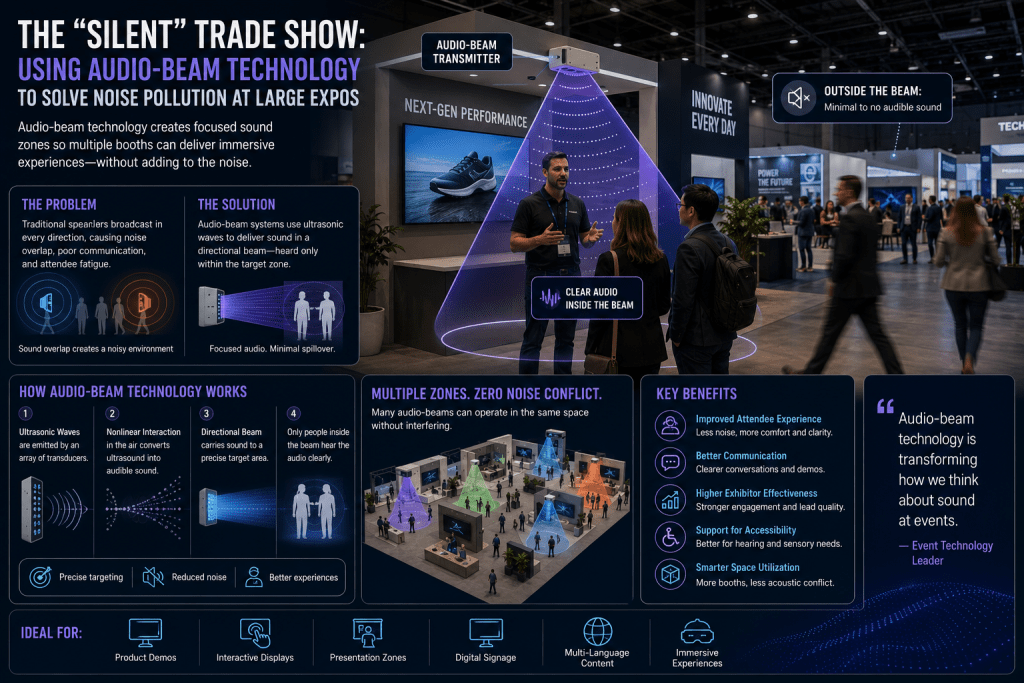
Sometimes referred to as directional sound or ultrasonic audio projection, audio-beam systems create highly focused sound zones that deliver targeted audio to specific listeners without flooding surrounding areas with noise. In exhibition environments, this technology is enabling the emergence of the “silent” trade show floor — a model where exhibitors can provide rich multimedia experiences while dramatically reducing overall venue noise pollution.
As attendee experience design becomes more data-driven and wellness-focused, audio-beam systems are increasingly being viewed as strategic infrastructure rather than novelty installations.
Why Noise Pollution Has Become a Serious Expo Problem
Modern expos are far louder than traditional exhibition environments of the past.
Several trends are contributing to increased acoustic pressure:
- Large LED video walls with integrated audio
- Interactive product demonstrations
- Live-streaming booths
- Hybrid event broadcasting
- Immersive brand activations
- AI-powered engagement experiences
- Open-stage presentations
- Dense exhibitor layouts
In large venues, these overlapping audio sources create continuous high-decibel environments that reduce intelligibility and increase attendee fatigue over time.
Noise pollution affects multiple operational dimensions.
Attendee Experience Degradation
High-noise environments reduce concentration and increase cognitive strain. Attendees often struggle to:
- Hear exhibitor representatives clearly
- Focus during product demonstrations
- Participate in networking conversations
- Absorb technical information
- Remain engaged for extended periods
This is particularly problematic at B2B exhibitions where detailed product discussions are central to the attendee journey.
Reduced Exhibitor Effectiveness
Exhibitors frequently respond to acoustic competition by increasing speaker volume, creating a cascading escalation effect across the exhibition floor.
This results in:
- Poor audio clarity
- Distorted demonstrations
- Lower presentation retention
- Reduced booth dwell time
- Weakened lead conversion quality
Accessibility Challenges
High-noise trade show environments also create accessibility barriers for attendees with:
- Hearing impairments
- Sensory sensitivities
- Neurodivergent conditions
- Cognitive processing challenges
As event accessibility standards evolve, acoustic management is becoming an increasingly important component of inclusive event design.
How Audio-Beam Technology Works
Audio-beam technology fundamentally changes how sound is distributed in physical spaces.
Traditional speakers disperse sound broadly across an area. Audio-beam systems instead create highly directional sound paths that concentrate audio into narrow listening zones.
Most commercial directional audio systems rely on ultrasonic sound projection.
Ultrasonic Audio Projection
These systems emit ultrasonic frequencies above the range of human hearing. As the ultrasonic waves travel through the air, nonlinear acoustic interactions demodulate the signal into audible sound within highly targeted areas.
The result is often described as an “audio spotlight.”
A listener standing within the sound beam hears clear audio, while people outside the beam hear little or no sound leakage.
This enables multiple audio experiences to operate simultaneously within close proximity without creating overlapping noise pollution.
Beamforming and Directional Control
Advanced systems use digital beamforming techniques to shape and steer audio paths dynamically.
Using arrays of small transducers and digital signal processing, the system can:
- Narrow or widen sound beams
- Redirect audio zones
- Track listener positions
- Adjust acoustic focus dynamically
- Reduce reflective interference
This creates more precise control over sound distribution within crowded exhibition environments.
Integration with Spatial Audio Systems
Some high-end deployments combine audio-beam systems with spatial audio processing to create immersive directional experiences.
This allows exhibitors to build localized soundscapes around product demonstrations without affecting neighboring booths.
Applications in Trade Show Environments
Audio-beam technology is being deployed across several expo use cases.
Product Demonstration Zones
One of the most common applications involves targeted product demonstrations.
Instead of broadcasting audio across an entire booth, exhibitors can direct sound toward specific interaction zones where attendees are actively engaging with displays.
This improves clarity while minimizing acoustic spillover.
Interactive Displays and Digital Signage
Directional audio is increasingly integrated into interactive kiosks and digital signage systems.
Attendees approaching a display can hear contextual audio without requiring:
- Headphones
- External speakers
- Enclosed demo spaces
This improves engagement while preserving exhibition floor acoustics.
Multi-Language Content Delivery
At international exhibitions, directional audio systems can support simultaneous multilingual presentations within shared spaces.
Different attendees can receive different audio streams based on location or device synchronization without requiring physically separated presentation rooms.
Silent Presentation Theaters
Some event organizers are experimenting with “silent theater” concepts using directional sound zones.
Attendees standing in designated listening areas can hear keynote or product presentation audio clearly while surrounding expo traffic continues uninterrupted.
This allows educational programming to coexist more effectively with exhibition activity.
Integration with Smart Event Infrastructure
Audio-beam systems are becoming increasingly integrated with broader event technology ecosystems.
Occupancy and Crowd Analytics
Directional audio platforms can integrate with:
- Crowd density sensors
- Computer vision systems
- Heat mapping platforms
- Smart badge tracking
This allows sound distribution to adapt dynamically based on attendee movement patterns.
For example, systems may automatically narrow sound beams during crowded periods to reduce acoustic spillover.
AI-Driven Acoustic Optimization
AI-based acoustic management systems are beginning to analyze real-time environmental conditions including:
- Ambient noise levels
- Reflection patterns
- Foot traffic density
- Audience engagement metrics
The system can then optimize sound direction, intensity, and equalization automatically.
This transforms audio management from static speaker configuration into adaptive acoustic orchestration.
Personalized Audio Experiences
Future systems may integrate with attendee devices and wearable technologies to deliver personalized directional audio experiences linked to:
- Language preferences
- Accessibility settings
- Session interests
- Navigation assistance
This creates opportunities for more customized exhibition engagement.
Operational and Business Benefits
The adoption of directional audio technology provides several measurable advantages.
Improved Attendee Comfort
Reducing acoustic congestion lowers cognitive fatigue and creates more comfortable exhibition environments, particularly during multi-day events.
Increased Presentation Effectiveness
Focused sound delivery improves:
- Speech intelligibility
- Information retention
- Product demonstration quality
- Audience engagement duration
This increases the effectiveness of exhibitor activations.
Better Booth Density Management
Trade show organizers may gain greater flexibility in booth placement because exhibitors can operate multimedia experiences without generating large acoustic footprints.
This can improve exhibition floor planning efficiency.
Enhanced Accessibility
Directional audio systems support more inclusive event environments by reducing background noise and improving listening clarity for attendees with auditory sensitivities or hearing challenges.
Challenges and Limitations
Despite its advantages, audio-beam deployment still faces practical limitations.
Cost and Scalability
High-quality directional audio systems remain more expensive than traditional speaker deployments, particularly for large-scale implementations across entire exhibition halls.
Environmental Complexity
Trade show venues create difficult acoustic conditions due to:
- Reflective surfaces
- High ceilings
- Moving crowds
- Temporary structures
Maintaining precise sound targeting within dynamic environments can be technically challenging.
Listener Position Sensitivity
Audio-beam systems are most effective when listeners remain within designated sound zones. Rapid attendee movement can reduce consistency if beam tracking systems are limited.
Integration Complexity
Successful deployment requires coordination between:
- AV providers
- venue acoustics teams
- exhibitors
- smart infrastructure platforms
This adds operational complexity during event planning and setup.
The Future of Silent Trade Shows
Over the next several years, audio-beam technology is expected to evolve significantly through advances in AI, spatial computing, and smart venue infrastructure.
Future developments may include:
- AI-controlled adaptive sound fields
- Real-time acoustic digital twins
- Listener-tracking beam steering
- Personalized directional audio streams
- Integration with AR experiences
- Venue-wide intelligent acoustic orchestration
As expos continue to become more immersive and multimedia-driven, managing acoustic environments will become increasingly important for attendee wellness and operational quality.
Conclusion
Noise pollution has become one of the defining operational challenges of modern trade shows. As exhibitors deploy increasingly immersive and attention-driven experiences, traditional audio management approaches are no longer sufficient for maintaining high-quality attendee environments.
Audio-beam technology offers a fundamentally different model by enabling highly targeted sound delivery that minimizes acoustic spillover while preserving rich multimedia engagement.
Its value extends beyond quieter exhibition halls. Directional audio improves presentation clarity, supports accessibility goals, reduces attendee fatigue, and enables more sophisticated booth experiences within dense expo environments.
While technical and cost challenges remain, the emergence of intelligent directional sound systems suggests that the future trade show floor may become significantly more acoustically controlled, adaptive, and personalized than today’s convention environments.
The “silent” trade show is no longer a conceptual experiment. It is becoming a realistic next step in the evolution of smart event infrastructure.