RFID Access Control Frameworks for High-Security Corporate and Government Events
Introduction
Security expectations for corporate summits, executive leadership forums, defense conferences, diplomatic meetings, shareholder assemblies, and government events have increased significantly over the past decade. Organizers are no longer responsible only for attendee registration and crowd management; they must also protect sensitive discussions, intellectual property, restricted facilities, and high-profile participants while maintaining a seamless attendee experience. Traditional paper badges and barcode-based credentials, although effective for general admission, often lack the speed, flexibility, and security required for environments where access permissions change dynamically and unauthorized entry carries significant operational or national security risks.
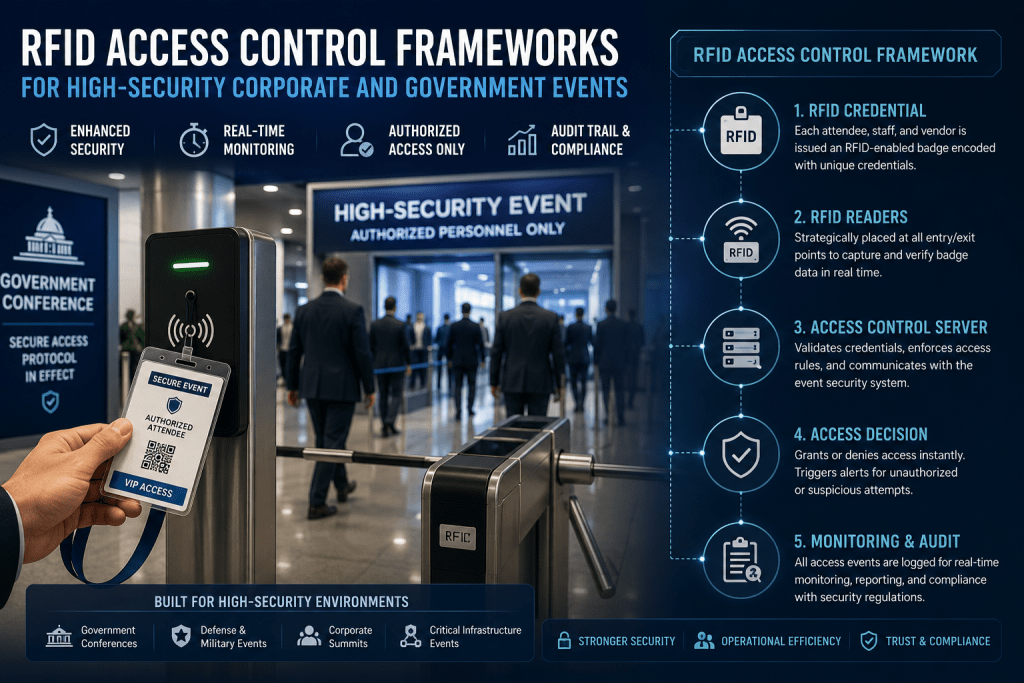
Radio Frequency Identification (RFID) access control frameworks have become a cornerstone of modern high-security event management. By embedding RFID chips within smart badges, wristbands, or credentials, organizers can authenticate attendees within milliseconds while integrating identity verification, zone-based permissions, occupancy monitoring, emergency accountability, and audit logging into a unified security architecture.
For event technology professionals, RFID is far more than a replacement for barcode scanning. A well-designed RFID framework functions as an intelligent access management ecosystem that integrates registration platforms, physical security infrastructure, identity management, analytics, and compliance processes. The value lies not simply in faster entry but in establishing a secure, scalable, and centrally managed authorization system capable of supporting complex event operations.
Why Traditional Access Control Falls Short
Conventional event access typically relies on printed badges, QR codes, or visual inspections performed by security personnel. While suitable for public conferences, these approaches introduce limitations in high-security environments.
Manual verification is slower during peak arrivals and vulnerable to human error. Printed credentials can be shared, duplicated, or counterfeited. Static permissions also make it difficult to accommodate schedule changes, restricted meetings, or evolving security requirements without reissuing credentials.
Government and executive events often require multiple security zones with varying authorization levels. A participant may be permitted to attend general sessions but restricted from executive briefings, media centers, or classified demonstration areas. Managing these permissions manually quickly becomes impractical as attendee numbers increase.
RFID technology addresses these challenges through automated authentication and centralized authorization management.
Understanding RFID Access Control
RFID enables wireless communication between embedded credential chips and strategically placed readers. Unlike barcode systems that require line-of-sight scanning, RFID credentials can be detected rapidly when presented near authorized readers.
A typical framework consists of:
- RFID-enabled badges or smart credentials
- Fixed and handheld RFID readers
- Access control software
- Identity and permissions database
- Event management platform
- Security monitoring dashboard
When an attendee presents a credential at an entry point, the reader captures the badge identifier and transmits it securely to the authorization platform. The system evaluates permissions in real time before granting or denying access, often completing the entire transaction in less than one second.
Core Architecture of an RFID Access Control Framework
A secure RFID deployment depends on several interconnected technology layers.
Credential Management
Each RFID badge contains a unique encrypted identifier linked to the attendee profile.
Credential records may include:
- Identity information
- Organization
- Security clearance
- Registration status
- Access permissions
- Emergency contact data
- Credential validity period
Sensitive personal information should remain within protected backend systems rather than being stored directly on the badge.
Authorization Engine
The authorization platform evaluates every access request using configurable security policies.
Rules may consider:
- Authorized zones
- Time-based permissions
- Event schedules
- Meeting invitations
- Security classifications
- Badge expiration
- Credential status
Centralized policy management allows organizers to modify permissions instantly without replacing physical credentials.
Reader Infrastructure
RFID readers may be installed at:
- Registration entrances
- Session rooms
- Executive lounges
- Operations centers
- Media facilities
- Security checkpoints
- Parking areas
- Restricted demonstration zones
Reader placement should balance operational efficiency with comprehensive coverage while minimizing unauthorized bypass routes.
Zone-Based Security
One of RFID’s greatest advantages is dynamic zone management.
Instead of assigning identical permissions to all attendees, organizers define multiple access levels based on operational requirements.
Typical zones include:
- Public conference areas
- Exhibition halls
- Speaker preparation rooms
- Executive meeting spaces
- Government delegation rooms
- Technical operations centers
- Press facilities
- Restricted security areas
Permissions can also change throughout the day. An attendee may receive temporary access to a private workshop during a scheduled session before those privileges expire automatically afterward.
This significantly reduces administrative effort while improving overall security.
Real-Time Monitoring and Incident Response
RFID frameworks continuously generate operational intelligence beyond simple entry records.
Security teams can monitor:
- Current occupancy
- Badge activity
- Unauthorized access attempts
- Tailgating incidents
- Credential misuse
- Zone utilization
- Movement history
During emergencies, organizers can rapidly determine which attendees remain inside specific areas, supporting evacuation procedures and accountability.
Real-time alerts also enable security personnel to respond immediately if unauthorized badges repeatedly attempt to access restricted locations or if credentials previously reported lost continue appearing within the venue.
Integration with Event Technology Systems
RFID delivers maximum value when integrated with broader event infrastructure.
Registration Platforms
Approved registrations automatically generate RFID credentials linked to attendee profiles, eliminating duplicate identity management.
Identity and Access Management (IAM)
Large enterprises frequently synchronize RFID permissions with corporate identity platforms to ensure employees, contractors, and invited guests receive appropriate authorization levels based on existing organizational policies.
Visitor Management Systems
Government facilities and corporate headquarters often require temporary visitor credentials.
RFID frameworks automate issuance, expiration, and revocation while maintaining complete audit histories.
Event Analytics
Access data supports valuable operational insights including:
- Session attendance
- Traffic flow
- Zone utilization
- Capacity management
- VIP movement patterns
- Queue analysis
These analytics help optimize staffing, scheduling, and venue design for future events.
Security Best Practices
Because RFID credentials influence physical security, framework design must prioritize resilience.
Encryption
Badge identifiers and communication channels should use modern encryption protocols to reduce interception and cloning risks.
Mutual Authentication
Readers and credentials should authenticate one another before exchanging sensitive information, helping prevent rogue devices from capturing credential data.
Role-Based Administration
Administrative access should follow least-privilege principles, ensuring only authorized personnel can modify permissions or security policies.
Audit Logging
Every credential transaction should generate immutable audit records documenting:
- Access requests
- Granted permissions
- Denied attempts
- Administrative changes
- Credential lifecycle events
Comprehensive logging supports compliance investigations and post-event security reviews.
Privacy and Regulatory Considerations
RFID systems process behavioral information describing attendee movement throughout the venue. While operationally valuable, this data introduces privacy obligations.
Organizers should communicate:
- What information is collected
- Why location data is processed
- How long records are retained
- Who may access movement logs
- Available attendee rights
Location tracking should remain proportionate to legitimate security requirements rather than enabling unnecessary surveillance.
Where applicable, organizations should implement privacy-by-design principles, collecting only the information required to achieve operational objectives while applying strong retention and deletion policies after the event concludes.
Implementation Challenges
Successful RFID deployment requires careful planning beyond hardware installation.
Large venues may require site surveys to evaluate reader placement, signal interference, and physical access routes. Metal structures, dense crowds, and competing wireless systems can affect read performance if not properly addressed.
Credential distribution also requires disciplined operational processes. Lost or stolen badges should be deactivated immediately while replacement credentials inherit appropriate permissions without creating duplicate identities.
Interoperability across registration platforms, physical security systems, and identity management software should be validated through comprehensive testing before deployment.
Finally, contingency planning remains essential. Manual verification procedures should remain available during network disruptions or hardware failures to ensure uninterrupted event operations.
Future Trends
RFID access control is increasingly converging with digital identity technologies.
Future deployments are expected to integrate with:
- Mobile digital credentials
- NFC-enabled smart badges
- Facial recognition verification
- Decentralized identity (DID) frameworks
- Artificial intelligence-driven risk assessment
- Internet of Things (IoT) security sensors
Artificial intelligence may also evaluate access patterns in real time to identify anomalous behavior, enabling proactive threat detection before security incidents escalate.
As organizations adopt zero-trust security architectures across physical and digital environments, RFID frameworks will play an increasingly important role in unified identity and access management strategies.
Conclusion
RFID access control frameworks have become essential components of high-security corporate and government events by combining rapid authentication with centralized authorization, real-time monitoring, and comprehensive audit capabilities. Unlike traditional badge systems, RFID enables dynamic permission management, stronger operational visibility, and seamless integration with registration platforms, identity management systems, and physical security infrastructure. While successful implementation requires careful attention to encryption, privacy, governance, and interoperability, the resulting framework significantly enhances both security and attendee experience. As event technology continues advancing toward intelligent, connected security ecosystems, RFID will remain a foundational technology supporting secure, efficient, and adaptable access management for the world’s most sensitive and mission-critical events.