Understanding DECT NR+: What it means for wireless audio in events
Background and context
DECT NR+ is a new development within the long‑established DECT wireless standard that is beginning to attract attention in the professional audio and event technology sectors.
It sits alongside existing DECT profiles rather than replacing them, and is designed to make wireless operation more efficient in crowded RF environments.
DECT (Digital Enhanced Cordless Telecommunications) has been used for years in cordless phones, wireless intercoms and some audio systems.
As demand for wireless devices has grown in live events, broadcast and corporate environments, the need to use spectrum more efficiently has become a key issue for manufacturers and users.
Sennheiser, which develops wireless microphone and intercom solutions based on DECT, has published an explainer on DECT NR+ aimed at clarifying what the technology does and does not change for end users.
The company positions DECT NR+ as an enhancement of the underlying standard, not a new product category in itself.
Key announcement
DECT NR+ is presented as an evolution of DECT that focuses on improving spectrum use and reliability rather than introducing a completely new radio technology.
It is defined within the official DECT standard framework and must remain backward compatible with existing DECT operation.
According to Sennheiser, the approach behind DECT NR+ is to enable more robust and efficient communication in environments where many DECT devices operate simultaneously.
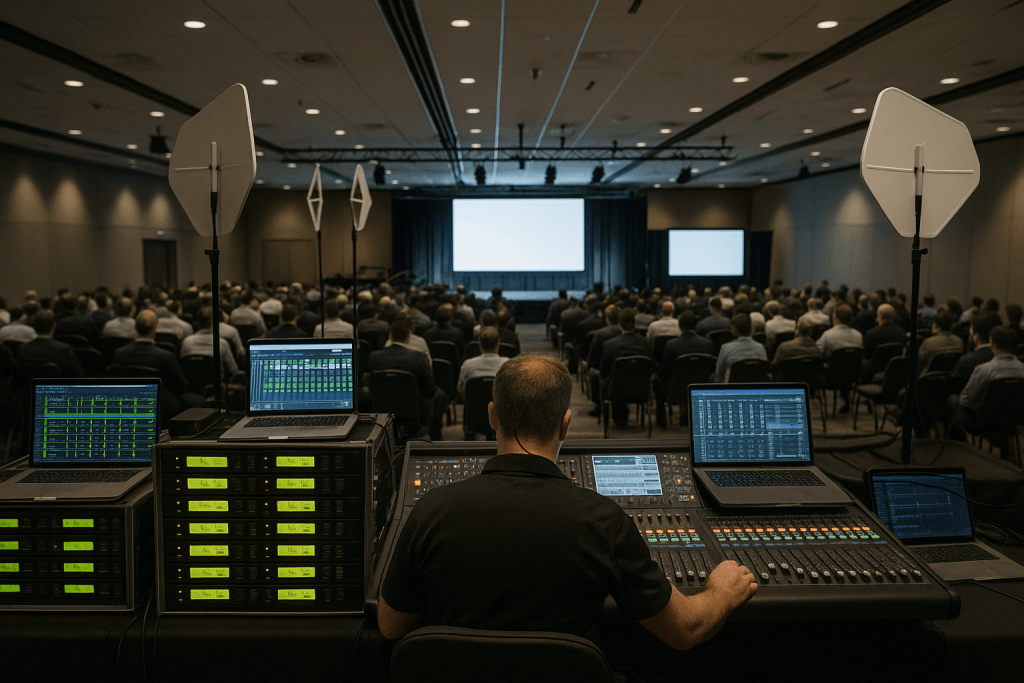
This is particularly relevant for busy venues, multi-room conference centres and large productions where wireless capacity is often stretched.
Instead of promising dramatic increases in channel counts or range, the technology aims to optimise how devices access and share radio resources.
In practical terms, this could help reduce interference, improve connection stability and support denser deployments of DECT-based systems.
Sennheiser emphasises that DECT NR+ will be one option among several DECT profiles, and that manufacturers can choose how and when to implement it in products.
More detailed technical information and ongoing updates are being made available via the company’s official website at sennheiser.com.
Industry impact
For event professionals, the relevance of DECT NR+ lies in day-to-day challenges: fitting more wireless systems into limited spectrum, operating reliably in congested RF environments and managing multiple rooms or stages without dropouts.
DECT-based solutions are already common in production intercoms, tour guide systems and some wireless audio links.
If DECT NR+ delivers better spectrum efficiency under real-world conditions, it could allow venues and rental companies to scale up the number of units on site with fewer coordination headaches.
Because DECT operates in licence-free frequency bands in many regions, it is often used alongside UHF microphones, Wi‑Fi and other wireless technologies.
Improvements in how DECT shares its own band can indirectly ease pressure on the wider RF ecosystem at busy events.
Manufacturers may also see DECT NR+ as a way to extend the life of DECT-based platforms while broader changes in spectrum policy and wireless standards continue to unfold.
Why this matters
While the term “NR+” might suggest a radical new system, the core message from Sennheiser is that this is an incremental but important refinement of an existing standard.
For technical managers and RF coordinators, the key questions will be how quickly products adopt DECT NR+ and what measurable benefits it brings in real deployments.
The development underscores a wider trend in event technology: incremental improvements to established standards can be as significant as headline-grabbing new formats, especially when they address spectrum efficiency and reliability.
As venues and productions continue to increase their reliance on wireless systems, any tools that help stabilise performance in dense RF conditions are likely to attract interest.
- For rental houses, DECT NR+ could support higher device densities and more flexible deployment strategies.
- For fixed installations, it may offer more predictable performance in multi-room and multi-tenant facilities.
- For engineers on site, the benefits will be judged by fewer dropouts, easier coordination and more consistent audio and intercom links.
As DECT NR+ moves from standard to implementation, the practical impact will depend on product design, firmware, and how mixed fleets of legacy and NR+ devices are managed.
For now, the technology represents a notable step in the gradual evolution of wireless tools used across the live, corporate and broadcast event sectors.