Event Knowledge Graphs: Structuring Event Data for Contextual Intelligence
Introduction: The Missing Layer in Event Intelligence
Event technology has made significant progress in capturing and processing data. Registration systems, engagement platforms, analytics tools, and behavioral intelligence engines all contribute to a growing pool of information. Yet, despite this abundance, a critical gap remains: context.
Most event systems store data in relational or document-based structures that capture entities and transactions but fail to represent the relationships between them in a meaningful way. Attendees are linked to sessions, sessions to speakers, and interactions to timestamps—but these connections are often implicit, fragmented, or difficult to traverse.
Event knowledge graphs address this limitation by explicitly modeling relationships between entities. They provide a structured, interconnected representation of the event ecosystem, enabling systems to understand not just data points, but how those data points relate to one another.
This shift—from storing data to structuring knowledge—enables a new class of intelligent applications that rely on context, inference, and connectivity.
What Is an Event Knowledge Graph?
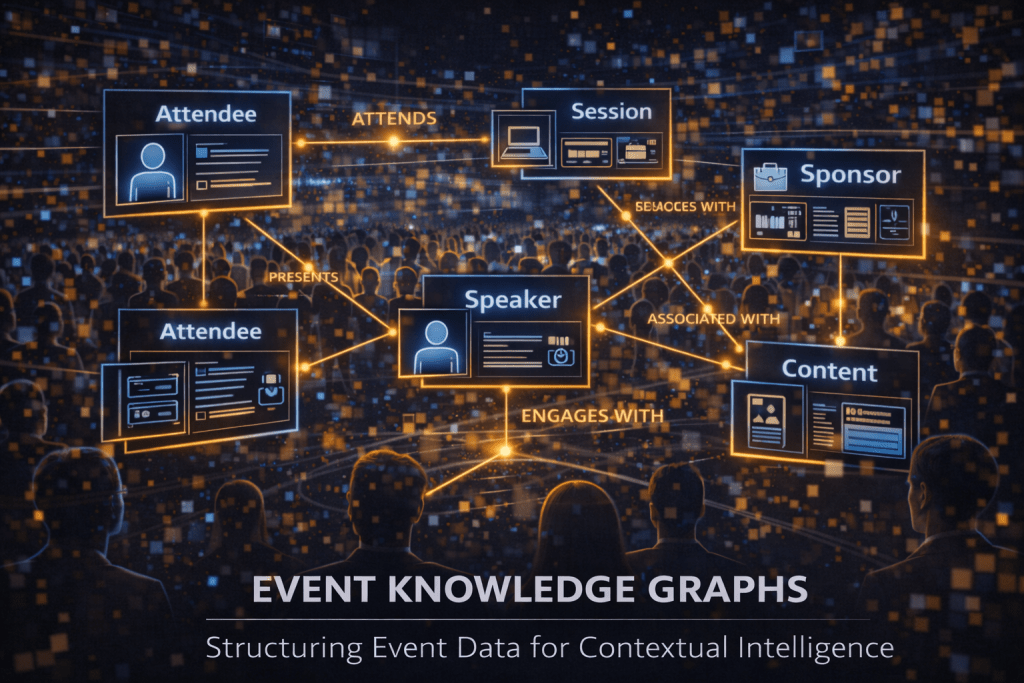
A knowledge graph is a data structure that represents entities and their relationships as nodes and edges within a graph. In an event context, these entities may include:
- Attendees
- Sessions
- Speakers
- Sponsors
- Content assets
- Locations
Relationships define how these entities interact:
- An attendee attends a session
- A speaker presents at a session
- A sponsor is associated with a booth
- A session belongs to a track
Unlike traditional databases, which require predefined queries, knowledge graphs enable flexible exploration of relationships. This allows systems to answer complex questions that involve multiple levels of connection.
For example, instead of simply identifying which sessions an attendee attended, a knowledge graph can infer which topics they are interested in, which speakers they are likely to engage with, and which sponsors align with their preferences.
Building the Graph: Data Modeling and Ontologies
The foundation of a knowledge graph lies in its schema, often referred to as an ontology. This defines the types of entities and relationships that exist within the system.
Designing an ontology for events requires careful consideration of both structure and flexibility. The model must be comprehensive enough to capture the complexity of event interactions, yet adaptable to different event formats and use cases.
Entities are defined with attributes that describe their properties. Relationships are defined with semantics that describe how entities are connected. For example, the relationship “attends” may include attributes such as time, duration, and engagement level.
A well-designed ontology enables consistent data representation across systems, facilitating integration and interoperability.
Data Ingestion and Graph Construction
Constructing a knowledge graph involves integrating data from multiple sources and transforming it into a graph structure.
Event data platforms play a critical role in this process, providing the unified data layer from which graph entities and relationships are derived. Data ingestion pipelines extract relevant information, map it to the ontology, and populate the graph.
This process is not static. As new data is generated במהלך the event—such as interactions, movements, and engagement signals—the graph is updated in real time. This dynamic nature allows the graph to reflect the evolving state of the event.
Graph databases, such as those optimized for relationship queries, are typically used to store and manage this data. These systems enable efficient traversal of connections, which is essential for real-time applications.
Contextual Intelligence and Inference
The primary advantage of knowledge graphs lies in their ability to support contextual intelligence. By explicitly modeling relationships, they enable systems to infer new insights that are not directly stored in the data.
Inference can occur through rule-based logic or machine learning models. For example, if an attendee attends multiple sessions within a specific track, the system can infer an interest in that topic. If they interact with certain sponsors, the system can identify potential alignment with specific products or services.
Graph-based algorithms, such as link prediction and community detection, can uncover hidden patterns within the data. These insights can be used to enhance personalization, networking, and content recommendations.
The ability to traverse relationships also enables more sophisticated queries. Systems can explore multi-hop connections, identifying indirect relationships that would be difficult to capture باستخدام traditional data models.
Applications in Event Environments
Knowledge graphs enable a range of advanced applications that rely on contextual understanding.
In personalization, they provide a richer foundation for recommendations. Instead of relying solely on direct interactions, systems can consider related entities and inferred interests, resulting in more accurate and relevant suggestions.
Networking systems benefit from graph-based insights. By analyzing connections between attendees, sessions, and shared interests, systems can identify high-value networking opportunities that may not be immediately obvious.
Content discovery is enhanced through semantic relationships. Attendees can explore topics, speakers, and sessions in a more intuitive way, navigating through interconnected content rather than static lists.
Operational systems can also leverage knowledge graphs. Understanding relationships between entities allows for more informed decision-making, such as optimizing schedules or identifying dependencies between sessions.
Integration with Event Intelligence Systems
Knowledge graphs act as a connective layer within the event technology ecosystem. They integrate with various systems to enhance their capabilities.
Behavioral intelligence systems use graph structures to refine intent modeling, incorporating relational context into their analysis. Real-time personalization engines leverage graph data to improve recommendation accuracy.
Autonomous networking systems rely on graph-based representations to identify and evaluate connections between attendees. Orchestration systems use graph insights to coordinate actions across different components.
This integration creates a cohesive intelligence layer that supports multiple applications, ensuring that insights are consistent and contextually informed.
Challenges in Implementation
Despite their advantages, knowledge graphs introduce several challenges. Designing an effective ontology requires deep domain expertise and careful planning. Overly complex models can become difficult to manage, while overly simplistic models may fail to capture important relationships.
Data integration is another challenge. Mapping data from diverse sources into a consistent graph structure requires robust transformation and validation processes.
Performance considerations are also महत्वपूर्ण. Graph queries, particularly those involving multiple levels of traversal, can be computationally intensive. Systems must be optimized to handle real-time workloads.
Finally, maintaining the graph over time requires continuous updates and governance. As event structures and requirements evolve, the graph must adapt دون compromising consistency.
Future Outlook: Toward Semantic Event Systems
The evolution of knowledge graphs points toward a future where event systems are inherently semantic. Data will not only be stored and processed but understood in context.
Advances in graph-based machine learning, such as graph neural networks, will enable more sophisticated analysis and prediction. These models can learn from the structure of the graph itself, uncovering patterns that are not visible in traditional data representations.
Integration with natural language interfaces may also become more prevalent. Users could query event systems in conversational language, with knowledge graphs providing the underlying structure for understanding and responding to these queries.
As event ecosystems become more interconnected, knowledge graphs will play a central role in enabling interoperability and shared intelligence across platforms.
Conclusion: From Data to Connected Knowledge
Event knowledge graphs represent a critical evolution in how event data is structured and utilized. By explicitly modeling relationships, they provide the context needed to unlock deeper insights and more intelligent applications.
This approach transforms event systems from collections of data points into interconnected knowledge networks. It enables richer personalization, more effective networking, and more informed decision-making.
For event technology leaders, adopting knowledge graphs is not just a technical choice but a strategic one. It lays the foundation for a new generation of event intelligence systems that are capable of understanding, reasoning, and adapting in ways that traditional architectures cannot.