Multimodal Event Intelligence: Integrating Vision, Audio, and Behavioral Signals
Introduction: Beyond Single-Channel Analytics
Event technology has historically relied on discrete data streams—registration records, app interactions, or session attendance—to understand attendee behavior. While these signals provide useful insights, they capture only fragments of a much richer reality. Human behavior in events is inherently multimodal, expressed through movement, speech, gestures, and interactions with both digital and physical environments.
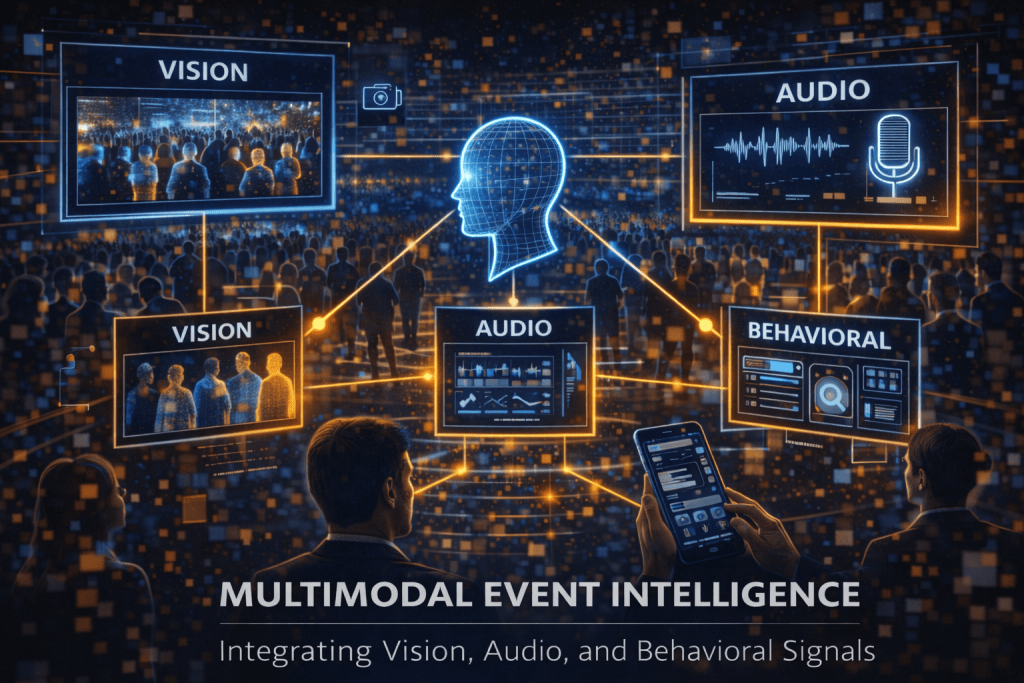
As events become more instrumented and AI capabilities advance, a new paradigm is emerging: multimodal event intelligence. This approach integrates diverse data modalities—visual, auditory, spatial, and behavioral—into a unified analytical framework. The objective is not merely to collect more data, but to construct a more complete and context-aware understanding of what is happening within an event.
By combining these modalities, event systems can move closer to real-world perception, enabling more accurate insights, more responsive operations, and more personalized experiences.
Understanding Multimodal Intelligence in Events
Multimodal intelligence refers to the ability of systems to process and interpret multiple types of data simultaneously. In an event context, this involves correlating signals from different sources to derive higher-level insights.
Visual data, captured through cameras and computer vision systems, provides information about crowd density, movement patterns, and physical interactions. Audio data, including speech and ambient sound, reveals sentiment, engagement levels, and conversational dynamics. Behavioral data, derived from digital interactions and tracking systems, captures intent and preferences.
Individually, each modality offers limited perspective. When combined, they enable a more nuanced understanding. For example, a crowded session may indicate popularity, but when combined with audio analysis showing low engagement or sentiment, it may suggest passive attendance rather than active interest.
Data Acquisition and Sensor Integration
The foundation of multimodal intelligence lies in data acquisition. Event environments increasingly incorporate a range of sensors and input systems, each capturing different aspects of attendee behavior.
Camera systems provide continuous visual input, which can be processed using computer vision techniques to detect movement, estimate crowd density, and identify patterns of interaction. These systems must balance accuracy with privacy considerations, often relying on anonymized or aggregated data.
Audio capture systems, including microphones embedded in venues or devices, enable analysis of speech and ambient sound. Natural language processing can extract topics, keywords, and sentiment from conversations or Q&A sessions, while acoustic analysis can detect levels of engagement or attention.
Wearable devices and mobile applications contribute additional layers of data, capturing location, interaction patterns, and user inputs. These signals provide a bridge between physical and digital behavior, enabling more comprehensive analysis.
Integrating these diverse inputs requires a robust sensor network and data ingestion framework capable of handling high volumes of real-time data.
Fusion Layer: Combining Modalities into Unified Insights
The core challenge of multimodal systems is not data collection, but data fusion—combining disparate signals into coherent insights.
Fusion can occur at multiple levels. Early fusion involves combining raw data from different modalities before processing, while late fusion integrates insights derived from individual models. In event systems, a hybrid approach is often used, balancing computational efficiency with analytical depth.
Machine learning models play a central role in this process. Multimodal models can learn relationships between different types of data, enabling them to interpret complex scenarios. For example, combining visual and behavioral data can improve the accuracy of engagement detection, while integrating audio signals can provide additional context.
Temporal alignment is critical. Data from different sources must be synchronized to ensure that insights reflect the same moment in time. This requires precise timestamping and coordination across systems.
Real-Time Processing and Edge Intelligence
Multimodal event intelligence operates under strict latency requirements. Many use cases—such as crowd management or real-time personalization—depend on immediate insights.
Edge computing is often employed to process data close to its source. Visual and audio data, in particular, can be computationally intensive and bandwidth-heavy. Processing these signals at the edge reduces latency and minimizes the need for data transmission.
Local inference models can analyze inputs and generate insights that are then transmitted to central systems for aggregation and further analysis. This distributed approach enables scalability while maintaining responsiveness.
Applications in Event Environments
The integration of multiple data modalities unlocks a range of advanced applications.
In crowd management, combining visual data with location tracking enables precise monitoring of movement patterns. Systems can detect emerging congestion points and predict crowd behavior, allowing for proactive interventions.
Engagement analysis benefits from multimodal inputs. Visual cues, such as body orientation and movement, can be combined with audio signals and interaction data to assess attention and interest levels. This provides a more accurate measure of session effectiveness than attendance alone.
Content optimization becomes more sophisticated כאשר multimodal data is used to evaluate performance. Organizers can understand not only which sessions are attended, but how they are experienced—identifying moments of high engagement or disengagement.
Security systems also gain enhanced capabilities. Anomalies can be detected by correlating behavioral, visual, and audio signals, enabling faster identification of potential risks.
Integration with Event Intelligence Systems
Multimodal intelligence does not operate in isolation. It integrates with broader event technology systems to enhance their capabilities.
Behavioral intelligence platforms incorporate multimodal insights to refine intent modeling, improving the accuracy of personalization and networking recommendations. Real-time orchestration systems use these insights to make more informed decisions, aligning operations with actual conditions.
Event data platforms serve as the central repository, storing and organizing multimodal data for analysis and historical insights. This integration ensures that insights are not only actionable in real time but also contribute to long-term learning.
Operational and Ethical Considerations
The deployment of multimodal intelligence systems introduces significant operational and ethical considerations.
From an operational perspective, managing diverse data sources and ensuring system reliability requires advanced infrastructure and expertise. Calibration, synchronization, and maintenance of sensors are critical for accuracy.
Ethically, the use of visual and audio data raises privacy concerns. Attendees must be informed about data collection practices, and systems must be designed to minimize intrusion. Techniques such as anonymization, aggregation, and on-device processing can help mitigate risks.
Transparency is essential. Attendees should understand how their data is used and have control over their participation in such systems.
Challenges and Constraints
Multimodal systems are inherently complex. Integrating multiple data types, ensuring synchronization, and maintaining performance at scale present significant technical challenges.
Data quality varies across modalities, and noise or inaccuracies in one source can affect overall insights. Robust validation and error-handling mechanisms are आवश्यक.
Cost is another factor. Deploying and maintaining sensor networks, processing infrastructure, and advanced models can be resource-intensive, limiting adoption for smaller events.
Future Outlook: Toward Perceptive Event Systems
The evolution of multimodal intelligence points toward event systems that approximate human perception. As models become more advanced, they will be able to interpret complex scenarios, understand context, and respond with greater nuance.
Integration with emerging technologies, such as spatial computing and digital twins, will further enhance capabilities. Event environments will become more adaptive, responding not only to explicit inputs but to subtle behavioral cues.
Advances in AI will also enable more efficient processing, reducing costs and improving accessibility. As these systems mature, multimodal intelligence will become a core component of event technology infrastructure.
Conclusion: Seeing the Event as a Whole
Multimodal event intelligence represents a shift from fragmented analysis to holistic understanding. By integrating visual, audio, and behavioral signals, it enables a richer and more accurate interpretation of event dynamics.
This approach transforms how events are monitored, managed, and optimized. It provides deeper insights, supports real-time decision-making, and enhances the overall experience for attendees and organizers alike.
As event environments continue to evolve, the ability to see, hear, and understand them in a unified way will become a defining capability. Multimodal intelligence is a key step in that direction.