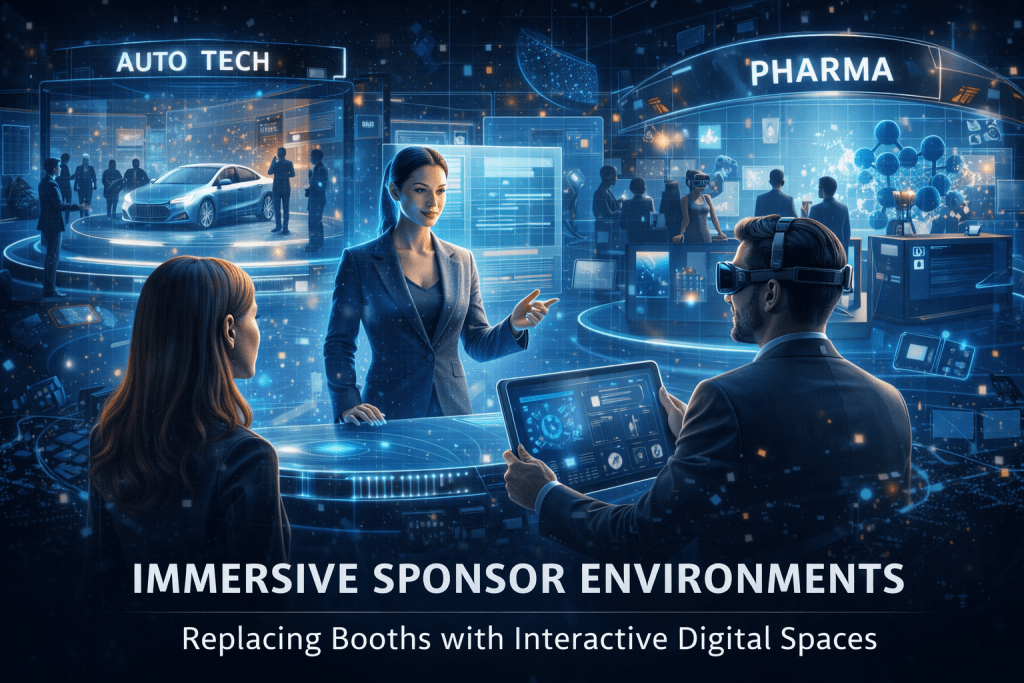
Immersive Sponsor Environments: Replacing Booths with Interactive Digital Spaces
Introduction: The Shift from Physical Presence to Experiential Engagement
For decades, sponsor booths have been the commercial backbone of conferences and exhibitions. They provide visibility, facilitate lead generation, and enable direct interaction between brands and attendees. However, traditional booth models are constrained by physical space, staffing limitations, and inconsistent engagement quality.
As event technology evolves toward hybrid and digital-first formats, sponsors are demanding more measurable, scalable, and engaging alternatives. Immersive sponsor environments—interactive, digitally rendered spaces that replicate or extend physical booths—are emerging as a viable replacement. These environments are not simply virtual booths; they are programmable, data-driven ecosystems designed to optimize engagement, personalization, and conversion.
This shift represents a fundamental rethinking of how sponsors participate in events, moving from static presence to dynamic, software-defined experiences.
What Are Immersive Sponsor Environments?
Immersive sponsor environments are interactive digital spaces where attendees can explore branded content, engage with products, and interact with representatives in real time or asynchronously. These environments can exist across:
-
Virtual event platforms (web-based 3D environments)
-
Augmented reality (AR) overlays within physical venues
-
Virtual reality (VR) experiences for remote attendees
-
Hybrid layers integrated into event mobile apps
Unlike traditional booths, these environments are not constrained by physical dimensions. They can dynamically adapt to user behavior, scale to unlimited attendees, and integrate deeply with event data systems.
Core Technology Components
1. 3D Environment Design and Rendering
At the core of immersive sponsor environments is real-time 3D rendering. Technologies commonly used include:
-
Game engines such as Unity or Unreal Engine
-
Web-based rendering frameworks (WebGL, WebGPU)
-
Lightweight 3D frameworks (Three.js, Babylon.js)
These engines enable:
-
Interactive navigation within branded spaces
-
Realistic product visualization
-
Dynamic content updates
Design considerations include polygon count optimization, lighting models, and cross-device performance.
2. Interaction Systems and User Interfaces
Immersive environments must support multiple interaction modalities:
-
Click/tap-based navigation (for web and mobile)
-
Gesture-based interaction (for AR/VR)
-
Voice and conversational interfaces
Interactive elements include:
-
Product demos and simulations
-
Embedded videos and live streams
-
Downloadable assets and CTAs
The challenge is balancing immersion with usability, especially for users unfamiliar with 3D interfaces.
3. Real-Time Communication Infrastructure
To replicate the human element of booths, immersive environments integrate communication systems such as:
-
WebRTC-based video and audio calls
-
Live chat and messaging
-
AI-driven conversational agents
These systems enable:
-
One-on-one or group interactions
-
Scheduled or on-demand meetings
-
Persistent conversations across sessions
4. Data Integration and Personalization Engines
Immersive sponsor environments are tightly coupled with event data systems:
-
Registration and attendee profiles
-
Behavioral tracking within the environment
-
CRM and marketing automation platforms
Personalization engines can dynamically adjust:
-
Content displayed
-
Product recommendations
-
Interaction prompts
This transforms sponsor engagement from generic to context-aware.
5. Analytics and Measurement Frameworks
Unlike physical booths, digital environments provide granular analytics:
-
Time spent in specific zones
-
Interaction heatmaps
-
Conversion events (downloads, meetings booked)
-
Engagement sequences
These insights enable sponsors to quantify ROI with far greater precision.
System Architecture and Integration
Experience Layer
-
Web/mobile interfaces for 3D navigation
-
VR/AR clients for immersive access
-
Embedded widgets for interaction
Application Layer
-
Interaction logic and state management
-
Personalization engines
-
Communication services (chat, video)
Integration Layer
-
APIs connecting to event platforms
-
CRM and marketing tools (e.g., lead capture systems)
-
Identity and access management
Data Layer
-
Real-time event streams (user interactions)
-
Analytics pipelines
-
Storage for user profiles and engagement data
This modular architecture allows immersive environments to function as standalone experiences or as integrated components within broader event ecosystems.
Real-World Use Cases
Product Demonstration Environments
Sponsors can create interactive product showcases where attendees:
-
Explore features in 3D
-
Simulate use cases
-
Access contextual information
For example, a hardware company can allow users to “disassemble” a product virtually to understand its components.
Branded Experience Zones
Instead of static booths, sponsors can design themed environments:
-
Virtual showrooms
-
Interactive storytelling spaces
-
Gamified experiences
These environments increase dwell time and brand recall.
Hybrid Event Extensions
At physical events, immersive environments can complement booths:
-
AR overlays triggered by QR codes
-
Digital twins of booth experiences for remote attendees
-
Extended content libraries beyond what is physically displayed
AI-Assisted Engagement
AI agents can act as virtual booth staff:
-
Answer attendee queries
-
Recommend products
-
Schedule meetings
This ensures continuous engagement without requiring large teams.
Operational and Business Impact
Scalability and Reach
Digital environments remove physical constraints:
-
Unlimited concurrent visitors
-
Global accessibility
-
Consistent experience across time zones
Improved Lead Quality
With behavioral data and personalization:
-
Leads are more qualified
-
Engagement intent is measurable
-
Follow-ups can be automated and contextual
Cost Optimization
While initial setup costs may be high, long-term benefits include:
-
Reduced staffing requirements
-
Reusable digital assets
-
Lower logistics costs compared to physical booths
Enhanced Sponsor ROI
Sponsors gain:
-
Deeper engagement insights
-
Higher conversion rates
-
Extended engagement beyond event duration
Challenges and Considerations
User Adoption and Usability
Not all attendees are comfortable navigating 3D environments. Poor UX can reduce engagement.
Performance and Accessibility
High-fidelity environments may:
-
Require powerful devices
-
Struggle on low-bandwidth connections
Optimization is critical for inclusivity.
Integration Complexity
Connecting immersive environments with existing event tech stacks can be challenging due to:
-
API limitations
-
Data silos
-
Inconsistent standards
Content Production Overhead
Creating high-quality 3D environments requires:
-
Specialized design skills
-
Longer production timelines
-
Iterative testing
Measurement Standardization
While data is abundant, standard metrics for immersive engagement are still evolving.
Future Trends
Web-Based Immersive Experiences
Advances in WebGPU and browser capabilities will reduce reliance on heavy applications, making immersive environments more accessible.
AI-Driven Environment Generation
Generative AI will enable:
-
Rapid creation of 3D spaces
-
Automated content updates
-
Personalized environment layouts
Persistent Sponsor Spaces
Instead of event-specific booths, sponsors may maintain دائم digital environments that persist across multiple events and platforms.
Integration with Spatial Computing
As spatial computing devices gain adoption, immersive sponsor environments will:
-
Blend seamlessly with physical spaces
-
Enable mixed-reality brand interactions
-
Support continuous engagement beyond events
Conclusion: From Booths to Programmable Experiences
Immersive sponsor environments represent a shift from static, location-bound booths to dynamic, programmable engagement platforms. They enable sponsors to interact with attendees in more meaningful, measurable, and scalable ways.
However, replacing traditional booths entirely is not an immediate transition. Hybrid models—where physical and digital experiences complement each other—are likely to dominate in the near term.
For event organizers and sponsors, the key is not to replicate physical booths digitally, but to rethink engagement from first principles. Immersive environments offer the tools to do so, but their success depends on thoughtful design, robust technology integration, and a clear understanding of attendee behavior.
As event ecosystems become increasingly digital and data-driven, immersive sponsor environments will play a central role in shaping how brands connect with audiences.