Showstop e-learning expands to nine languages
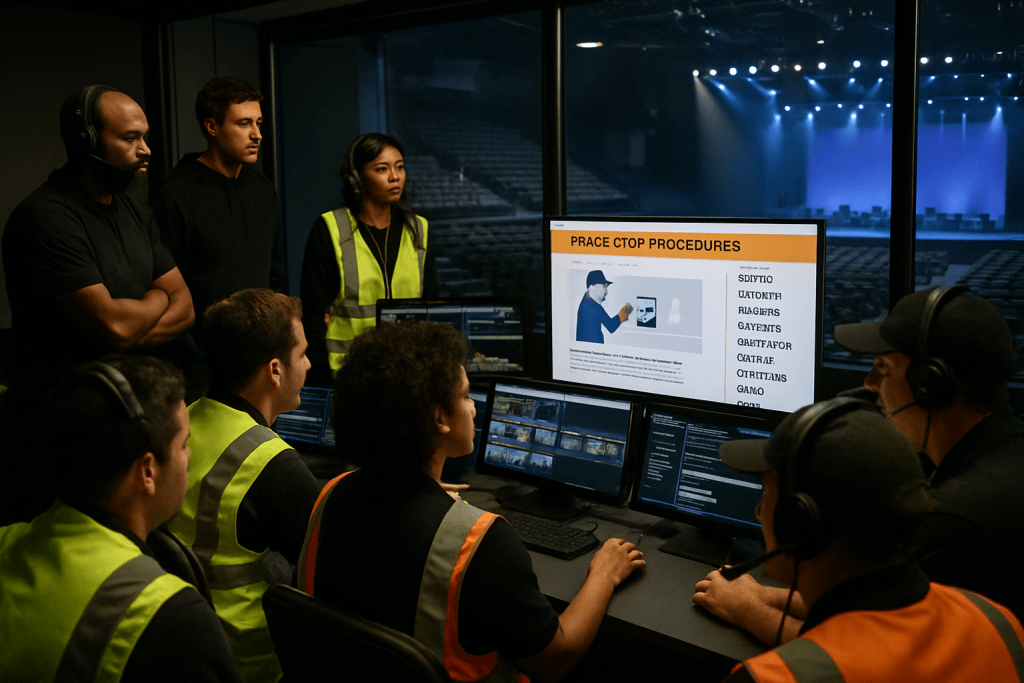
The Showstop Procedure e-learning programme, first introduced in March 2026, has been expanded with new language options, reflecting growing international demand for structured event safety training. The online course, which focuses on a consistent and defensible approach to managing show stops, is now available in nine languages.
Alongside the original English version, the training is now offered in German, French, Spanish, Portuguese, Hindi, Arabic, Dutch and Italian. The move is intended to make the framework more accessible to crews, contractors and organisers working across multilingual teams and cross-border events.
Background and industry context
Show stop procedures have become an increasingly prominent part of safety planning for live events, exhibitions and large-scale productions. These pre-agreed steps guide how a show is paused or halted when safety is compromised, enabling rapid, coordinated action among technical teams, frontline staff and decision-makers.
As events have grown in scale, complexity and international reach, organisers are under pressure from regulators, insurers and clients to demonstrate robust risk management and incident response processes. Standardised training programmes have emerged as one way to align the many different stakeholders involved in an event, from local contractors to touring production crews.
The Showstop Procedure course was launched in 2026 to provide a structured introduction to this approach. Delivered online, it is aimed at professionals who need to understand their role in a show stop scenario and how it integrates with wider event safety planning. The expansion into multiple languages is positioned as a response to use cases beyond English-speaking markets, including large international festivals, touring shows, sport events and exhibitions.
Key developments in the multilingual rollout
The latest update extends the course’s reach to nine languages in total. Newly added are:
- German
- French
- Spanish
- Portuguese
- Hindi
- Arabic
- Dutch
- Italian
These sit alongside the original English version, creating a language portfolio that covers key markets across Europe, the Middle East, South Asia and the Americas. By localising content rather than relying solely on subtitles or ad-hoc interpretation on site, the course aims to reduce misunderstandings around roles, commands and communication protocols during critical moments.
The multilingual approach is particularly relevant for event operations that rely on internationally sourced crew or mixed-language supplier teams. Aligning all participants on a shared safety vocabulary and set of processes can be challenging when training resources exist only in one language. The updated course seeks to bridge that gap while maintaining a consistent core methodology for implementing the Showstop Procedure.
Potential impact on global event safety practice
This expansion has implications for how safety training can be standardised across different territories. Large organisers, venue operators and production companies frequently run events in multiple countries, often with varying regulatory frameworks, cultural expectations and workforce profiles. Being able to deploy the same foundational training in multiple languages can support more consistent implementation of show stop protocols.
The move may also support regulatory compliance and insurance requirements in markets where authorities and risk managers increasingly expect documented training and clear chains of responsibility. While the course itself does not replace local legal obligations, it can form part of a broader safety management system, providing a common reference point for internal procedures and external audits.
For suppliers and freelancers, access to multilingual training can help demonstrate competency when working on international projects. Crew members who may not be fluent in English can now engage with the material in their native language, potentially improving comprehension and retention of critical safety information.
Why this matters for event professionals and technology providers
For event organisers, promoters and venues, the availability of multilingual e-learning in this area supports several operational priorities:
- Consistent safety culture across markets: A unified training framework, accessible in local languages, makes it easier to embed a common safety culture across multiple sites and countries.
- Clearer communication on site: In an emergency or during a show stop, clarity of instruction is essential. Training that reflects the working language of staff can reduce the risk of misinterpretation.
- Scalable onboarding: As teams expand ahead of major events or peak seasons, online modules in multiple languages can streamline onboarding of new staff and contractors.
- Evidence of due diligence: Documented participation in recognised training supports internal governance processes and can assist when demonstrating due diligence to partners, insurers or regulators.
For event technology providers, particularly those offering safety, operations or training platforms, the multilingual Showstop Procedure course highlights several broader trends:
- Integration of training with digital workflows: As more safety-critical processes are codified in software and communication tools, there is an opportunity to integrate e-learning into existing event management systems and crew apps.
- Demand for localisation: Technology and content designed for a single-language market may face adoption limits in global event portfolios. Multilingual support is becoming a baseline expectation rather than an added feature.
- Data-informed safety management: Standardised training across languages can facilitate consistent measurement of competency and engagement, informing decisions on staffing, supervision and process design.
Conclusion
The expansion of the Showstop Procedure e-learning course into nine languages underscores the growing emphasis on structured, accessible safety training in the live events and exhibition sectors. As organisers run increasingly complex programmes with international teams, language-inclusive training becomes a practical requirement rather than a convenience.
While the course is one component within a broader safety management ecosystem, its multilingual rollout is a signal of where the industry is heading: toward more standardised, software-supported and globally applicable approaches to event safety. For professionals responsible for planning, delivering and supporting events, the development offers an additional tool to help create a more consistent safety culture across diverse markets and teams.