First Sight Media strengthens live event tech team
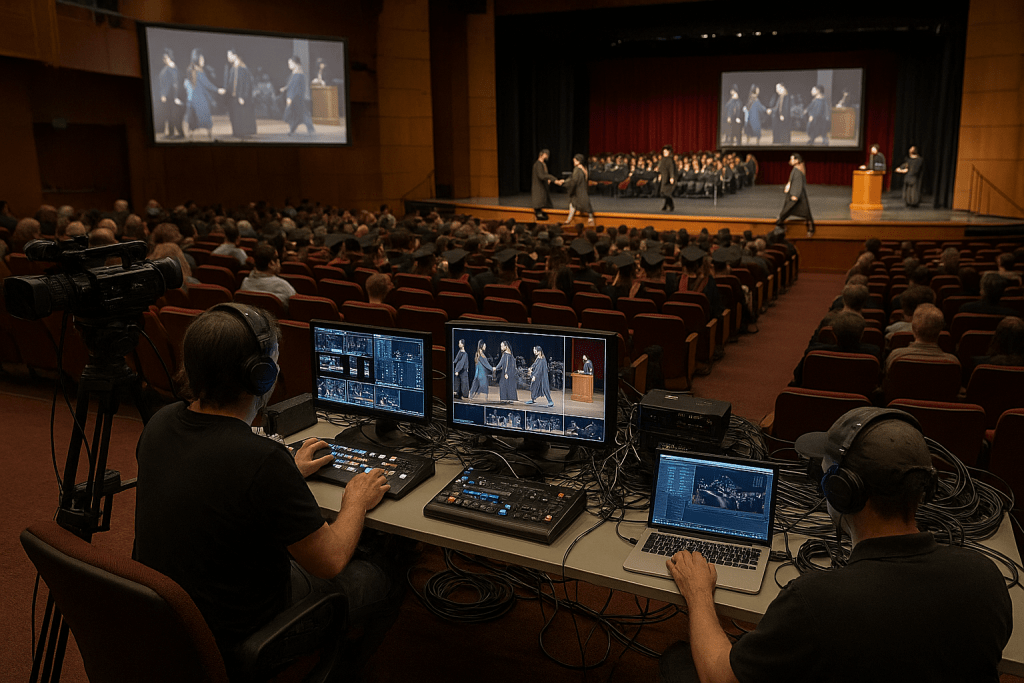
First Sight Media has expanded its technical team with three new appointments, reflecting rising demand for professional video, streaming, and hybrid production services across graduations, conferences, and large-scale live events.
The event content and streaming specialist has added Harrison Ford, Luke Main, and Emma Pullen to its technical operations, increasing its capacity to deliver multi-camera production, broadcast-quality live streams, and complex hybrid event setups for its growing client base.
Background: rising demand for streamed and hybrid events
The move comes as organisers across higher education, corporate, and association sectors continue to invest in streaming and on-demand video as standard components of their event strategies. Graduation ceremonies, once exclusively in-person experiences, are now routinely live-streamed to global audiences, archived for later viewing, and repurposed for marketing and alumni engagement.
Similarly, conferences and exhibitions are increasingly adopting hybrid formats, combining in-room production with remote viewing, virtual participation, and content capture for long-term use. This shift has driven sustained demand for reliable production partners that can manage broadcast, AV integration, and streaming under one roof.
Service providers like First Sight Media, which focus on specialist event content creation, have been scaling teams and infrastructure to handle higher volumes of concurrent events and more technically sophisticated briefs from clients seeking TV-level output and fault-tolerant streaming.
Key developments: three technical appointments
In response to this growth, First Sight Media has recruited three technical professionals whose combined experience spans live events, video production, and streaming operations. Their appointments are intended to deepen the company’s bench of on-site engineers and operators and support more simultaneous projects during peak seasons such as summer graduations and year-end conferences.
Harrison Ford joins the business in a technical role focused on live event delivery. While specific responsibilities have not been publicly detailed, the company indicated that the new hire will support the planning and execution of multi-camera shoots, live mixing, and on-site technical coordination. This typically includes working with camera crews, audio teams, and venue AV staff to ensure consistent output across both in-room screens and broadcast feeds.
Luke Main also joins the technical team, bringing additional hands-on capability across the company’s core services: live streaming, video capture, and content production workflows. With client expectations increasing around latency, reliability, and viewer experience, technical staff are required to manage streaming platforms, redundancy paths, encoding profiles, and integrations with registration or event platforms. The expansion of the team is aimed at strengthening this operational backbone.
Completing the trio of appointments, Emma Pullen adds further depth to technical delivery and project support. While the company has not disclosed role titles or specific project allocations, the combined impact of these hires is to enhance overall capacity, giving the organisation greater flexibility to scale up crews for complex events and to cover multiple sites or overlapping schedules.
Industry impact: capacity and resilience in peak seasons
For universities and colleges, graduation seasons can involve back-to-back ceremonies over several days or weeks, often across multiple venues. Each ceremony may require simultaneous video capture, live streaming, captioning, and rapid turnaround edits. Production firms servicing this market must therefore operate with enough technical staff to crew multiple productions while maintaining consistency of quality.
The three appointments at First Sight Media point to a wider trend in the sector: specialist production and streaming firms are building larger in-house teams rather than relying solely on freelance networks, particularly for mission-critical events where redundancy, service continuity, and institutional reputation are at stake.
In the conference and corporate events arena, organisers are planning more content-heavy programmes with parallel sessions, remote speakers, and on-demand libraries. This raises the technical complexity of each event, requiring greater coordination between production crews, event tech platforms, and venue infrastructure. Additional permanent staff within production businesses can improve planning, reduce risk, and support more integrated workflows.
Why this matters for event professionals and technology providers
For event organisers, the expansion of technical teams at specialist providers offers several potential benefits:
- Increased availability: More technical staff can translate into greater date flexibility and the ability to handle multiple concurrent events, particularly for institutions with large graduation schedules or global conference programmes.
- More consistent quality: An expanded in-house team can help standardise production approaches, from camera placement and audio mixing to branding, graphics, and streaming configuration, reducing variability across events and locations.
- Stronger hybrid capabilities: As events blend in-person and remote participation, organisers need partners able to manage both physical AV and virtual delivery in a single workflow. Extra technical capacity supports this integration.
- Improved resilience: With more engineers and operators, production companies can create built-in redundancy in staffing as well as technology, mitigating operational risk during high-profile broadcasts.
For technology providers and platform vendors, the strengthening of teams like First Sight Media’s can also influence how solutions are specified, integrated, and supported in the field. Production partners with more technical expertise are better positioned to implement advanced features such as multi-stream distribution, platform APIs, analytics integration, and custom microsites or portals for event content.
This, in turn, can lead to closer collaboration between production companies, event platforms, and AV integrators, especially where clients are looking for a unified approach rather than a patchwork of suppliers. As in-house capabilities expand, these firms may also play a larger advisory role in technology selection and workflow design for long-term event content strategies.
Conclusion
The addition of three technical professionals to First Sight Media’s team underscores how sustained demand for event streaming, hybrid formats, and large-scale content capture is reshaping the event production landscape. While each appointment is an operational step for a single company, it reflects broader market dynamics: graduations, conferences, and corporate events now rely on broadcast-grade production as a core expectation, not an add-on.
As organisers plan for future seasons, the capacity and technical strength of their production partners will be a key factor in how effectively they can scale hybrid programmes, extend audience reach, and extract long-term value from event content. The latest expansion at First Sight Media suggests that specialist providers are investing accordingly to keep pace with these evolving requirements.