Los Angeles prepares for a decade of global sports events
Background and context
Los Angeles is entering a sustained period of international attention as it prepares to host several of the world’s largest sporting events over the next decade. The city has been named one of the North American host locations for the FIFA World Cup in 2026, adding to a pipeline that already includes Super Bowl LXI and the 2028 Olympic and Paralympic Games.
For event planners and technology providers, the schedule signals a prolonged phase of large-scale infrastructure use and enhancements across venues, transportation networks, and hospitality services. It also invites scrutiny of how a major metropolitan area adapts its existing assets to meet global broadcast, security, and fan experience expectations.
Key announcement
Officials in Los Angeles have begun using the 2026 World Cup as an early showcase of the city’s readiness to handle multiple, overlapping mega-events. The city plans to activate a variety of districts and neighborhoods around match days, positioning its diverse areas as part of the overall visitor experience rather than concentrating activity solely at stadium sites.
World Cup fixtures are expected to be staged at major regional venues, supported by extensive transport links, hospitality zones, and temporary event infrastructure. Local authorities and venue operators are working with technology partners on core services such as connectivity, digital ticketing, crowd flow management, and broadcast capabilities to handle high global viewership.
In parallel, preparations for Super Bowl LXI and the 2028 Games are informing how systems are deployed and scaled. Solutions piloted for the World Cup may be refined and reused for later events, creating a multi-year testing ground for event technology, from in-venue audiovisual systems to citywide wayfinding and real-time information platforms.
Industry impact
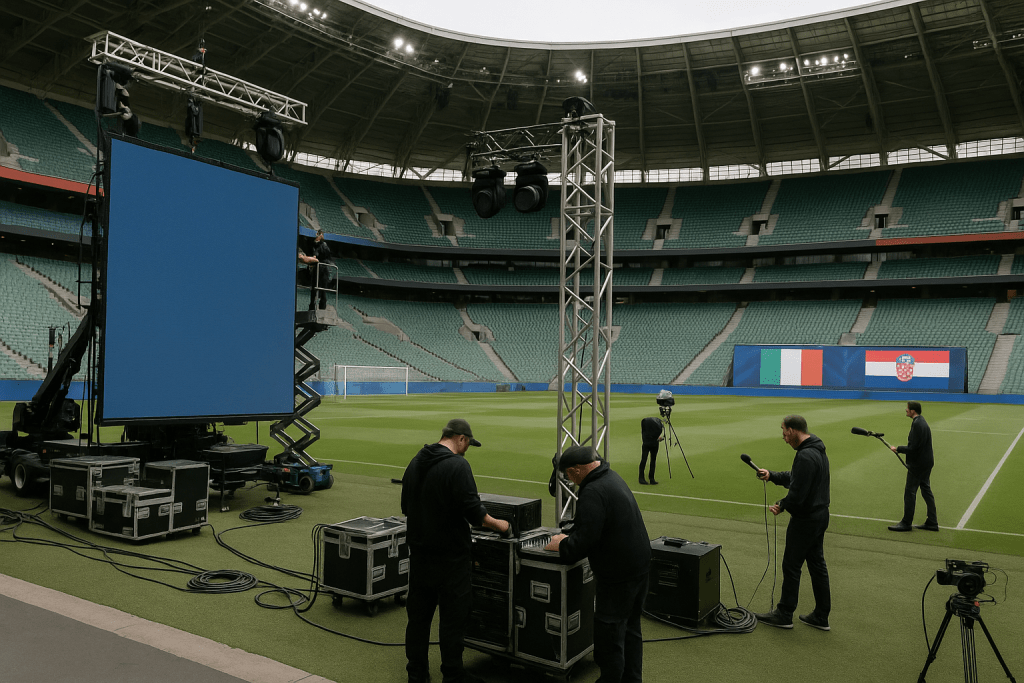
For the live events and AV industry, Los Angeles’ long runway of major sports competitions offers sustained demand for staging, production, and digital engagement tools. Stadiums and fan zones are likely to require robust LED displays, sound reinforcement, broadcast infrastructure, and temporary structures capable of supporting different sports and event formats.
Vendors providing wireless networks, data analytics, and interactive fan experiences may find opportunities to implement and refine solutions over multiple years. The need to serve international audiences also puts pressure on translation services, accessible design, and inclusive wayfinding, driving wider adoption of multilingual signage and mobile interfaces.
In addition, the region’s hotel and convention properties can expect spillover business from corporate hospitality, sponsorship activations, and associated meetings and events. This broader ecosystem may accelerate investments in permanent AV upgrades, hybrid-event capabilities, and higher-capacity network infrastructure.
Why this matters
The sequence of the World Cup, Super Bowl LXI, and the 2028 Olympics positions Los Angeles as a case study in how an urban area manages repeated mega-events within a relatively short timeframe. For event professionals, it offers insights into planning cycles, vendor coordination, and the reuse of infrastructure between global tournaments.
The focus on integrating the city’s neighborhoods into official and unofficial programming underscores a trend toward distributed events, where fan experiences extend beyond primary venues into cultural districts and public spaces. This model relies heavily on scalable AV systems, reliable connectivity, and cohesive digital communications.
As preparations continue, industry observers will watch how Los Angeles balances local needs with international expectations, and how lessons from each event inform the next. More information on upcoming events and venue developments can be found via official Los Angeles tourism and event planning resources online.