Ghent’s Wintercircus debuts as immersive audio nightclub with L-Acoustics L-ISA
Background and context
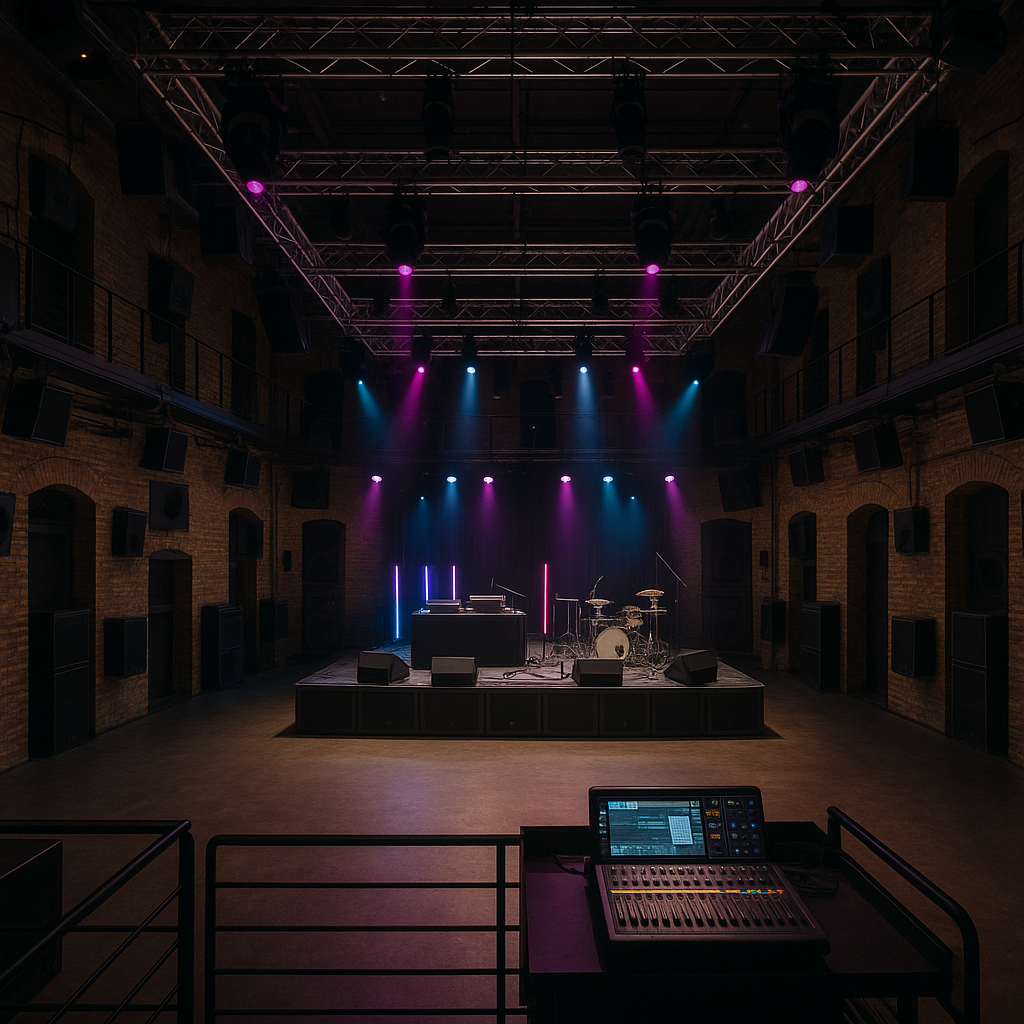
Club Wintercircus, a new 550-capacity venue in Ghent, Belgium, has opened inside the city’s historic Wintercircus building with immersive audio as a central design feature. The circular 19th-century structure forms part of a wider heritage redevelopment, but the club itself is a newly built interior space aimed at both nightlife and live music.
Cultural organisations Viernulvier and Democrazy initiated the project with a specific requirement: an immersive system that could support club-level sound pressure levels as well as concert production standards, and provide consistent coverage across the room.
Belgian integrator XLR Pro won the public tender in 2024 and proposed an installation based on L-Acoustics’ L-ISA Immersive Hyperreal Sound technology. The manufacturer’s object-based platform is already established in touring, theatre and fixed installations, and here it has been used as the primary system rather than an add-on to a conventional left-right rig.
Key announcement
The completed installation at Club Wintercircus is a full L-ISA setup designed to keep every listener effectively “in the mix” regardless of position in the room. Five hangs of A10i loudspeakers form the main front-of-house system, each array combining three A10i Focus with one A10i Wide cabinet for tonal and dispersion consistency.
Low-frequency coverage is delivered by eight KS21i subwoofers installed beneath the stage in a shallow arc. This configuration is intended to distribute bass evenly while keeping the hardware out of sight to preserve the venue’s visual design.
For the immersive field, XLR Pro specified 11 X12 loudspeakers for surround reinforcement and a further 11 X8 units as elevation channels, allowing sound objects to be positioned across width, depth and height. A 32-output L-ISA Processor manages spatialisation, with amplification handled by three LA7.16i and one LA4X amplified controllers.
The signal path is built on a Milan-AVB network, using two LS10 switches integrated into an Agora MK2 Ghost backbone that also carries Dante and GigaAce over redundant 10 Gb fibre. An Allen & Heath dLive console feeds the L-ISA Processor via MADI, while an L-Acoustics P1 device brings stereo sources onto the AVB network when visiting engineers opt for a traditional left-right mix rather than immersive operation.
Industry impact
From an integration perspective, the Wintercircus project illustrates how immersive audio is moving from flagship concert venues into mid-size club environments. The tight project schedule is notable: XLR Pro reports that design, procurement, installation, commissioning and staff training were completed within a five-week window before opening.
The circular architecture of the building posed a series of acoustic and structural challenges. XLR Pro used L-Acoustics’ Soundvision software with L-ISA extensions to model reflections and coverage prior to installation, and chose microphone positions during tuning to account for the room’s geometry. All loudspeakers were mechanically isolated from the building to minimise vibration transfer, a key concern when working within a protected structure running at high SPLs.
According to Wintercircus’ technical team, the system has already influenced visiting engineers, some of whom switched to L-ISA operation after hearing the venue’s capabilities and subsequently adopted immersive workflows on other projects. For L-Acoustics, the installation adds a high-profile European reference for L-ISA in a club setting. Details of the L-ISA platform and components are available on the company’s official website at https://www.l-acoustics.com.
Why this matters
For the event technology sector, Club Wintercircus highlights several trends. First, immersive audio is increasingly treated as a core design element in new-build venues rather than a premium add-on, with spatial mixing expected to serve both live acts and DJs. Second, the deployment shows how object-based systems can be integrated with existing touring workflows, offering both immersive and conventional stereo options on the same infrastructure.
The project also underlines the role of networked audio standards such as Milan-AVB in large-scale, low-latency installations, particularly when different protocols and manufacturers need to coexist. As cultural institutions and venue operators look to differentiate their spaces, Club Wintercircus provides a case study in combining heritage architecture with a technically advanced, future-facing audio platform.