Sennheiser Spectera supports RF coordination on Ed Sheeran’s global stadium tour
Background and context
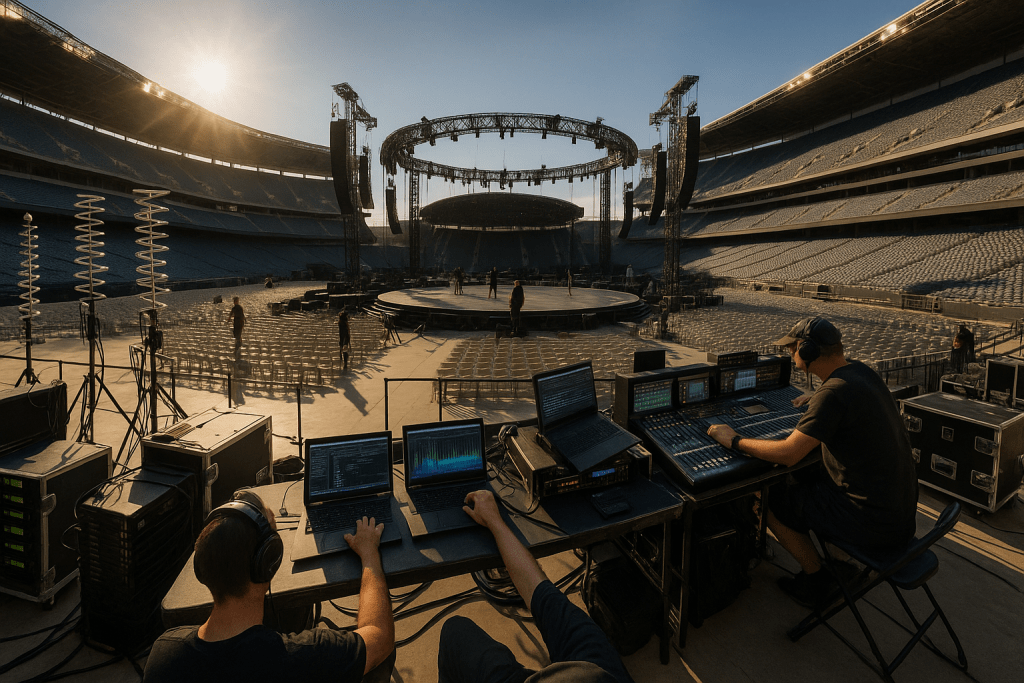
Ed Sheeran’s current global stadium run, known as ‘The Mathematics Tour’ and featuring his circular ‘The Loop’ stage design, presents a demanding environment for wireless audio and RF management.
With multiple stages, extensive in-ear monitoring, and large video and broadcast infrastructures, the tour’s RF team must manage a crowded spectrum while touring through countries with different frequency regulations and interference conditions.
To handle this, the production has adopted Spectera, Sennheiser’s RF coordination and monitoring platform, as a central tool in its wireless workflow.
Key announcement
Sennheiser announced that its Spectera software is being deployed throughout Ed Sheeran’s stadium tour to coordinate and supervise the show’s wireless systems. The tour’s RF specialists use the platform to plan, assign, and monitor frequencies for microphones, in-ear systems, and other wireless equipment across changing venues.
According to the production team, Spectera is used in both advance planning and on-site operation. It aggregates data from receivers and transmitters, visualizes spectrum usage, and helps identify potential interference before and during each performance. This is particularly important for the tour’s 360-degree stage layout, which places performers and RF equipment in the middle of large open venues.
The software is integrated alongside Sennheiser’s wireless systems to create a single view of active channels, signal strength, and potential conflicts. The RF crew can then adjust frequencies, power levels, and antenna configurations in response to changing conditions such as local broadcasters, event-day wireless activity, or unexpected interference.
Sennheiser positions Spectera, detailed on its official website, as a data-driven coordination tool intended for complex productions such as stadium tours, festivals, and large broadcast events.
Industry impact
The use of Spectera on a tour of this scale underlines how RF coordination is becoming more software-driven and centralized. Stadium productions often operate in crowded urban frequency environments, where spectrum is limited and shared with broadcasters, venue infrastructure, and other events.
By consolidating RF data into a single interface, platforms like Spectera aim to reduce the risk of dropouts and interference that can affect live audio quality. For high-profile tours, where shows are tightly scheduled and often filmed or streamed, stable wireless performance is critical.
The Ed Sheeran deployment also reflects a broader shift in touring workflows, where RF engineers are expected to manage a higher channel count while maintaining compliance with regional spectrum regulations. Tools that provide automated planning, real-time visualization, and logging can help maintain consistency across dozens of venues.
Why this matters
For event technology professionals, this case highlights several ongoing trends in large-scale live production:
- Growing channel density: Modern stadium shows rely on more wireless equipment than ever, from microphones and in-ear monitors to intercoms and control links, increasing pressure on RF planning.
- Regulatory variation: Touring productions must adapt to different national and regional spectrum rules, making repeatable, software-based coordination processes more valuable.
- Need for real-time insight: As RF environments become less predictable, live monitoring and quick adjustment are essential to avoid show-impacting issues.
While many large tours already use RF coordination tools, high-profile deployments such as Ed Sheeran’s ‘The Mathematics Tour’ draw attention to the role of centralized RF management in maintaining audio reliability at scale.
For venue operators, rental companies, and production houses, the example reinforces the importance of investing not only in wireless hardware, but also in the software and workflows that keep those systems operating reliably under demanding conditions.