NFC in Events: Tap-Based Interaction for Seamless Digital Engagement

Introduction: From Contactless Access to Intent-Driven Interaction
As event environments become increasingly digitized, the need for low-friction, intuitive interaction mechanisms has grown. While RFID enables passive, background identification, Near Field Communication (NFC) introduces a more deliberate interaction model—one based on intentional “tap” actions.
NFC transforms physical touchpoints into digital triggers. By enabling short-range, secure communication between devices, it allows attendees to initiate actions—check-ins, content access, networking, and payments—with a simple tap. This makes NFC particularly suited for experiences where user intent and control are essential.
Defining NFC in Event Contexts
Near Field Communication (NFC) is a short-range wireless communication technology that operates typically within a few centimeters. Unlike RFID, which can function passively at varying ranges, NFC requires close proximity and is often user-initiated.
In event environments, NFC is embedded in:
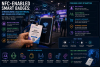
- Smart badges or cards
- Wristbands for access and payments
- Smartphones (via built-in NFC chips)
- Physical touchpoints such as posters, kiosks, and booths
The defining characteristic is intentional interaction—actions occur when users actively tap or bring devices close together.
Core Components of NFC Systems
NFC Tags
NFC tags are small, passive chips embedded in objects. They store data such as URLs, identifiers, or commands.
In events, tags may be placed on:
- Exhibitor booths
- Posters and signage
- Access points and kiosks
Tags act as triggers for digital actions.
NFC Readers and Devices
Readers can be dedicated hardware or integrated into smartphones and tablets.
In event contexts:
- Smartphones often act as both reader and interface
- Access control points use fixed readers
- Payment terminals integrate NFC for transactions
Secure Element and Protocols
NFC supports secure communication protocols, particularly important for payments and identity verification.
Encryption and authentication mechanisms ensure that interactions are सुरक्षित and reliable.
Backend Systems and APIs
NFC interactions trigger backend processes through APIs. These systems:
- Validate actions (e.g., access permissions)
- Retrieve or update user data
- Trigger workflows (e.g., sending content or notifications)
This integration enables real-time responses.
Interaction Models in Events
Tap-to-Access
Attendees tap badges or phones at entry points to gain access. Compared to RFID, NFC provides more controlled, intentional access validation.
Tap-to-Network
Two attendees can exchange information by tapping devices or badges. This replaces manual business card exchange with instant digital transfer.
Tap-to-Engage
Exhibitors can embed NFC tags in booths or materials. Attendees tap to:
- Download brochures
- Save contact details
- Access exclusive content
This creates measurable, trackable engagement.
Tap-to-Pay
NFC enables secure, contactless payments. Wristbands or smartphones can be linked to accounts, allowing fast transactions without cash or cards.
System Architecture: Intent-Driven Event Flow
NFC operates as an event-triggered system with explicit user action.
- User taps device or tag
- NFC reader detects and initiates communication
- Data is transmitted securely
- Backend systems process the request
- Action is executed (e.g., access granted, content delivered)
This flow emphasizes precision and control, reducing unintended interactions.
Integration with Event Technology Ecosystems
NFC integrates seamlessly with broader event systems.
Event apps act as primary interfaces, enabling attendees to interact with NFC touchpoints. Event data platforms capture interaction data, feeding into analytics and personalization engines.
Workflow automation systems can trigger follow-ups—such as sending emails or updating CRM systems—based on NFC interactions.
Compared to RFID, NFC provides richer context around user intent, making it valuable for engagement tracking.
Operational and Experience Impact
NFC enhances both usability and engagement.
For attendees, interactions become intuitive and immediate. Tapping is a familiar gesture, reducing learning curves and friction.
For organizers, NFC provides precise interaction data. Each tap represents a deliberate action, offering high-quality insights into engagement.
For sponsors, it enables measurable and interactive experiences. Booth interactions can be tracked and analyzed in detail.
Strategically, NFC supports personalized and data-driven event models.
NFC vs RFID: Complementary Technologies
While often compared, NFC and RFID serve different roles.
- RFID excels in passive, large-scale tracking (e.g., crowd movement, access flow)
- NFC excels in intentional, user-driven interactions (e.g., networking, content access)
In advanced event architectures, both technologies are used together—RFID for background sensing, NFC for active engagement.
Challenges and Considerations
NFC implementation involves several considerations.
User awareness is important. Attendees must understand where and how to use NFC touchpoints.
Device compatibility can vary, particularly across different smartphone ecosystems.
Interaction design must be clear and visible. Without proper cues, users may not engage with NFC-enabled elements.
Security must be maintained, especially for payment and identity-related use cases.
Future Outlook: Toward Unified Contactless Ecosystems
NFC is evolving as part of broader contactless interaction ecosystems.
Integration with digital wallets, identity systems, and IoT devices will expand capabilities. Attendees may use a single device for access, networking, payments, and personalization.
Advances in mobile platforms will improve compatibility and user experience, making NFC interactions more seamless.
Combined with AI and real-time analytics, NFC will enable more adaptive and context-aware engagement.
Conclusion: Designing for Intentional Interaction
NFC introduces a deliberate, user-driven interaction layer into event environments. By enabling simple, secure, and intuitive tap-based actions, it bridges physical touchpoints and digital systems.
In modern event ecosystems, where engagement and data quality are critical, this intentionality is valuable. It ensures that interactions are meaningful, measurable, and actionable.
For event technology leaders, NFC is not just a convenience—it is a strategic tool for designing precise, user-centered interactions within increasingly complex event environments.