GES EMEA Cuts Emissions While Expanding Global Operations
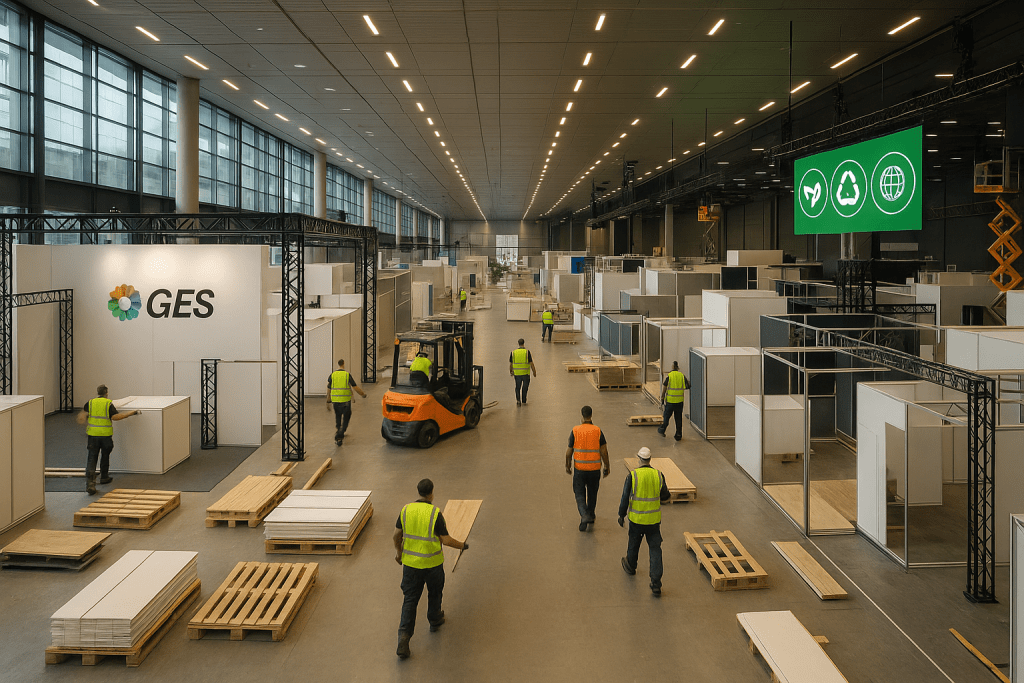
GES EMEA has reported a substantial reduction in its carbon footprint while continuing to scale its global operations, underscoring how large event service providers are attempting to decouple growth from environmental impact.
The company’s latest Impact Report highlights an 8.5% year-on-year decrease in carbon emissions across its EMEA operations, achieved during a period in which GES expanded its global workforce by 15% and supported a 12% increase in business activity. Since 2023, the business reports a cumulative 23% cut in emissions, positioning its regional arm as an example of how operational efficiency and sustainability strategies can move in tandem.
Background and industry context
The exhibition and live events sector has been under mounting pressure to address its environmental footprint as organisers, venues, exhibitors and sponsors face growing scrutiny from regulators, corporate clients and attendees. Energy-intensive build and break processes, logistics, waste generation and international travel all contribute to the sector’s emissions profile.
In response, many large suppliers and production partners are now publishing annual sustainability or impact reports that set out measurable goals and disclose progress. GES, as one of the major full-service providers to exhibitions and corporate events worldwide, is among the companies using formal reporting frameworks to benchmark reductions in carbon emissions and resource use.
The EMEA division’s latest figures add to a broader pattern within the sector: leading players are increasingly expected to demonstrate quantifiable change, not only through policy announcements but via operational data that can be integrated into clients’ own ESG reporting.
Key developments in the latest report
In its new Impact Report, GES EMEA outlines headline emissions reductions alongside indicators of business expansion. Despite a 15% rise in its global headcount and the delivery of services for a 12% higher volume of business across markets, the company states that it was able to reduce carbon emissions in the region by 8.5% year-on-year.
When measured from a 2023 baseline, the cumulative reduction reported reaches 23%, suggesting that measures implemented over the past two years are beginning to show a sustained effect. While the report’s full dataset and breakdown of scopes are not detailed here, the performance signals a focus on energy use, materials, and operational efficiencies within the company’s event delivery model.
The reporting period covers a time of continuing recovery and rebalancing for the events sector, following the post-pandemic rebound and the subsequent normalisation of event calendars. Many organisers are now refining portfolios, formats and geographies, with suppliers required to adapt while also meeting stricter sustainability expectations from clients and host destinations.
Although specific initiatives behind the reductions are not fully outlined in the summary, such improvements in emissions intensity typically involve changes to logistics planning, the sourcing and reuse of stand materials, investment in lower-emission fleet or transport solutions, and greater collaboration with venues on energy and waste management. Internal programmes around measurement, training and supplier engagement are also common levers in achieving year-on-year gains.
Industry impact and benchmark setting
The progress reported by GES EMEA is likely to be closely watched by organisers, venues and other contractors seeking evidence that significant emissions cuts are achievable even as event volumes increase. For many organisers working with large service partners, supplier-level data is an essential component in understanding the overall carbon impact of their shows.
By pairing reductions with documented business growth, the report contributes to a growing set of case studies that suggest decarbonisation is possible without constraining activity levels. This is particularly relevant for trade fairs, exhibitions and large-scale live events where the economic value of growth must now be balanced against environmental commitments.
For destination marketing organisations and convention bureaux, supplier performance on sustainability is becoming a differentiator when bidding for international events. Service providers that can present verified carbon data and reduction trajectories may find themselves better positioned in tender processes where ESG metrics form part of the evaluation criteria.
Why this matters for event professionals and technology providers
For organisers, the data shared by suppliers like GES EMEA has a direct bearing on how they design, deliver and report on events:
- Integrated reporting: Corporate and association clients increasingly request emissions reporting at event level. Supplier impact reports offer a foundation for more granular, event-specific calculations.
- Procurement decisions: Emissions performance is becoming a standard evaluation point when selecting general service contractors, stand builders and logistics partners, alongside cost and capability.
- Operational planning: Demonstrated reductions can encourage organisers to adopt new build formats, materials and workflows that prioritise reuse and lower emissions without compromising attendee experience.
For technology providers operating in registration, data analytics, logistics, and event management platforms, the trends highlighted in the report present additional opportunities:
- Carbon data integration: As more suppliers publish sustainability metrics, there is growing demand for tools that can aggregate supplier data into organiser dashboards and client-facing sustainability reports.
- Resource optimisation: Technology that helps model transport routes, stand configurations, waste streams and on-site operations can support further reductions, building on the progress already reported.
- Standardisation of metrics: Platforms that align with emerging industry frameworks for carbon accounting in events can help clients compare performance across suppliers and events.
Hybrid and digital event solutions also remain part of the broader sustainability conversation. While physical exhibitions and conferences continue to dominate in-person engagement and revenue, technology-enabled formats can play a role in reducing travel-related emissions and extending content reach.
Conclusion
The latest Impact Report from GES EMEA adds weight to the view that significant carbon reductions and business expansion can coexist within the events ecosystem. An 8.5% annual decrease in emissions, contributing to a 23% reduction since 2023, achieved alongside increases in workforce and business volume, signals a concerted shift in how a major service provider structures its operations.
For event organisers, venues and technology providers, this kind of performance data is becoming a central reference point when shaping long-term strategies. As regulatory pressure, stakeholder expectations and client ESG requirements intensify, measurable progress from large suppliers may influence how the wider sector prioritises investment in sustainable infrastructure, digital tools and operational innovation.
While the details behind every reduction lever are not fully disclosed here, the trajectory reinforces a broader message: decarbonisation is no longer a peripheral initiative but an operational objective woven into growth planning for leading event service companies. The extent to which others follow, and the role technology will play in standardising and accelerating such progress, will be key themes for the events industry in the years ahead.