The Ultimate Guide to Outdoor Projection Mapping: Weather, Logistics, and Lumens
Outdoor projection mapping has become one of the most powerful visual technologies in the event industry. From product launches and cultural festivals to public celebrations, sporting events, and destination marketing campaigns, large-scale projection experiences can transform buildings, monuments, stadiums, and temporary structures into immersive storytelling canvases.
The appeal is obvious. Projection mapping allows organizers to create visually spectacular experiences without constructing permanent installations or physically altering venues. Entire architectural facades can appear to move, transform, collapse, rebuild, or tell complex visual narratives synchronized with music, lighting, and live performance.
However, outdoor projection mapping is significantly more complex than indoor deployment. Unlike controlled indoor environments, outdoor installations must contend with weather variability, ambient light, power distribution challenges, audience positioning, equipment protection, and logistical constraints that can dramatically affect performance and return on investment.
Success depends not only on creative content but also on understanding the technical realities of outdoor production. Weather planning, logistics management, and proper lumen calculations often determine whether a projection mapping experience becomes a memorable spectacle or a costly disappointment.
Why Outdoor Projection Mapping Is Different
Indoor projection environments offer predictable conditions.
Event teams typically control:
- Lighting levels
- Viewing angles
- Audience positioning
- Environmental conditions
- Equipment placement
Outdoor environments remove much of that control.
Projection teams must account for:
- Changing weather conditions
- Ambient city lighting
- Variable viewing distances
- Large audience areas
- Infrastructure limitations
- Surface reflectivity differences
These factors directly influence image quality, operational reliability, and production costs.
As a result, outdoor projection mapping requires significantly more planning than most indoor visual deployments.
Understanding Lumens: The Foundation of Outdoor Projection
Brightness is the single most important technical consideration in outdoor projection mapping.
What Are Lumens?
Lumens measure the total amount of visible light produced by a projector.
Higher lumen output generally means:
- Brighter images
- Better visibility
- Improved large-scale coverage
- Greater resistance to ambient light
For outdoor projection, insufficient brightness is one of the most common causes of poor visual performance.
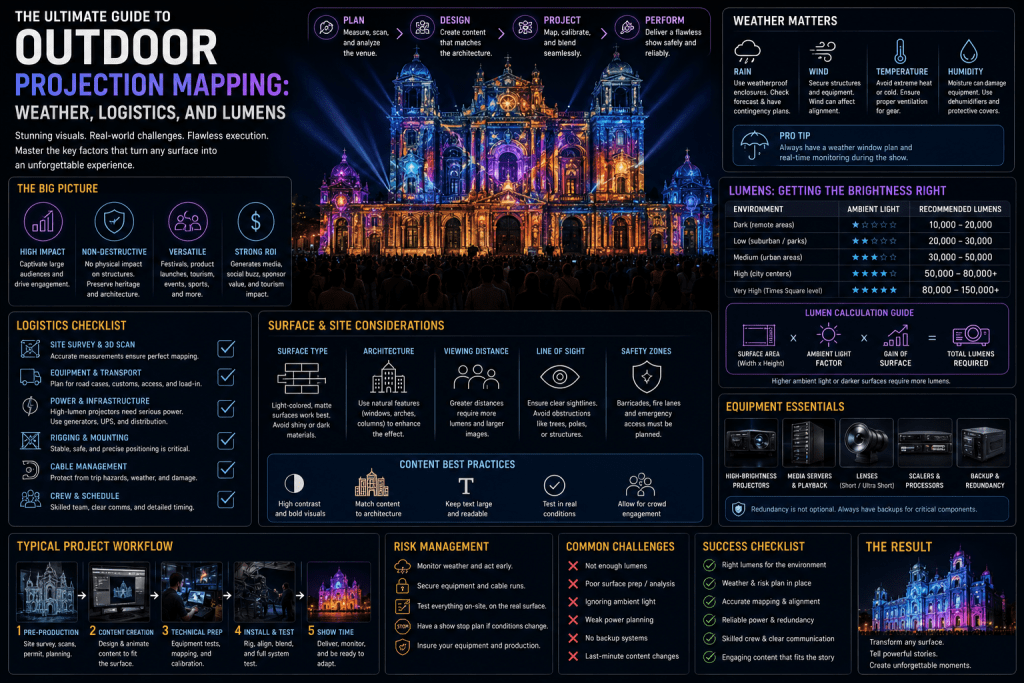
Typical Lumen Requirements
Different outdoor environments require different brightness levels.
General guidelines include:
| Environment | Typical Brightness Requirement |
|---|---|
| Small evening installations | 10,000–20,000 lumens |
| Medium-sized building facades | 20,000–40,000 lumens |
| Large architectural projections | 40,000–60,000 lumens |
| Major landmarks and mega-events | 60,000+ lumens |
Many large-scale public projection shows combine multiple projectors through edge blending to achieve effective brightness levels exceeding 100,000 lumens.
The Impact of Ambient Light
Lumens alone do not determine image quality.
Projection performance is heavily influenced by:
- Street lighting
- Digital signage
- Vehicle traffic
- Nearby buildings
- Moonlight conditions
- Event lighting infrastructure
A 30,000-lumen projector may perform exceptionally well in a dark heritage site but struggle in a brightly illuminated urban environment.
Site-specific lighting assessments are essential during planning.
Weather: The Most Important Operational Variable
Outdoor projection mapping is highly dependent on environmental conditions.
Weather planning must begin long before deployment.
Rain and Moisture
Water represents one of the greatest risks to projection equipment.
Most high-brightness projectors are not designed for direct exposure to:
- Rain
- Condensation
- Water spray
- High humidity
Protection strategies often include:
- Weatherproof enclosures
- Environmental housing systems
- Elevated equipment positioning
- Waterproof cable management
Production teams should always establish weather contingency plans before installation begins.
Wind Considerations
Wind can affect multiple components of projection systems.
Potential issues include:
- Temporary structure movement
- Screen instability
- Equipment vibration
- Alignment disruption
- Safety risks for rigging systems
Even minor structural movement can affect projection accuracy, particularly when mapping onto complex architectural surfaces.
Temperature Management
High-brightness projectors generate substantial heat.
Extreme temperatures may affect:
- Lamp performance
- Laser efficiency
- Cooling systems
- Electronic reliability
Outdoor deployments often require additional environmental monitoring to maintain safe operating conditions.
Humidity and Condensation
Condensation can create significant operational challenges.
Rapid temperature changes may cause moisture accumulation on:
- Projection lenses
- Optical components
- Electronic systems
This can reduce image quality and potentially damage equipment.
Professional deployments typically incorporate environmental controls to minimize these risks.
Site Selection and Surface Analysis
The projection surface itself plays a major role in determining success.
Surface Color and Reflectivity
Lighter surfaces generally produce better projection results.
Dark materials absorb more projected light, reducing perceived brightness.
Ideal projection surfaces include:
- Light-colored stone
- Concrete
- Architectural facades
- Temporary scenic structures
Dark brick, tinted glass, and reflective metal surfaces often require additional brightness compensation.
Architectural Complexity
Projection mapping benefits from architectural detail.
Features such as:
- Columns
- Windows
- Arches
- Sculptures
- Decorative elements
create opportunities for immersive visual effects.
However, increased complexity also requires more detailed content production and alignment work.
Viewing Distance
Audience positioning influences projector selection and placement.
Long viewing distances typically require:
- Higher brightness
- Larger image sizes
- Additional projection coverage
- More sophisticated blending strategies
Understanding audience sightlines is critical during planning.
Logistics and Infrastructure Planning
Outdoor projection projects often involve extensive logistical coordination.
Power Requirements
High-brightness projectors consume substantial electrical power.
Large-scale deployments may require:
- Dedicated generators
- Temporary power distribution
- Redundant electrical systems
- UPS backup protection
Power planning should account for all projection, media server, and control equipment requirements.
Equipment Transportation
Large projection systems involve significant logistics.
Common considerations include:
- Equipment shipping
- Customs clearance
- Venue access restrictions
- Load-in scheduling
- Equipment security
Landmark and heritage locations often present additional access challenges.
Rigging and Positioning
Projectors must be placed precisely to maintain alignment.
Potential mounting options include:
- Ground-supported structures
- Temporary towers
- Building rooftops
- Elevated platforms
Rigging plans must consider safety, stability, and environmental conditions.
Content Creation for Outdoor Projection
Creative content must be designed specifically for outdoor environments.
Architectural Integration
Successful projection mapping treats architecture as part of the narrative.
Rather than projecting generic video content, designers use:
- Structural geometry
- Architectural details
- Surface depth
- Physical dimensions
to create visual illusions and immersive storytelling experiences.
Visibility Optimization
Outdoor content should prioritize:
- High contrast
- Strong visual hierarchy
- Bold motion design
- Simplified visual complexity
Fine details may become difficult to perceive at large viewing distances.
Synchronization Systems
Many outdoor events integrate projection mapping with:
- Audio systems
- Lighting rigs
- Pyrotechnics
- Drones
- Live performances
Accurate synchronization requires robust show-control infrastructure.
Risk Management and Contingency Planning
Outdoor productions require extensive risk mitigation.
Best practices include:
- Backup projectors
- Redundant media servers
- Weather contingency plans
- Alternative scheduling options
- Equipment insurance
- Emergency power systems
The most successful projection teams assume that environmental conditions may change unexpectedly and plan accordingly.
Measuring ROI for Outdoor Projection Mapping
Projection mapping often generates value across multiple dimensions.
Common ROI indicators include:
- Audience attendance
- Social media reach
- Earned media coverage
- Sponsor visibility
- Brand recall
- Tourism impact
- Community engagement
Large-scale architectural projections frequently generate significant user-generated content, extending visibility well beyond the event itself.
For many organizations, the media amplification value can exceed the direct audience impact of the live experience.
The Future of Outdoor Projection Mapping
Emerging technologies are making outdoor projection systems increasingly sophisticated.
Future developments include:
- AI-assisted content generation
- Real-time environmental adaptation
- Interactive audience participation
- Drone-assisted projection systems
- Digital twin integration
- Automated alignment systems
- Higher-efficiency laser projectors
These innovations will continue expanding the creative and operational possibilities of outdoor projection experiences.
Conclusion
Outdoor projection mapping is one of the most powerful tools available for creating large-scale immersive event experiences. Yet its success depends on far more than compelling visuals. Brightness calculations, weather preparedness, infrastructure planning, surface analysis, and logistical coordination are equally important components of a successful deployment.
Understanding lumens ensures sufficient visibility. Weather planning protects both equipment and audience experience. Effective logistics guarantee operational reliability from setup through show execution.
When these elements are managed correctly, outdoor projection mapping can transform ordinary buildings, public spaces, and landmarks into extraordinary storytelling environments that captivate audiences, generate widespread media attention, and deliver lasting event impact.
In outdoor projection mapping, creativity may attract the audience, but technical execution determines whether the experience truly shines.