Transforming Historic Venues with Non-Destructive Projection Mapping
5 months ago Timothy Myres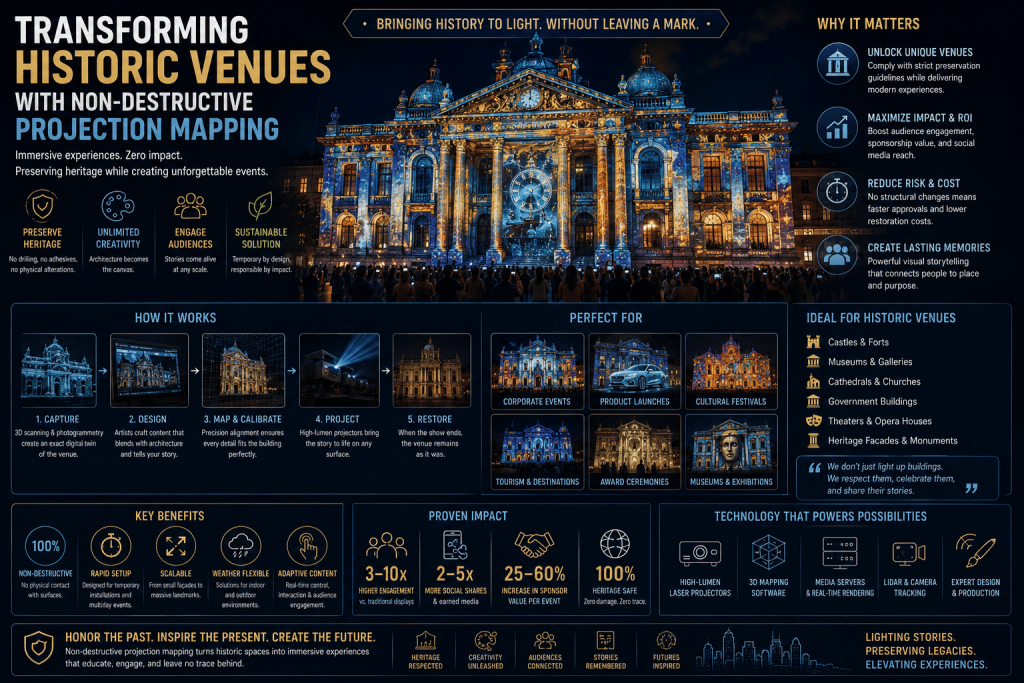
Historic venues occupy a unique position within the event industry. From centuries-old castles and heritage buildings to museums, cathedrals, theaters, and landmark civic structures, these spaces offer architectural character and cultural significance that modern venues often cannot replicate. Their authenticity creates powerful emotional connections, making them highly desirable locations for conferences, product launches, public celebrations, cultural festivals, and immersive brand experiences.
However, historic venues also present significant challenges for event designers. Preservation requirements often limit physical modifications, prohibit structural alterations, restrict rigging installations, and impose strict regulations regarding lighting, signage, and branding. Organizers must balance creative ambition with the responsibility of protecting culturally significant assets.
Non-destructive projection mapping has emerged as one of the most important technologies for solving this challenge. By using precisely calibrated projection systems to transform architectural surfaces without physically touching or altering them, organizers can create immersive visual experiences while preserving the integrity of historic structures.
As projection technology, AI-driven content creation, and real-time rendering systems continue advancing, non-destructive projection mapping is becoming a cornerstone of heritage-focused event innovation. It allows event professionals to reimagine historic environments without compromising the very features that make them valuable.
The Challenge of Modern Events in Historic Spaces
Table of Contents
ToggleHistoric venues were not designed to accommodate modern event technology requirements.
Many heritage sites face restrictions involving:
- Structural modifications
- Permanent installations
- Physical branding
- Surface attachments
- Rigging systems
- Electrical infrastructure changes
- Construction activities
Conservation authorities and venue operators often impose strict preservation guidelines to prevent damage to architectural elements.
For event organizers, this creates several limitations.
Limited Branding Opportunities
Corporate events and product launches frequently require large-scale visual branding. Traditional solutions such as banners, signage, and temporary structures may be prohibited within protected environments.
Infrastructure Constraints
Historic venues often lack the mounting points, ceiling supports, and technical infrastructure needed for large-scale AV installations.
Preservation Requirements
Even temporary physical contact with protected surfaces can present risks to:
- Historic stonework
- Frescoes
- Wood carvings
- Decorative facades
- Original finishes
- Archaeological features
As a result, event technology solutions must prioritize minimal physical impact.
What Is Non-Destructive Projection Mapping?
Projection mapping is a technique that uses high-powered projectors and specialized software to align digital content precisely with physical surfaces.
Unlike conventional projection systems that display content on flat screens, projection mapping treats architecture itself as the display medium.
Non-destructive projection mapping specifically focuses on creating immersive visual experiences without physically modifying the venue.
The technology relies on:
- High-lumen projectors
- 3D scanning systems
- Digital architectural models
- Projection mapping software
- Real-time rendering engines
- Content management platforms
Because no physical materials are attached to the structure, the venue remains unchanged once the event concludes.
How the Technology Works
The success of projection mapping depends on precise alignment between digital content and physical architecture.
3D Site Capture
The process typically begins with detailed digital modeling of the venue.
Teams use technologies such as:
- LiDAR scanning
- Photogrammetry
- Drone imaging
- Laser measurement systems
to create highly accurate three-dimensional representations of architectural surfaces.
This digital twin becomes the foundation for content development.
Content Design
Creative teams design visual content that interacts with architectural features.
Rather than ignoring structural details, projection mapping embraces them.
Columns, windows, arches, statues, and decorative elements become part of the storytelling environment.
Content may create illusions such as:
- Architectural transformation
- Historical reconstruction
- Dynamic movement
- Immersive storytelling
- Interactive visual effects
Projection Calibration
Projectors are positioned strategically to align visuals precisely with the physical structure.
Advanced mapping software compensates for:
- Surface irregularities
- Viewing angles
- Distance variations
- Architectural complexity
This creates the appearance that the building itself is animated.
Why Historic Venues Are Ideal for Projection Mapping
Historic architecture often provides richer visual opportunities than modern structures.
Architectural Complexity
Historic buildings typically feature:
- Ornate facades
- Detailed carvings
- Arches
- Towers
- Decorative stonework
- Sculptural elements
These features create visually engaging surfaces that enhance projection effects.
Storytelling Potential
Many heritage sites possess compelling narratives spanning decades or centuries.
Projection mapping allows organizers to visualize:
- Historical events
- Cultural heritage
- Architectural evolution
- Community stories
- Brand narratives connected to location
This creates experiences that feel authentic and contextually meaningful.
Preservation-Friendly Innovation
Perhaps most importantly, projection mapping allows venues to embrace innovation without compromising preservation goals.
The building remains physically untouched while still serving as an immersive event centerpiece.
Applications Across Event Types
Non-destructive projection mapping is increasingly used across diverse event categories.
Cultural and Heritage Events
Museums, heritage organizations, and cultural institutions frequently use projection mapping to bring history to life.
Experiences may include:
- Historical reenactments
- Interactive storytelling
- Educational visualizations
- Cultural celebrations
These applications enhance visitor engagement while preserving artifacts and architecture.
Corporate Events and Product Launches
Brands increasingly choose historic venues because of their uniqueness and prestige.
Projection mapping allows companies to create immersive branded experiences without violating preservation restrictions.
This is particularly valuable for luxury brands, technology launches, and executive events.
Tourism and Destination Marketing
Cities and tourism organizations use architectural projection to highlight landmarks and attract visitors.
Large-scale projection shows can generate:
- Tourism interest
- Social media visibility
- Community engagement
- Economic activity
without altering protected structures.
Festivals and Public Events
Projection mapping has become a centerpiece of many urban festivals and cultural celebrations.
Historic buildings become temporary storytelling canvases capable of accommodating large audiences without requiring physical modifications.
Operational and Business Benefits
Beyond visual impact, non-destructive projection mapping offers several operational advantages.
Preservation Compliance
Because no permanent changes are made, organizers can often secure approvals more easily than with physical installations.
Reduced Installation Risk
The absence of physical attachments lowers the risk of accidental damage to protected structures.
Faster Venue Restoration
Once equipment is removed, the venue immediately returns to its original condition.
This reduces post-event restoration requirements and associated costs.
Increased Sponsorship Value
Projection-mapped landmarks often generate significant audience attention and social sharing.
This creates premium sponsorship opportunities while maintaining venue integrity.
Challenges and Considerations
Despite its advantages, projection mapping presents several challenges.
Ambient Light Sensitivity
Projection systems perform best in controlled lighting conditions.
Daylight environments may require:
- High-brightness projectors
- Additional infrastructure
- Evening scheduling
to achieve desired visual quality.
Content Production Complexity
Creating content for historic structures requires specialized design expertise.
Each venue demands custom creative development based on its architectural characteristics.
Equipment and Calibration Requirements
Successful projection mapping requires:
- Precise alignment
- Advanced planning
- Technical expertise
- Specialized equipment
Complex structures often increase production time and operational requirements.
Conservation Collaboration
Organizers must work closely with:
- Preservation authorities
- Venue operators
- Architects
- Conservation specialists
to ensure compliance with heritage protection guidelines.
Future Trends in Heritage Projection Mapping
The next generation of projection mapping systems is expected to become more intelligent and interactive.
Emerging developments include:
- AI-generated visual storytelling
- Real-time audience interaction
- Spatial computing integration
- Digital twin synchronization
- Interactive historical simulations
- Adaptive projection environments
- Mixed-reality heritage experiences
These innovations will enable increasingly sophisticated experiences while maintaining preservation-first approaches.
Conclusion
Non-destructive projection mapping is transforming how historic venues participate in modern events. By turning architecture into an immersive digital canvas without physically altering or damaging protected structures, the technology creates a powerful bridge between heritage preservation and contemporary experience design.
Its value extends beyond visual spectacle. Projection mapping enables storytelling, branding, education, tourism promotion, and audience engagement while respecting the integrity of culturally significant spaces.
As event organizers continue seeking memorable venues and immersive experiences, non-destructive projection mapping offers a compelling solution that aligns creativity with conservation. Rather than forcing historic buildings to adapt physically to modern events, the technology allows modern experiences to adapt intelligently to historic architecture—preserving the past while creating unforgettable moments for the future.