Modular event infrastructure supports leaner, smarter shows
Event organisers are being asked to deliver more ambitious experiences with fewer resources, pushing infrastructure choices to the top of strategic discussions. As budgets tighten, labour remains scarce and sustainability expectations increase, modular event infrastructure is gaining traction as a practical way to balance cost, quality and environmental performance.
Across conferences, exhibitions, brand activations and outdoor shows, modular systems are being deployed to streamline builds, reduce waste and give production teams greater flexibility. The shift reflects a wider reassessment of how temporary environments are designed, transported, installed and reused from one event to the next.
Background: a changing operating environment
Organisers in the UK and beyond are working in a tough economic climate. Production costs have risen sharply in areas such as materials, transport and energy. At the same time, experienced technical crew and site staff can be harder to secure, particularly around peak seasons when multiple large-scale events overlap.
Layered on top of these commercial pressures are more stringent sustainability targets. Corporate clients, public sector buyers and venues are setting clearer expectations on emissions, resource use and waste. Procurement teams increasingly scrutinise the lifecycle of staging, structures, graphics and fittings, alongside traditional metrics such as price and reliability.
Yet audience expectations remain high. Delegates, visitors and sponsors still look for polished environments, strong production values and seamless hybrid or digital integrations. This tension between constraints and expectations is encouraging organisers to re-evaluate the underlying infrastructure that supports their shows.
Key developments in modular event infrastructure
Modular event infrastructure refers to systems designed from repeatable, standardised components that can be configured into different layouts and reused across multiple projects. This can include stages, platforms, truss systems, temporary venues, exhibition booths, walls, seating structures, AV supports and back-of-house facilities.
Several trends are driving its adoption:
- Standardisation of components: Manufacturers are developing ranges of compatible parts that work across different event formats. A common structural language means beams, decks, panels and connectors can be recombined to suit changing requirements, instead of building bespoke elements from scratch.
- Lighter, more durable materials: Advances in aluminium, engineered timber and composite materials are reducing the weight of components while maintaining load-bearing capacity. This lightens the transport footprint and simplifies on-site handling.
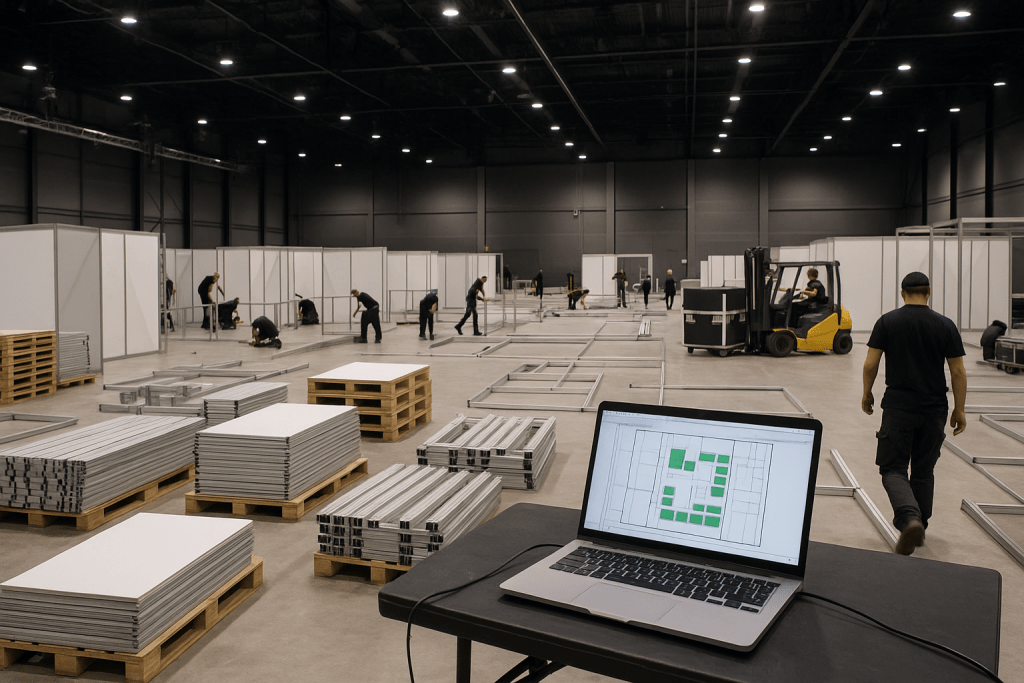
- Faster assembly and disassembly: Tool-free or low-tool connection systems, integrated fixings and pre-engineered joints are shortening build and strike times. This supports tighter tenancy windows in venues and reduces the number of specialist crew required on site.
- Integration with digital planning tools: Many modular systems now come with digital design libraries or CAD/BIM models, allowing production teams to plan structures in detail, check clearances and test multiple layout options before anything is physically built.
These developments are not limited to large structures. Smaller elements such as wayfinding, registration desks, charging stations, signage frames and content pods are increasingly being specified as modular assets that can travel from event to event.
Industry impact: cost, labour and sustainability
One of the most significant impacts of modular infrastructure is on cost management. While the upfront investment in a modular system can be higher than one-off build, the ability to reuse stock across multiple events spreads that cost over time. For organisers, agencies and production suppliers operating repeat shows or annual series, this can provide a more predictable cost base.
Labour efficiency is another factor. Pre-engineered components with standard fixings reduce reliance on bespoke fabrication and time-intensive carpentry on site. Crews can become familiar with a single system and deploy it in different configurations, rather than learning a new structure on each job. This can be particularly valuable at a time when experienced riggers and installers are in high demand.
From a sustainability perspective, modularity is helping to address some long-standing concerns about waste in the events industry. Traditional one-off builds often result in materials going to landfill after a short period of use. Reusable systems, by contrast, are designed for multiple lifecycles. When combined with careful inventory management and maintenance, this can significantly reduce material consumption.
Transport emissions are also in focus. Stackable, standard-sized components can be packed more efficiently into trucks and containers, reducing the number of journeys required. Lighter elements cut fuel consumption further. Some providers are exploring how shared stock, regional depots or cross-event logistics planning can minimise vehicle mileage.
Why this matters for event professionals and technology providers
For event organisers, modular infrastructure can sit alongside digital platforms, registration systems and content delivery tools as part of a broader strategy to run leaner, more resilient events. Being able to specify, cost and model physical layouts quickly can help teams respond to late changes in delegate numbers, sponsor requirements or venue constraints.
Exhibition organisers can use modular systems to reconfigure floorplans between editions, support different exhibitor mixes or add new features such as networking lounges and content theatres without redesigning from scratch. For conference producers, the ability to resize stages, adjust seating layouts or integrate hybrid broadcast zones from a common kit of parts can simplify planning across multiple destinations.
Technology providers working in areas such as event apps, attendee tracking, streaming and analytics also have an interest in how modular infrastructure evolves. Consistent physical layouts and structural standards make it easier to integrate hardware such as cameras, sensors, LED walls, access control points and power distribution. A known infrastructure framework enables more replicable technical designs from show to show.
For agencies and suppliers, modular systems can be a route to new commercial models. Instead of charging mainly for one-off fabrication, they can offer asset libraries, configuration services, storage, refurbishment and multi-year deployment plans for brand clients. This can deepen relationships and create opportunities to embed technology more tightly into the physical environment.
Conclusion
As event businesses navigate cost pressures, skills shortages and environmental scrutiny, modular event infrastructure is emerging as a pragmatic response rather than a niche design choice. By prioritising reuse, standardisation and speed of deployment, it offers a framework for building temporary environments that are more economically and operationally sustainable.
The approach does not remove the need for creativity or bespoke elements; flagship features, experiential zones and high-impact brand moments will still rely on custom design. However, placing modular systems at the core of an event’s physical fabric can free up budgets, time and carbon savings that can be redirected towards content, engagement and innovation.
For event professionals and technology providers alike, understanding how to integrate modular infrastructure into future planning is becoming an important competency. As client expectations continue to evolve, the ability to build adaptable, resource-efficient spaces may be one of the factors that distinguishes resilient event businesses in the years ahead.