RFID in Events: Real-Time Identification and Interaction Infrastructure
Introduction: From Identification to Interaction
Events have always required mechanisms to identify attendees, control access, and track participation. Traditional methods—printed badges, manual verification, barcode scanning—have improved efficiency but remain limited in responsiveness and integration.
Radio Frequency Identification (RFID) transforms identification into a real-time, automated system. By enabling contactless communication between tags and readers, RFID extends beyond access control into interaction, data capture, and operational intelligence.
In modern event ecosystems, RFID is not just a check-in tool. It is an infrastructure layer that connects physical actions to digital systems.
Defining RFID in Event Contexts
RFID is a wireless communication technology that uses electromagnetic fields to identify and track tags attached to objects or individuals.
In events, RFID is typically embedded in:
- Wristbands for festivals and large-scale events
- Badges for conferences and exhibitions
- Cards or tokens for controlled environments
Each tag contains a unique identifier that can be read by RFID readers without direct line-of-sight.
Core Components of RFID Systems
RFID Tags
Tags are the endpoints carried by attendees. They may be:
- Passive (no battery, powered by reader signals)
- Active (battery-powered, longer range and continuous transmission)
Passive tags are most common in events due to cost and simplicity.
RFID Readers and Antennas
Readers emit radio signals to detect and communicate with tags. Antennas define the read zone and range.
Deployment varies based on use case:
- Entry gates for access control
- Booths for interaction tracking
- Checkpoints for movement analysis
Middleware and Data Processing
RFID systems generate large volumes of data. Middleware processes this data by:
- Filtering duplicate reads
- Associating tag IDs with attendee profiles
- Triggering actions based on events
This layer is critical for transforming raw signals into meaningful information.
Integration Interfaces
APIs and integration layers connect RFID systems with other event technologies, including:
- Registration platforms
- Event apps
- Analytics systems
- Access control systems
This ensures that RFID data is usable across the ecosystem.
Operational Workflows
Access Control and Check-In
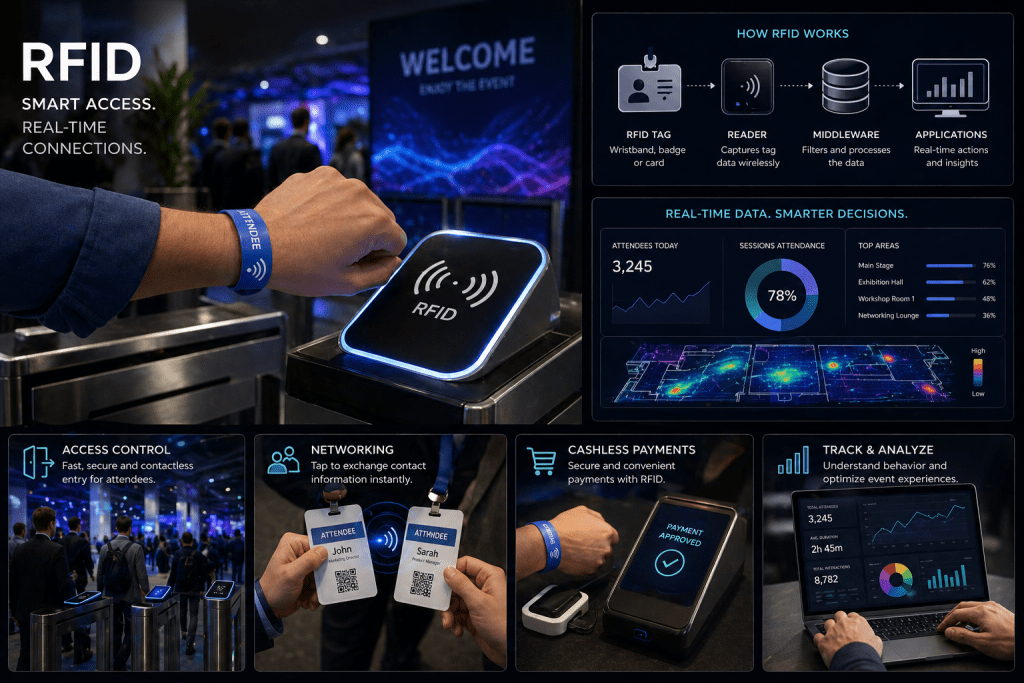
RFID enables fast, contactless entry. Attendees simply tap or pass through a reader zone, and the system verifies credentials in real time.
This reduces queues and improves throughput, particularly in high-volume events.
Session Tracking and Attendance
Readers at session entrances can automatically log attendance. This provides accurate participation data without manual scanning.
Networking and Interaction
RFID badges can be used for tap-based interactions:
- Exchanging contact information
- Collecting digital content
- Engaging with sponsor activations
These interactions are recorded and integrated into attendee profiles.
Cashless Payments
In some events, RFID is used for payments. Wristbands can be linked to accounts, enabling fast, cashless transactions.
System Architecture: Event-Driven Data Flow
RFID systems operate within an event-driven architecture.
- A tag enters a reader zone
- The reader captures the tag ID
- Middleware processes and validates the event
- Actions are triggered (e.g., grant access, log attendance, update profile)
- Data is sent to analytics and other systems
This pipeline operates in real time, enabling immediate प्रतिक्रिया and synchronization.
Integration with Event Technology Ecosystems
RFID acts as a bridge between physical actions and digital systems.
Event data platforms use RFID events as primary inputs for behavioral analysis. Real-time orchestration systems can trigger actions based on RFID interactions, such as sending notifications or updating schedules.
Personalization engines use RFID data to tailor experiences, while analytics systems derive insights into movement patterns, engagement, and outcomes.
Operational and Business Impact
RFID delivers measurable improvements in both operations and experience.
Operationally, it reduces manual processes, improves accuracy, and increases efficiency. Entry flows are smoother, and data collection is automated.
For attendees, it simplifies interactions. Actions such as check-in, networking, and payments become seamless and intuitive.
For organizers and sponsors, RFID provides rich data. Engagement can be measured at a granular level, enabling better decision-making and ROI analysis.
Challenges and Considerations
Despite its advantages, RFID implementation requires careful planning.
Infrastructure setup is critical. Reader placement and calibration affect accuracy and coverage.
Interference and signal overlap can cause read errors, particularly in dense environments.
Privacy and data protection must be addressed. Attendees should have transparency and control over how their data is used.
Cost considerations include hardware, deployment, and integration.
Future Outlook: Toward Intelligent Event Sensing
RFID is evolving as part of broader event sensing systems.
Integration with IoT devices, computer vision, and location tracking will provide more comprehensive insights into attendee behavior.
Advances in chip technology will improve range, reliability, and cost efficiency.
Combined with AI and real-time analytics, RFID will enable more adaptive and intelligent event environments.
Conclusion: Connecting Physical Presence to Digital Intelligence
RFID transforms events by linking physical interactions with digital systems in real time. It enables seamless access, richer engagement, and data-driven operations.
As events become more complex and interconnected, RFID will continue to play a central role in bridging the gap between the physical and digital layers of the event ecosystem.
For event technology leaders, RFID is not just a tool—it is a foundational capability for building responsive, data-driven event environments.