Vodafone launches 5G network slicing for crowded live events
Introduction
Vodafone Business has introduced commercial 5G network slicing in the UK, targeting organisations that need assured connectivity at high-density venues such as stadiums, arenas and major outdoor events. Alongside this, the operator has unveiled a complementary service called Network Boost, aimed at improving reliability and performance for enterprises operating in the most congested locations.
The launch positions Vodafone Business as the first provider in the UK to formally offer 5G network slicing to enterprise customers, with clear implications for event organisers, rights holders, venue operators and technology vendors who rely on mobile networks for mission-critical services.
Background or industry context
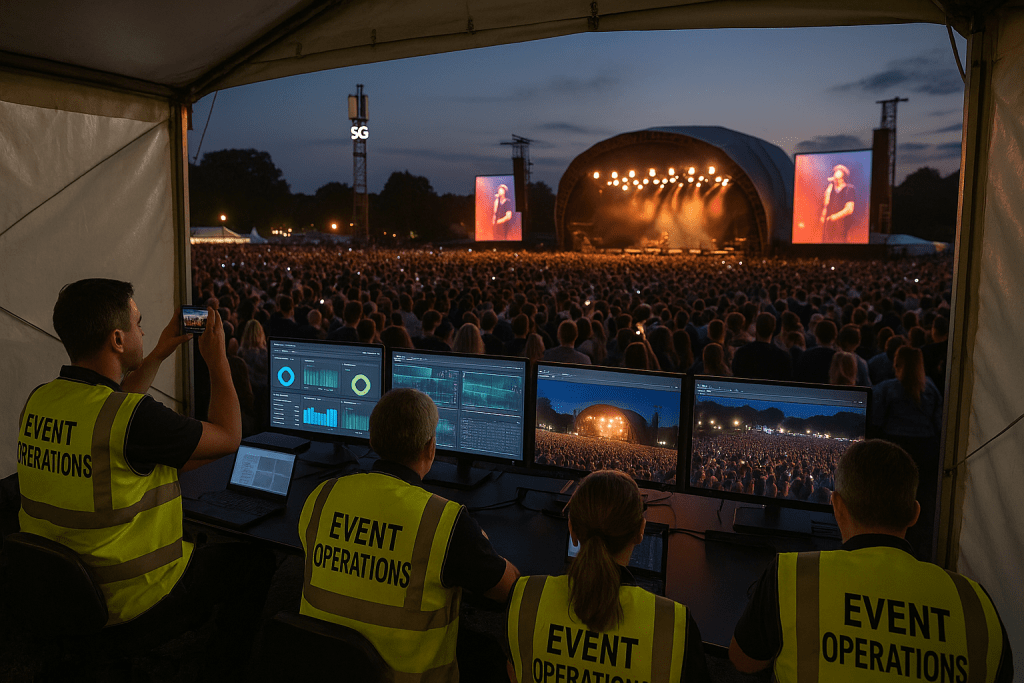
Large-scale sports and music events routinely push mobile networks to their limits. Tens of thousands of attendees simultaneously sharing photos, streaming video, using event apps and accessing digital tickets can easily saturate local 4G and 5G capacity. This congestion can disrupt essential operations including access control, point-of-sale systems, production workflows, safety communications and fan engagement tools.
Historically, event organisers and venues have mitigated these challenges through a mix of Wi-Fi deployments, temporary cells (COWs/COLTs), private networks and dedicated lines for critical services. While effective to a degree, these approaches can be costly, logistically complex and dependent on long planning cycles. They also struggle to adapt dynamically to real-time crowd behaviour, especially when traffic spikes unexpectedly.
5G network slicing is designed to address this by allowing operators to create virtual, logically separated segments of the same physical network, each with different performance characteristics. These dedicated slices can be tuned for latency, throughput, reliability and security, serving specific use cases such as broadcast production, ticketing, security operations or high-value VIP experiences within a single venue.
Key developments or announcement
Vodafone Business has confirmed that enterprise customers in the UK can now request their own 5G network slices, with guarantees around local performance in defined areas. This means organisations can secure dedicated capacity and quality of service, isolated from the general public’s mobile traffic during busy events.
According to Vodafone, the new offer allows businesses to:
- Reserve a portion of 5G network resources in a specific location, such as a stadium bowl, exhibition hall or fan zone.
- Define performance requirements for priority services, such as uplink bandwidth for live video, latency for control systems, or reliability for payment terminals.
- Run multiple applications on the same slice, while maintaining separation from best-effort consumer traffic on the wider network.
The announcement is accompanied by the launch of Network Boost, a service designed for organisations that may not need a fully customised slice, but still require more dependable connectivity in high-traffic zones. While technical details have not been fully disclosed, Network Boost appears focused on enhancing priority and throughput for selected devices or applications in congested environments.
Vodafone positions these offerings as suitable for sectors including live entertainment, sport, transport hubs, manufacturing and public services. For the events ecosystem, the primary use cases include ensuring connectivity for operations teams, media and broadcast workflows, contactless payments, access control and fan-facing digital services during peak periods of demand.
Industry impact
The commercialisation of 5G network slicing moves the technology from trial environments into real-world operations, and live events are a natural testbed. Event organisers frequently report that even with 5G available, performance can degrade when capacity is stressed by full venues. A reserved slice gives key stakeholders a way to ringfence connectivity for essential functions, reducing the risk of outages that affect safety, revenue or reputation.
For venues and rights holders, this development also opens up new models for connectivity provisioning. Instead of relying solely on best-effort public networks backed by on-site Wi-Fi, they can consider a layered approach:
- Public 4G/5G for general attendee use.
- Dedicated 5G slices for operational and broadcast requirements.
- Optional private or hybrid networks for highly sensitive workflows.
Technology providers in ticketing, cashless payments, event apps, production and security can potentially bundle access to a network slice into their service-level commitments, offering higher guarantees of uptime and performance. This could be particularly relevant for hybrid or digitally enhanced events, where live streaming, real-time interaction and data-driven services depend on low-latency, high-availability connections.
From a regulatory and industry standards perspective, Vodafone’s move may also accelerate the maturity of ecosystem support for network slicing. As more enterprises expect this capability, device manufacturers, application developers and systems integrators will likely need to ensure compatibility, testing procedures and performance monitoring tools are in place for sliced environments.
Why this matters for event professionals and technology providers
For event professionals, the reliability of mobile connectivity is no longer a nice-to-have; it underpins core business and safety functions. Digital ticketing, mobile accreditation, real-time crowd management dashboards, in-venue ordering and interactive fan experiences all depend on stable network access. Any failure can translate into long queues, revenue loss, safety concerns and reputational risk.
5G network slicing provides a new option in the connectivity toolkit:
- Operational assurance: Critical services such as access control, command-and-control communications, and incident response can be placed on a dedicated slice insulated from fan usage peaks.
- Enhanced media and broadcast: Broadcasters and content creators can reserve uplink capacity for multi-camera feeds, social content teams and remote production setups, reducing dependency on satellite or extensive cabling.
- Scalable fan experiences: Event apps, AR activations and real-time engagement tools can be designed with more confidence in available bandwidth, especially in defined zones like fan villages or VIP areas.
- Predictable performance for vendors: Payments, concessions and exhibitor services at trade shows and festivals can operate on a more predictable network layer, supporting higher transaction volumes.
Technology providers serving the event sector may see new opportunities to differentiate their offerings through tighter integration with network slices. For example, a ticketing platform could offer a premium tier that includes access to an operator-managed slice during ingress and egress periods, or a production company could design workflows around guaranteed 5G uplink capacity.
However, planning will be critical. Negotiating and configuring slices requires coordination with the operator well ahead of an event, including defining coverage zones, performance parameters and fall-back options. Event technology teams will need to integrate slice considerations into their broader connectivity strategy, alongside Wi-Fi, wired networks and any private 5G deployments.
Conclusion
Vodafone Business’s rollout of commercial 5G network slicing and the introduction of Network Boost mark a significant moment for enterprise connectivity in the UK, with direct relevance to the live events sector. As venues and organisers continue to digitise operations and audience experiences, the ability to secure dedicated 5G resources could become a competitive differentiator and a core element of risk management.
While cost, integration complexity and long-term commercial models are still evolving, the arrival of network slicing in a commercial form gives event professionals and technology providers a new lever to pull when designing resilient, high-capacity networks. As adoption grows, it is likely that connectivity at major sports, music and large-scale live events will increasingly be built on a combination of public networks, private infrastructure and tailored 5G slices, rather than a single, one-size-fits-all approach.