Beacon Technology in Events: Proximity Intelligence for Context-Aware Experiences
5 months ago Timothy Myres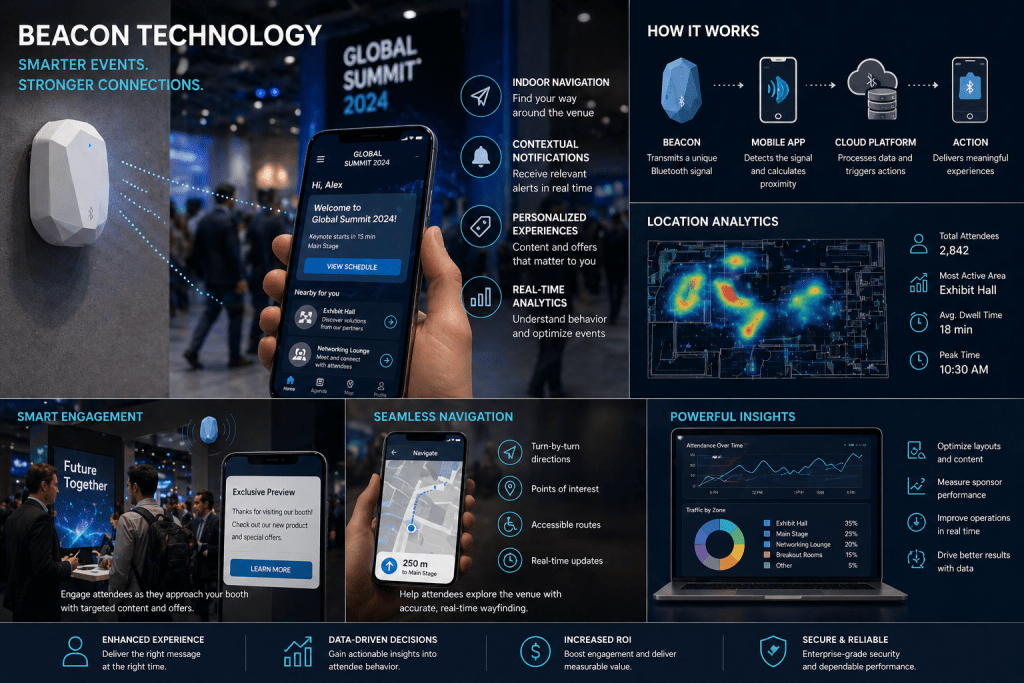
Introduction: From Presence to Context
Table of Contents
ToggleEvent systems have evolved from simply identifying attendees to understanding their behavior and intent. While technologies like RFID and NFC capture discrete interactions, they do not continuously interpret spatial context—where attendees are, how they move, and what they engage with over time.
Beacon technology fills this gap by enabling proximity-based sensing. Using low-energy Bluetooth signals, beacons create a persistent awareness layer within event environments. This allows systems to detect nearby devices and trigger context-aware actions in real time.
In modern event ecosystems, beacons act as ambient sensors—quietly enabling location intelligence and personalized engagement without requiring explicit user input.
Defining Beacon Technology in Event Contexts
Beacons are small wireless transmitters that use Bluetooth Low Energy (BLE) to broadcast signals at regular intervals. These signals are detected by nearby devices, typically smartphones, which interpret proximity based on signal strength.
In event environments, beacons are deployed across venues to:
- Detect attendee proximity to specific locations
- Trigger location-based interactions
- Collect movement and dwell-time data
Unlike NFC, which requires deliberate tapping, beacon interactions are passive and continuous.
Core Components of a Beacon System
Beacon Devices
Beacons are compact, battery-powered transmitters. Each beacon broadcasts:
- A unique identifier
- Signal strength indicators (RSSI)
- Configurable transmission intervals
Placement strategy is critical, as it defines coverage and accuracy.
Mobile Applications and Receivers
Attendee smartphones act as receivers, typically through event apps with BLE enabled.
These apps:
- Detect nearby beacons
- Estimate proximity
- Trigger actions based on predefined logic
User permissions and app adoption are essential for effectiveness.
Location and Proximity Engine
Backend systems interpret beacon signals to determine:
- Approximate location within the venue
- Movement patterns
- Dwell time in specific zones
This requires signal processing and filtering to handle noise and overlap.
Integration and Action Layer
Beacon data is integrated with event systems to trigger actions such as:
- Push notifications
- Personalized recommendations
- Workflow automation
APIs connect beacon systems with event platforms, analytics tools, and engagement systems.
Deployment Architecture: Spatial Sensing Network
Beacon systems function as distributed sensing networks.
- Beacons broadcast signals continuously
- Smartphones detect signals and estimate proximity
- Data is sent to backend systems
- Context is interpreted (location, duration, behavior)
- Actions are triggered in real time
This architecture enables continuous, passive data collection and response.
Use Cases in Event Environments
Indoor Navigation and Wayfinding
Beacons enable location-aware navigation within complex venues. Attendees receive directions based on their current position, improving flow and reducing confusion.
Contextual Notifications
As attendees approach specific areas—sessions, booths, or lounges—systems can deliver relevant notifications, such as:
- Session reminders
- Sponsor offers
- Personalized recommendations
Engagement Tracking
Beacons measure how attendees interact with spaces. Organizers can track:
- Foot traffic patterns
- Time spent in zones
- Popular areas and bottlenecks
This data supports optimization of layout and programming.
Sponsor Activation
Exhibitors can use beacons to trigger interactions when attendees approach booths. This enables:
- Targeted content delivery
- Lead capture
- Real-time engagement analytics
Integration with Event Technology Ecosystems
Beacon systems integrate with multiple layers of event technology.
Event data platforms aggregate proximity data with other interaction signals, creating a comprehensive view of attendee behavior.
Personalization engines use location context to tailor experiences dynamically. Real-time orchestration systems can adjust flows, notifications, and operations based on crowd conditions.
In advanced setups, beacon data complements inputs from RFID, NFC, and computer vision systems, forming a multi-layered sensing architecture.
Operational and Business Impact
Beacon technology enhances both operational intelligence and attendee experience.
For attendees, it enables context-aware interactions—information and recommendations are delivered when and where they are relevant.
For organizers, it provides continuous visibility into crowd dynamics. This supports better decision-making, from layout optimization to resource allocation.
For sponsors, it enables targeted engagement with measurable outcomes, improving ROI and accountability.
Challenges and Considerations
Implementing beacon systems requires careful planning.
Signal interference and environmental factors can affect accuracy. Overlapping signals may require calibration and filtering.
User adoption is critical. Attendees must install and enable event apps with Bluetooth permissions.
Privacy considerations must be addressed transparently. Attendees should understand how location data is used and have control over participation.
Battery management is also important, as beacon devices require periodic maintenance.
Future Outlook: Toward Real-Time Spatial Intelligence
Beacon technology is evolving as part of broader spatial intelligence systems.
Integration with AI and analytics platforms will enable predictive insights—anticipating crowd movement and optimizing flows proactively.
Advances in BLE technology and device capabilities will improve accuracy and reduce energy consumption.
Combined with other sensing technologies, beacons will contribute to a unified understanding of event environments—where systems continuously interpret and respond to spatial context.
Conclusion: Enabling Context-Aware Event Systems
Beacons introduce a continuous awareness layer into event environments. By enabling proximity-based sensing, they allow systems to understand not just who is present, but where they are and how they move.
This capability transforms events from static environments into responsive systems that adapt to attendee behavior in real time.
For event technology leaders, beacon technology is a ключевой component in building intelligent, context-aware event ecosystems that deliver more personalized, efficient, and data-driven experiences.