Sledge forecasts Q2 event trends in storytelling and hybrid
Introduction
Creative agency Sledge has released its outlook for the second quarter of the year, identifying how brands are reshaping live and hybrid experiences. The company’s latest trend snapshot highlights a renewed focus on narrative-driven events, a more selective approach to AI, and a gradual return to hybrid formats as organisations reassess how they connect with audiences in multiple locations.
Background or industry context
The business events sector entered 2024 with in-person experiences firmly re-established after years of disruption. Yet organisers continue to recalibrate formats, budgets and technologies against a backdrop of shifting audience expectations, economic caution and scrutiny of event impact.
Hybrid and virtual models, once driven primarily by necessity, are now being revisited with greater intention. Rather than simply streaming existing programmes, brands are exploring how content, formats and technology can be structured to serve distinct audience needs. At the same time, AI has moved from experimental pilots to widespread deployment, with vendors and clients alike positioning it as a key differentiator.
Sledge’s Q2 trend briefing sits within this broader landscape, drawing on its client work across corporate, brand and public sector events. The analysis signals where the agency expects demand, budgets and creative direction to move over the coming months.
Key developments or announcement
AI with clearer purpose
Sledge reports that AI remained highly visible in event discussions in the first quarter, but notes a shift away from adopting tools for their own sake. According to the agency, some brands continue to use AI as a status symbol to signal innovation, even in situations where it offers limited practical value.
Looking ahead to Q2, Sledge expects a more discerning approach. Event teams are anticipated to focus AI use on specific pain points, such as content personalisation, attendee journey design, translation, and analytics, rather than adding AI-branded features that do not materially improve the experience. The agency also points to ethical and trust considerations, including how data is handled and how clearly AI-assisted content is disclosed to audiences.
A new wave of storytelling
The report highlights storytelling as a central theme for the next quarter, with brands placing greater emphasis on how narratives are constructed and delivered across event touchpoints. Sledge observes that audiences, particularly younger demographics, are increasingly resistant to linear, presenter-led formats that offer limited interaction or relevance.
In response, organisations are experimenting with multi-threaded narratives, where participants can follow different storylines depending on their role, interests or location. This includes:
- Short-form content designed for social and internal channels to extend an event’s narrative beyond the venue.
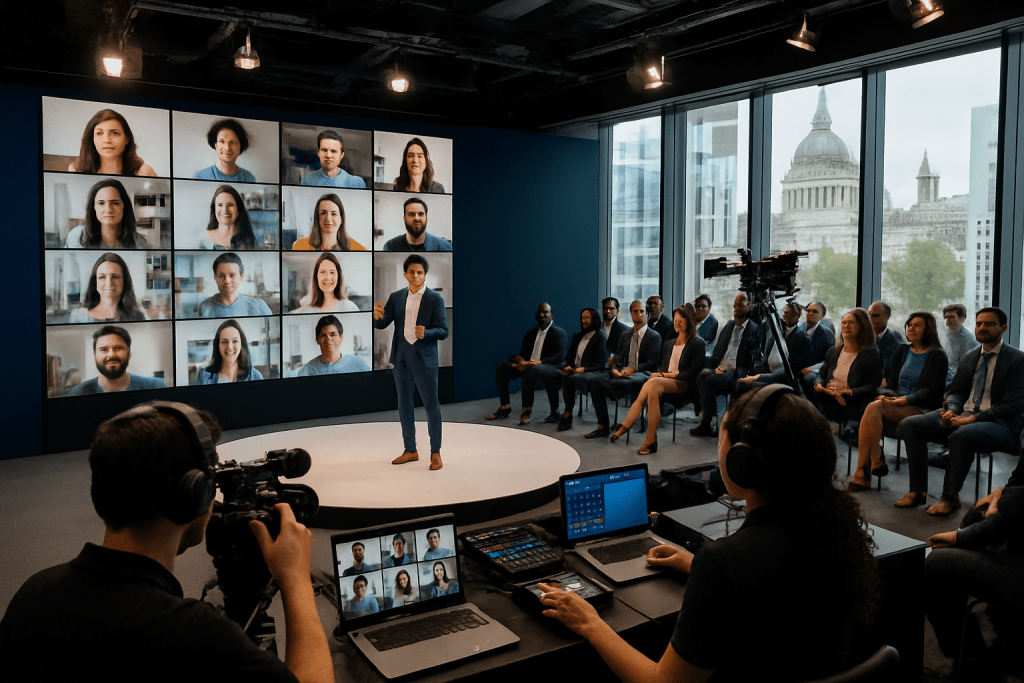
- Immersive staging, such as theatre-in-the-round or environment-led scenography, which puts the story at the centre rather than the stage set.
- Data-informed storytelling, where audience insights are used to adapt content in real time or between sessions.
Sledge suggests that brands are also rethinking how they measure the success of storytelling within events, shifting focus from attendance and satisfaction scores to indicators such as message recall, behavioural change and post-event engagement.
Hybrid formats return with a refined brief
While fully virtual events have declined from their pandemic peak, Sledge notes a “quiet resurgence” of hybrid formats heading into Q2. However, the form they take is evolving. Rather than replicating the full in-person agenda online, many organisations are prioritising distinct content and experiences for remote participants.
Examples cited by Sledge include:
- Shorter, high-impact digital programmes designed for global teams who cannot travel.
- Satellite gatherings or watch parties that pair live-streamed content with local facilitation.
- Hybrid town halls and leadership engagements where interactivity tools are used equally for in-room and remote audiences.
Budget pressure is also shaping the return of hybrid. Sledge observes that decision-makers are scrutinising the additional costs of multiple formats and expecting clear justifications in terms of reach, accessibility, and inclusivity. As a result, hybrid is being deployed more selectively for strategic moments rather than as a blanket default.
Industry impact
If Sledge’s Q2 trends play out, several knock-on effects for the event technology and production ecosystem are likely.
First, vendors providing AI capabilities may see a shift in buyer expectations from broad feature lists to demonstrable outcomes. Platforms that can show how AI improves attendee experience, reduces manual workload or generates actionable insights may gain ground over tools that rely mainly on branding and buzzwords.
Second, the renewed emphasis on storytelling will place pressure on content production workflows. Agencies, in-house teams and technology suppliers will need to collaborate more closely to ensure that narrative, format and platform capabilities are aligned. This may increase demand for flexible content management systems, audience segmentation tools and analytics that can inform iterative storytelling.
Third, the reconfiguration of hybrid models may influence the types of technology procured. Rather than large-scale broadcast infrastructure for every event, some organisations may opt for more modular setups: smaller studios, portable production kits and integrations between video platforms, registration systems and engagement apps.
Why this matters for event professionals and technology providers
For event planners and producers, Sledge’s analysis underscores the need to interrogate the purpose behind every technology and format decision. Practical considerations include:
- Defining clear use cases for AI, with success metrics tied to attendee experience, content quality or operational efficiency.
- Building narrative development into the planning process, including audience research, message hierarchy and multi-channel content strategies.
- Determining when hybrid is justified based on audience distribution, accessibility goals and return on investment, rather than treating it as a default feature.
For technology providers, the trends point to a market that is less tolerant of superficial innovation. Platforms that can support nuanced storytelling, data-driven decision-making and differentiated experiences for in-person and remote audiences may be better positioned. Providers may also need to offer clearer guidance on implementation and measurement, as clients seek evidence that new tools are contributing to strategic objectives.
Both sides of the market may benefit from closer collaboration at the planning stage, ensuring that the chosen technology stack directly supports narrative, engagement and accessibility goals rather than being added late in the process.
Conclusion
Sledge’s Q2 trends snapshot suggests an event landscape moving beyond experimentation towards more intentional use of technology and format. AI is expected to be judged on its practical contribution rather than its novelty, storytelling is becoming more layered and measurable, and hybrid events are re-emerging with tighter briefs and more targeted designs.
As brands continue to balance budget constraints, sustainability concerns and the push for meaningful engagement, the coming quarter may serve as a testing ground for more focused, story-led and audience-aware approaches to event design. For event professionals and technology providers, the opportunity lies in aligning tools and tactics with clearly defined outcomes, ensuring that innovation translates into tangible value for both organisers and participants.