Present Communications rethinks event value with hybrid production
Introduction
As organisers reassess what it means to stage an event in a digital-first era, audio-visual and streaming specialists are moving from support roles to strategic partners. In a recent discussion, Present Communications managing director Kieran Garlic outlined how advances in AV, live streaming and hybrid production are changing the way conferences and exhibitions are designed, delivered and measured. His perspective highlights a broader shift in the events sector: from one-off, in-room experiences to ongoing, content-led programmes that blend physical and digital participation.
Background or industry context
The past few years have accelerated long-anticipated changes in the event technology landscape. As travel budgets tightened and remote participation normalised, organisers experimented with webcast sessions, virtual platforms and hybrid formats. What began as a workaround has evolved into a more permanent reconfiguration of event design.
In this environment, technical production is no longer confined to ensuring a stage, screen and sound system function correctly. Instead, event technology providers are increasingly asked to help clients develop content strategies, plan for multi-channel distribution and ensure that events remain accessible and reliable regardless of location. The convergence of on-site AV and online broadcast workflows is blurring boundaries between live events, studio production and digital media.
Present Communications, which has worked across conferences, exhibitions and corporate meetings, operates within this convergence. The company’s experience reflects how providers are adapting to hybrid expectations and how organisers are reassessing the role of content generated on site.
Key developments or announcement
In the conversation with host James Dickson, Garlic described several areas where Present Communications is focusing its efforts to meet changing demand:
- Extending event lifespan through content reuse: Rather than treating sessions as transient, one-time experiences, Present Communications is helping clients view presentations, panel discussions and keynote addresses as reusable assets. Live streams are captured, edited and repurposed for on-demand viewing, training materials, internal communications or marketing campaigns, allowing content to reach audiences long after the closing session.
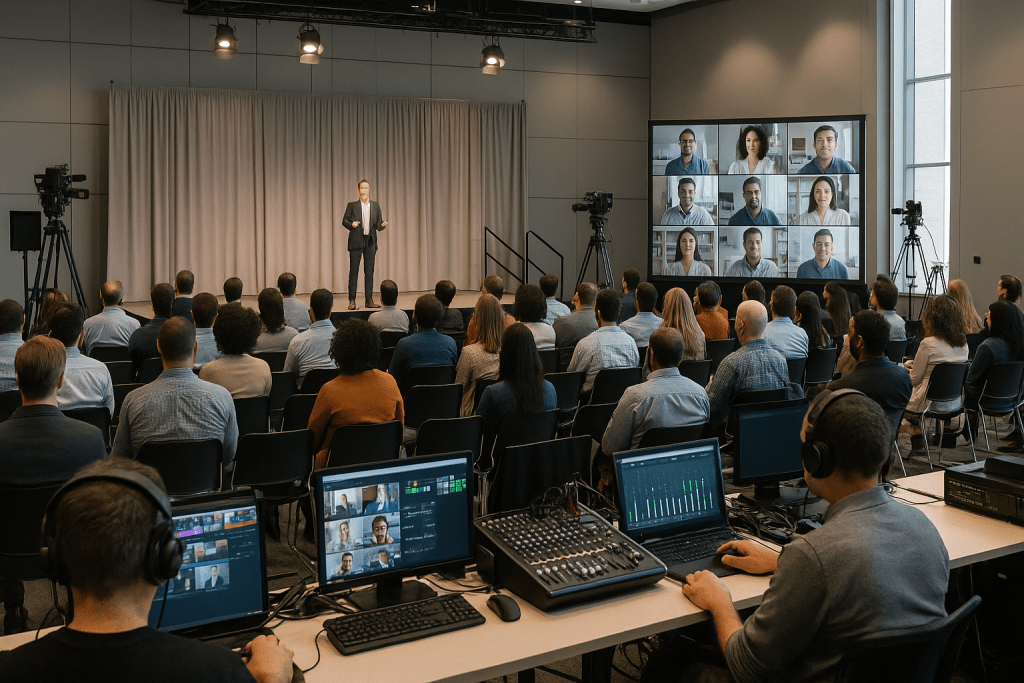
- Aligning AV and streaming from the outset: Garlic emphasised the need to design technical systems with both the in-room audience and remote participants in mind. This includes camera placement, audio routing, slide capture and redundancy planning, so that the same infrastructure can simultaneously support a high-quality on-site experience and a stable broadcast feed.
- Designing resilient hybrid systems: The company is prioritising resilience in both physical and digital workflows. This spans backup internet connections, failover hardware, mirrored recording paths and contingency plans for presenter or platform failures. The objective is to minimise disruption and maintain service levels even when components fail or external conditions change.
- Managing blurred lines between live and digital: Garlic noted that audiences increasingly expect parity between in-person and remote experiences, with consistent access to content and opportunities to interact. As a result, Present Communications is integrating production approaches that serve both groups, such as enabling Q&A from remote attendees, providing consistent slide and speaker views, and ensuring that set design works visually on camera as well as in the room.
- Improving accessibility and engagement: The company is also supporting organisers with practical steps to make content more accessible, such as incorporating captioning, choosing visual layouts that work for streaming platforms, and planning schedules that accommodate on-demand consumption. Engagement tools are selected and configured to complement, rather than distract from, the live programme.
Taken together, these developments demonstrate a shift from reactive technical provision to proactive planning, where event technology partners are embedded early in the design process.
Industry impact
The approach outlined by Present Communications reflects wider industry consequences of the move towards hybrid and digitally extended events.
First, organisers are reconsidering how they measure event success. Attendance in the room is now only one data point. Metrics such as live stream viewers, on-demand plays, average watch time and engagement levels are increasingly used to assess the value of a programme. AV and streaming partners are expected to supply reliable analytics or integrate with platforms that do.
Second, budgeting models are evolving. Investment in robust AV and streaming infrastructure is often offset by the expanded reach and the ability to repurpose content. Exhibitors and sponsors are also reevaluating their involvement, seeking opportunities not only on the show floor but within digital content that can circulate for months after the event.
Third, roles and responsibilities are shifting. Event planners are collaborating more closely with technical directors and production teams during concept development, not just in pre-event site visits. Decisions about room layouts, stage design, lighting and timing are increasingly informed by how they will translate to remote audiences and downstream content use.
Finally, attendee expectations have changed. Participants are accustomed to media-quality experiences from consumer platforms, making tolerance for poor audio, unstable connections or inaccessible content lower than in the past. Providers such as Present Communications are under pressure to bring broadcast-level standards to environments that were once considered purely live.
Why this matters for event professionals and technology providers
For event organisers, the practices described by Garlic point to several strategic considerations:
- Content strategy needs to be defined early: Organisers who know in advance how they intend to reuse and distribute session content can brief production teams accordingly, ensuring formats, rights and technical setups support long-term use.
- Technical resilience is now a core risk factor: Live and hybrid events depend on stable networks, reliable equipment and redundancy. Working with partners who prioritise resilience can reduce operational and reputational risk.
- Accessibility and inclusion demand deliberate planning: Captioning, clear audio, thoughtful camera work and flexible viewing options can broaden participation and help events meet organisational or regulatory requirements.
- Integrated experiences influence satisfaction: When on-site and remote participants access comparable content and interaction tools, it reduces the perception of a “second tier” remote audience and can improve feedback scores and return rates.
For technology providers, the discussion underscores the need to expand beyond technical execution:
- Advisory capabilities are in demand: Clients increasingly look to AV and streaming companies for guidance on platforms, formats, engagement tools and data collection, not just hardware choices.
- Interoperability is critical: Providers must ensure their solutions integrate with registration systems, event apps, virtual platforms and analytics tools in order to deliver a coherent experience and data set.
- Skills and workflows are converging: Traditional AV roles are intersecting with broadcast production and IT. Teams need familiarity with networking, streaming protocols and digital content workflows as much as with staging and audio.
Conclusion
The conversation with Present Communications’ Kieran Garlic illustrates how event technology providers are adjusting to a landscape where hybrid delivery and extended content life are becoming standard expectations. By aligning on-site AV with live streaming, prioritising resilience and considering content reuse from the outset, companies like Present Communications are helping organisers derive more value from their programmes while meeting rising expectations from both physical and remote participants.
For the wider events industry, this shift suggests that future growth will depend not only on drawing audiences to venues, but also on building sustainable, high-quality content ecosystems around every event. Those who integrate technical planning, accessibility and hybrid engagement into their core strategies are likely to be better positioned as the line between stage and stream continues to narrow.