Exhibition design shifts toward meaning-driven experiences
Introduction
Exhibitions and trade shows are undergoing a noticeable shift. As brands compete for attention in increasingly saturated environments, organisers and exhibitors are moving away from purely attention-grabbing installations toward experiences that feel more purposeful and relevant. The forthcoming Johnnie Walker Drop experience, created by creative agency Chorus, illustrates how exhibition design is evolving toward meaning-first concepts that prioritise narrative, visitor intent and measurable engagement over size or spectacle alone.
Background and industry context
For years, large-scale builds, dramatic set pieces and high-cost booths defined competitive success at major exhibitions. While these elements still have value, they no longer guarantee impact in a climate where audiences are more selective with their time and brands are under pressure to demonstrate clear returns on experience (ROX) and return on investment (ROI).
By 2026, exhibition and trade show strategies are increasingly being evaluated on their capacity to deliver substance, not just presence. Attendees expect exhibitions to be tailored, informative and aligned with their values, while event organisers expect activations to generate data, insight and long-term engagement opportunities. In this environment, meaning becomes a key differentiator: experiences need to be rooted in a clear purpose, supported by coherent storytelling and activated through technology that enhances rather than distracts.
For brands operating in mature or highly competitive categories such as premium beverages, the challenge is pronounced. Loyalty is contested, consumer expectations are evolving, and channels for discovery and advocacy are fragmented across digital, retail and live environments. Exhibitions for these brands are no longer just about visibility—they function as strategic touchpoints for education, sampling, community building and content creation.
Key developments: the Johnnie Walker Drop by Chorus
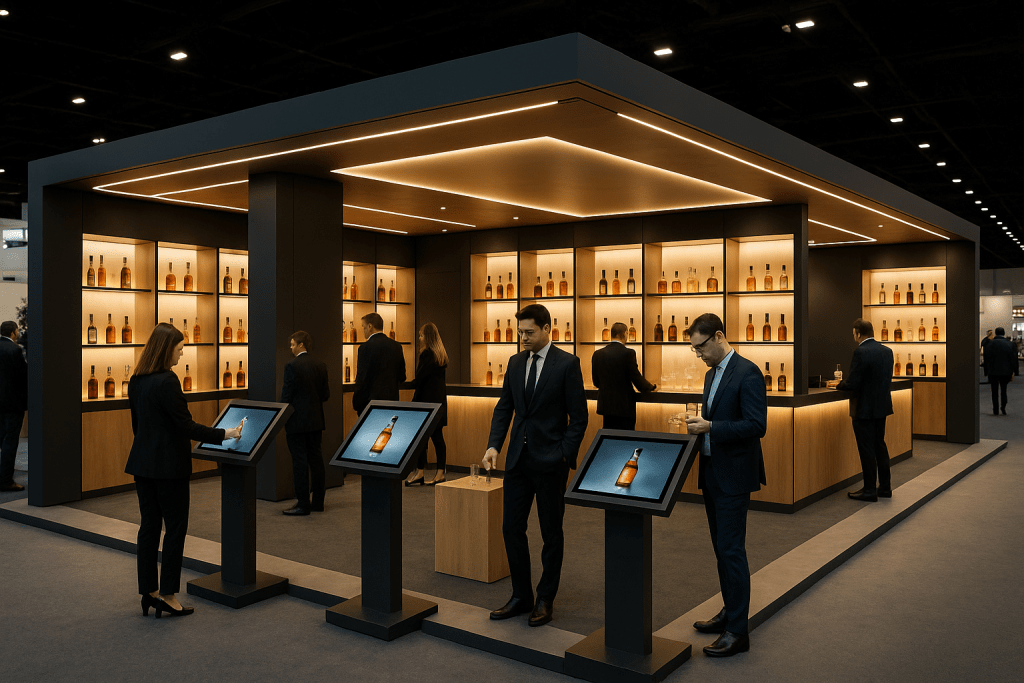
Against this backdrop, Chorus has developed the Johnnie Walker Drop, an exhibition concept built around intentionality rather than spectacle. While detailed technical specifications of the installation have not been fully disclosed, the project reflects several clear trends in how experiential teams are approaching exhibition design:
- Narrative-led environments: The experience is structured around a coherent brand story that guides visitors from curiosity through discovery to deeper understanding of the product and its heritage. Instead of multiple disconnected touchpoints, the environment functions as a single, continuous journey.
- Designed for specific audiences: The activation recognises that trade visitors, distributors and consumers all arrive with different expectations and levels of product knowledge. The Johnnie Walker Drop is therefore conceived to accommodate varied visitor profiles, with layers of content and engagement calibrated to different needs.
- Integration of digital and physical: While not presented as a fully hybrid event, the experience reflects hybrid thinking. Physical sampling, tactile materials and in-person storytelling are complemented by digital interactions and data capture, allowing the brand to extend engagement beyond the stand and into post-event communication.
- Measurement baked into design: The project is structured to provide the brand with meaningful feedback—whether through scanning, opt-ins, time spent in particular zones or engagement with specific content. This enables both qualitative and quantitative assessment of what elements actually resonate.
The Johnnie Walker Drop demonstrates a broader move toward experiences that are smaller in physical footprint but more concentrated in intent. It is less about commanding the largest space on the show floor and more about constructing an environment that clearly articulates what the brand stands for and why visitors should engage with it.
Industry impact
The approach embodied by the Johnnie Walker Drop has implications for exhibition organisers, agencies, technology providers and brands:
- Reframing success metrics: Traditional measures—footfall, impressions and one-off interactions—are giving way to metrics focused on depth of engagement, data quality and downstream impact on sales or brand perception. Experiences like the Johnnie Walker Drop are designed from the outset with these outcomes in mind.
- Smarter use of budget: As economic conditions remain uncertain and marketing budgets are scrutinised, brands are increasingly choosing focused, experience-rich environments over large, undifferentiated stands. Agencies are encouraged to allocate spend toward content development, interactive layers and analytics rather than sheer scale.
- Closer alignment between creative and technology: Exhibition concepts now frequently originate with a clear understanding of what can be tracked and optimised. This requires early collaboration between creative teams, technologists and data specialists so that the physical design supports meaningful digital interactions.
- Demand for modular, reusable assets: Experiences like the Johnnie Walker Drop can be adapted for multiple markets or event formats. This modularity allows brands to maintain consistency across global activity while tailoring content to local audiences and different event types, including pop-ups, trade fairs and experiential retail.
For exhibition organisers, the emergence of meaning-driven activations also raises expectations around infrastructure, connectivity and data policy. Exhibitors want to integrate their own tools—CRM systems, marketing automation, analytics platforms—with venue technology, and they expect clarity around data ownership and privacy compliance.
Why this matters for event professionals and technology providers
For event professionals, the Johnnie Walker Drop underscores the need to design with purpose at every stage of the exhibition lifecycle:
- Strategic briefing: Clear objectives, defined audiences and measurable outcomes should guide the brief. Creative partners and technology vendors need this clarity to recommend appropriate tools and formats.
- Experience architecture: Every element—from spatial layout and content sequencing to digital interfaces and sampling moments—should support a central narrative. Redundant elements that do not serve the story or the metrics are increasingly difficult to justify.
- Technology as enabler, not centrepiece: Tools such as RFID, QR codes, mobile apps, content management systems and analytics dashboards are valuable when they support the visitor journey and yield actionable insights. Overly complex or standalone tech that introduces friction is unlikely to be adopted at scale.
- Post-event continuation: Exhibitions are now treated as one chapter in a longer relationship. The data and content produced on-site power follow-up communications, ongoing education and future personalisation across channels.
For technology providers, these trends signal growing demand for interoperable platforms that can be embedded seamlessly into physical builds. Solutions must address real exhibitor challenges: managing lead data across multiple markets, measuring engagement reliably, and supporting agile content updates as messaging evolves.
Conclusion
As the exhibition sector continues to adapt to shifting audience expectations and economic pressures, meaning-driven design is emerging as a defining characteristic of successful activations. The Johnnie Walker Drop by Chorus is one example of how brands are rethinking their trade show presence—focusing on intentional storytelling, integrated technology and measurable outcomes rather than scale for its own sake.
For organisers, agencies and technology providers, the message is clear: future-ready exhibitions will prioritise clarity of purpose, thoughtful experience design and robust data strategies. Those able to align creative, operational and technological decisions around these principles are likely to find their exhibitions not only attract attention, but also deliver sustained value beyond the show floor.