Digital Badge Ecosystems: From Access Credentials to Programmable Identity Layers
Introduction: Rethinking the Role of Event Badges
Event badges have traditionally served a narrow purpose: identification and access control. Whether printed passes, QR codes, or RFID-enabled cards, badges have been designed primarily to verify entry and distinguish attendee types. While incremental improvements have enhanced efficiency, the underlying concept has remained largely unchanged.

As event ecosystems become more interconnected and data-driven, this limited role is increasingly insufficient. Attendees interact with multiple systems—registration platforms, networking tools, session tracking, sponsor activations—yet their identity is often fragmented across these touchpoints.
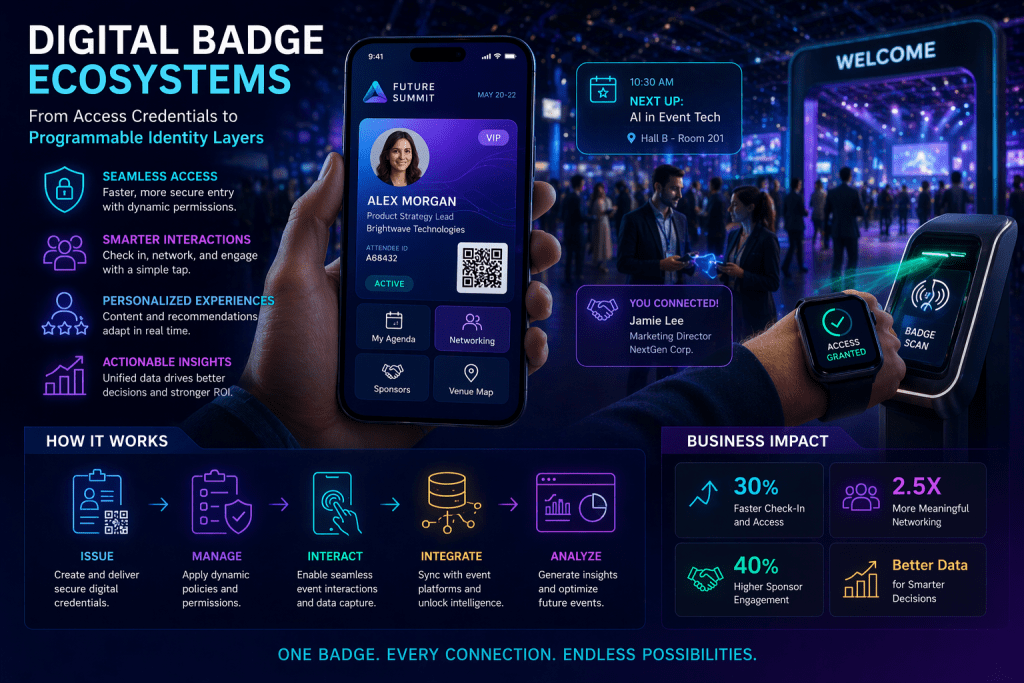
Digital badge ecosystems represent a shift from static credentials to programmable identity layers. Instead of functioning as simple access tokens, badges become dynamic, data-rich entities that enable authentication, interaction, personalization, and analytics across the entire event environment.
From Static Credentials to Dynamic Identity
Traditional badges are static by design. Once issued, their function rarely changes. Access rights are predefined, and interactions are limited to scanning or visual verification.
In contrast, digital badge ecosystems treat identity as dynamic and context-aware. A badge is no longer just a representation of who an attendee is, but a system that evolves with their behavior, interactions, and permissions.
This transformation is driven by three key capabilities:
- Programmability, allowing badge behavior to change based on rules or conditions
- Interoperability, enabling badges to function across multiple systems and platforms
- Real-time connectivity, ensuring that badge data is continuously updated and accessible
Together, these capabilities position badges as central nodes within the event technology architecture.
Architectural Foundations
Building a digital badge ecosystem requires a layered architecture that integrates identity management, data systems, and interaction interfaces.
Identity and Credential Layer
At the core is the identity layer, where badges are issued and managed. This may involve:
- Token-based credentials linked to attendee profiles
- Cryptographic identifiers for secure authentication
- Device-bound credentials stored in mobile wallets
This layer ensures that each badge is uniquely identifiable and verifiable across systems.
Access Control and Policy Engine
Access rights are governed by a policy engine that defines who can access what, when, and under what conditions. Unlike static permissions, these policies can be dynamic.
For example, access to a VIP area may be granted based on real-time conditions, such as availability or attendee status. Policies can also adapt based on behavior, enabling more flexible and responsive access control.
Interaction and Event Layer
Badges enable interactions across the event ecosystem. These interactions include:
- Session check-ins
- Networking exchanges
- Sponsor engagements
- Content access
Each interaction generates data that feeds back into the system, updating the badge’s state and enabling further actions.
Data Integration Layer
Digital badge ecosystems rely on integration with event data platforms and other systems. This ensures that badge data is consistent and accessible across applications.
APIs and event-driven architectures enable real-time synchronization, allowing badge interactions to trigger actions in other systems, such as personalization engines or analytics platforms.
Experience Interface Layer
Badges are accessed and used through various interfaces:
- Mobile apps and digital wallets
- Wearable devices
- Physical tokens with embedded chips
- Biometric-free authentication systems
The choice of interface affects usability, accessibility, and security.
Use Cases Across the Event Lifecycle
The expanded capabilities of digital badges enable a wide range of applications.
During entry, badges provide seamless authentication, enabling fast and secure access without manual verification. Advanced systems can support offline validation, ensuring reliability even in low-connectivity environments.
Within the event, badges facilitate interaction. Attendees can check into sessions, exchange contact information, and engage with sponsors using simple, frictionless interactions. These interactions are recorded and integrated into the broader data ecosystem.
For networking, badges enable controlled data sharing. Attendees can choose what information to share and with whom, maintaining privacy while enabling meaningful connections.
Post-event, badge data supports analytics and follow-up. Organizers and sponsors gain insights into attendee behavior, engagement patterns, and outcomes, enabling more targeted strategies.
Integration with Event Technology Systems
Digital badge ecosystems act as a connective layer within the event technology stack.
Event data platforms use badge interactions as primary inputs, constructing comprehensive attendee profiles and behavioral models. Real-time personalization engines leverage badge data to deliver context-aware recommendations.
Access control systems rely on badge credentials to manage entry and permissions, while networking platforms use them to facilitate connections.
This integration creates a unified identity framework that spans all aspects of the event, ensuring consistency and interoperability.
Operational and Business Impact
The transition to digital badge ecosystems has significant implications for event operations and business outcomes.
Operationally, it streamlines processes such as check-in, access control, and session tracking. Automation reduces manual effort and improves efficiency, particularly in large-scale events.
From an experience perspective, it reduces friction. Attendees interact with the event environment seamlessly, without the need for repetitive authentication or manual processes.
For sponsors, badge data provides deeper insights into engagement. Instead of relying on isolated interactions, they can analyze comprehensive behavior patterns, improving lead quality and conversion.
Strategically, digital badges enable events to function as interconnected systems rather than isolated components, enhancing both scalability and adaptability.
Security and Privacy Considerations
As badges become central to event identity, security and privacy become critical concerns.
Tokenization and encryption protect badge credentials from unauthorized access. Decentralized identity approaches can further enhance security by reducing reliance on centralized data stores.
Privacy controls are essential. Attendees must have clear visibility into what data is collected and how it is used. Mechanisms for consent and selective disclosure ensure that users retain control over their information.
Compliance with data protection regulations is also आवश्यक, particularly in global events with diverse attendee bases.
Challenges in Implementation
Despite their advantages, digital badge ecosystems present several challenges.
Integration complexity is a primary concern. Connecting multiple systems and ensuring consistent data flows requires robust architecture and governance.
User adoption can also be a barrier. Attendees must understand and trust the system, which requires intuitive design and clear communication.
Infrastructure requirements vary depending on the chosen implementation. Physical tokens, mobile apps, and wearable devices each introduce different constraints and dependencies.
Finally, balancing flexibility with control is a key challenge. While programmability enables dynamic behavior, it also requires careful management to avoid unintended consequences.
Future Outlook: Toward Persistent Identity Layers
The evolution of digital badge ecosystems points toward persistent identity systems that extend beyond individual events.
Attendees may carry digital credentials across multiple events, creating continuous identity profiles that evolve over time. This enables more consistent experiences and deeper insights.
Integration with broader identity ecosystems—such as enterprise systems or decentralized identity networks—will further expand capabilities.
Advances in authentication technologies, including passkeys and device-bound credentials, will enhance security and usability.
Conclusion: Identity as Infrastructure
Digital badge ecosystems redefine the role of identity in event technology. By transforming badges into programmable, interconnected systems, they enable a new level of integration, personalization, and intelligence.
This shift positions identity not as a supporting function, but as core infrastructure. It connects systems, enables interactions, and drives both operational efficiency and experiential quality.
For event technology leaders, the challenge lies in designing badge systems that are secure, scalable, and user-centric. When implemented effectively, digital badges become more than credentials—they become the foundation upon which modern event ecosystems are built.