UK events leaders push for national accessibility framework
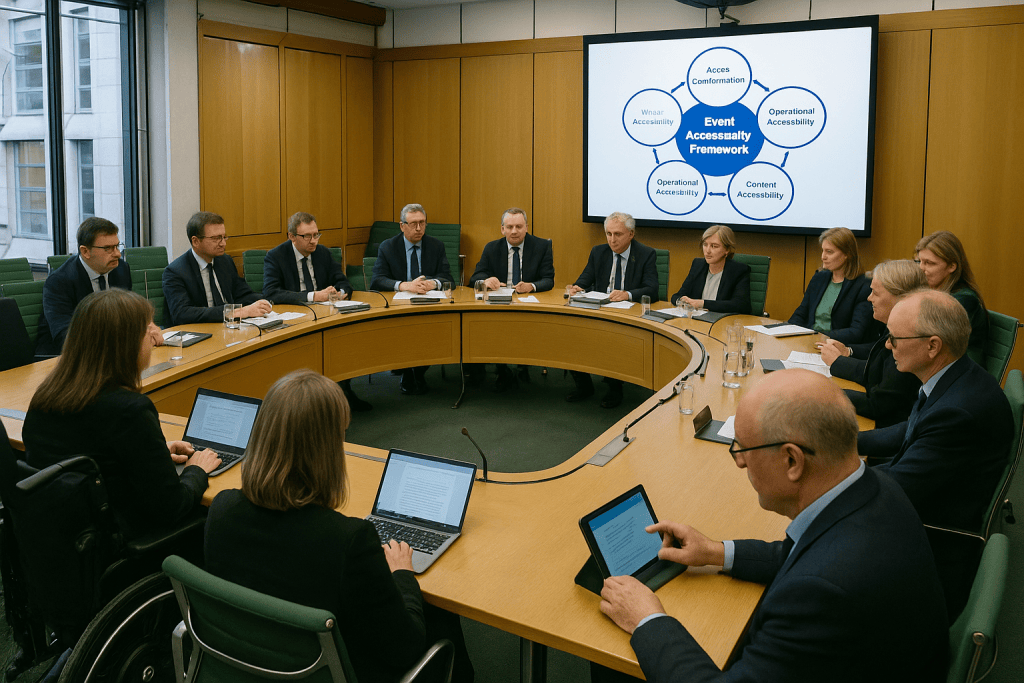
Senior figures from the UK events ecosystem, accessibility advocates and parliamentarians have renewed calls for a coordinated national approach to accessibility at events, during a roundtable held at Portcullis House, Westminster.
The discussion, convened by the All-Party Parliamentary Group (APPG) for Events in partnership with The Business of Events and ICC Wales, focused on how the UK can move towards a more consistent framework that improves access for disabled attendees, exhibitors, speakers and staff across business events, conferences and exhibitions.
Chaired by the APPG for Events, the session highlighted growing concern that accessibility standards across the sector remain uneven, despite heightened awareness and regulatory obligations. Participants argued that a clearer, shared framework would support venues, organisers and suppliers in implementing improvements more systematically.
Background and industry context
Accessibility has become a core focus for event organisers as expectations around inclusive design, assistive technology and hybrid participation have accelerated. The growth of digital and hybrid formats during the pandemic highlighted both new opportunities for inclusion and fresh barriers, from inaccessible platforms to inconsistent captioning and support services.
At the same time, UK equality legislation and building regulations establish legal responsibilities but do not always translate into practical, event-specific guidance. This has left many organisers relying on individual venue policies, supplier capabilities or voluntary best-practice standards, resulting in a patchwork of provision across the country.
Industry bodies and specialist organisations have been pushing for greater consistency for several years, including more structured training, clearer procurement standards and better integration of accessibility considerations into event technology and digital platforms.
Key developments from the Westminster roundtable
The Westminster meeting brought together representatives from event venues, event management companies, destination organisations, disability and accessibility groups, and members of Parliament. The central theme was how to move from isolated good practice to a UK-wide framework that could guide decision-making for all event types, from trade shows and association congresses to corporate meetings and public events.
During the discussion, the chair of the APPG for Events called for a ministerial-level meeting to explore how government could support the development and adoption of such a framework. The objective would be to create a more joined-up approach across departments with responsibility for tourism, business events, culture, equality, and digital infrastructure.
Participants stressed that any future framework should cover both physical and digital environments. This would include infrastructure and wayfinding within venues; booking and registration processes; on-site services such as interpretation, captioning and quiet spaces; and the accessibility of virtual event platforms, apps and content delivery tools.
The involvement of ICC Wales and The Business of Events underlined the importance of aligning national policy discussions with practical experience from venues and organisers implementing accessibility measures on the ground. Examples referenced within the debate included ongoing work on staff training, investment in assistive technologies, and initiatives to consult directly with disabled users during event planning.
Potential industry impact
A UK-wide accessibility framework for events, if developed and supported at ministerial level, could have several implications for event professionals and technology providers:
- Greater clarity on expectations: A shared framework would give organisers clearer benchmarks when designing events, specifying requirements for suppliers, or evaluating venues and digital platforms.
- More consistent attendee experience: Delegates and visitors with access needs could benefit from a more predictable level of support when attending events in different parts of the country or switching between in-person and online participation.
- Stronger link between policy and practice: Government engagement could encourage closer alignment between statutory duties and the operational realities of staging complex business events.
- Focus on measurable outcomes: A framework has the potential to support data collection and reporting on accessibility efforts, helping the industry track progress and identify gaps.
For event technology, the emphasis on digital and hybrid accessibility raises the bar for platform developers, registration systems, mobile app providers and content delivery tools. Captioning, screen-reader compatibility, customisable interfaces and support for assistive devices are likely to be increasingly scrutinised in procurement processes.
Why this matters for event professionals and technology providers
For organisers, accessibility is moving beyond compliance-driven box-ticking towards a strategic consideration that influences event design, audience reach and reputation. Corporate clients, associations and public sector buyers are placing greater weight on inclusion when selecting venues and partners, and accessibility performance is increasingly part of tender criteria.
A more coherent framework could help event professionals:
- Integrate accessibility earlier in the planning cycle, rather than retrofitting solutions close to delivery.
- Engage with disabled stakeholders and specialist advisors in a structured way.
- Build accessibility into contracts with venues, production companies and technology suppliers.
- Justify investment in training, infrastructure and digital tools to internal decision-makers.
For technology providers, the Westminster discussions signal a continuing shift in buyer expectations. Platforms that demonstrably support accessible participation – for example through robust captioning, keyboard navigation, alternative text options, colour contrast controls, and compatibility with assistive software – are likely to gain competitive advantage as standards evolve.
Vendors serving the UK events market may need to prepare for more detailed accessibility questions during procurement, and for closer collaboration with accessibility consultants and user groups when designing new features. Interoperability between on-site and online systems will also be under increased scrutiny, as organisers look to deliver consistent experiences for hybrid audiences.
Conclusion
The Westminster roundtable highlighted a shared recognition across Parliament, industry and the accessibility community that the UK’s current approach to event accessibility is fragmented and in need of more structure. The call from the APPG for Events chair for a ministerial meeting marks a step towards elevating the issue on the government agenda and exploring what a national framework could look like.
While any formal framework will take time to develop and adopt, the direction of travel is clear: accessibility is becoming a central pillar of event strategy, and technology is integral to delivering on that ambition. Event professionals, venues and tech providers operating in the UK market may wish to review their current practices, assess where they stand against emerging expectations, and prepare for a landscape in which accessibility standards are more clearly defined and more consistently enforced.