Autonomous Networking Systems: AI Agents That Network on Your Behalf
7 months ago Timothy Myres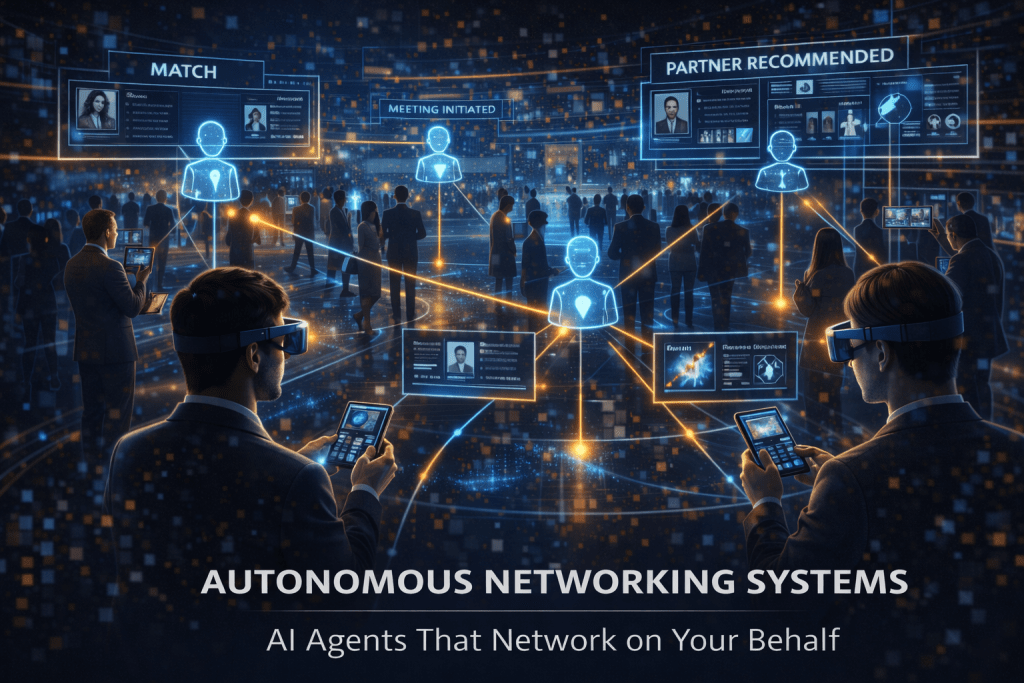
Introduction: The Limits of Human-Centric Networking
Table of Contents
ToggleNetworking has long been positioned as one of the primary value drivers of events. Yet, despite advances in matchmaking algorithms and event apps, the process remains fundamentally manual. Attendees browse profiles, send requests, attend sessions, and attempt to connect—often with limited success and significant friction.
The core issue is not a lack of data, but a mismatch between opportunity and execution. Events generate dense networks of potential connections, but individuals lack the time, context, and cognitive bandwidth to identify and pursue the most valuable interactions in real time.
Autonomous networking systems introduce a new model. Instead of relying solely on attendees to initiate and manage connections, AI agents act on their behalf—interpreting intent, identifying opportunities, and facilitating interactions dynamically. This shifts networking from a user-driven activity to a system-orchestrated process.
From Matchmaking to Autonomous Representation
Traditional networking tools operate as recommendation systems. They suggest connections based on profile similarity, shared interests, or past behavior. While useful, these systems stop short of execution. The responsibility to act remains with the user.
Autonomous networking systems extend this model by introducing agent-based representation. Each attendee is paired with an AI agent that continuously analyzes their behavior, preferences, and objectives. These agents do not merely recommend connections; they initiate, coordinate, and optimize interactions.
This transformation parallels broader trends in AI, where systems move from passive assistance to active participation. In the context of events, it enables networking to scale beyond human limitations.
Modeling Attendee Intent in Real Time
At the heart of autonomous networking lies intent modeling. Understanding what an attendee is trying to achieve—whether learning, hiring, selling, or exploring—is essential for identifying meaningful connections.
Intent is not static. It evolves throughout the event, influenced by sessions attended, conversations held, and content consumed. Autonomous systems must therefore operate on continuous streams of behavioral data, updating their understanding in real time.
Machine learning models interpret signals such as session participation, dwell time, interaction patterns, and contextual metadata. These signals are translated into probabilistic representations of intent, allowing agents to prioritize connections that align with current objectives.
The challenge is not simply accuracy, but responsiveness. Intent must be inferred quickly enough to influence interactions as they unfold.
Agent Architecture: Representation, Communication, and Coordination
An autonomous networking system is composed of multiple interacting agents, each representing an attendee. These agents operate within a shared environment, communicating and negotiating to identify mutually beneficial connections.
Each agent maintains a dynamic profile that includes inferred intent, preferences, constraints, and interaction history. Based on this profile, the agent evaluates potential connections and initiates engagement when appropriate.
Communication between agents is governed by protocols that balance autonomy with alignment. For example, an agent may propose a meeting with another agent, negotiate timing and context, and finalize the interaction without direct user intervention. At the same time, user-defined constraints—such as availability or privacy preferences—are respected.
Coordination mechanisms ensure that the system avoids redundant or conflicting interactions. In large-scale events, where thousands of agents operate simultaneously, efficient coordination is essential to maintain system performance and relevance.
Interaction Models: Blending Automation with Control
A critical design consideration is how much autonomy to grant these agents. Fully automated interactions may maximize efficiency but risk reducing user control and transparency. Conversely, requiring explicit user approval for every action can reintroduce friction.
Most implementations adopt a hybrid approach. Agents operate autonomously within defined boundaries, initiating low-risk interactions while seeking user confirmation for higher-stakes engagements. For example, an agent may suggest a meeting and tentatively schedule it, allowing the user to confirm or adjust details.
User interfaces play a key role in maintaining trust. Attendees must be able to understand why connections are suggested, how decisions are made, and how to override or refine agent behavior. Transparency is not merely a usability feature; it is a prerequisite for adoption.
Real-Time Orchestration of Networking Opportunities
The true value of autonomous networking emerges in real-time environments. As events unfold, opportunities for interaction are transient. A relevant contact may be nearby for only a short window, or a session may create a temporary alignment of interests.
Autonomous systems continuously monitor these conditions, identifying moments where interactions are most likely to be valuable. Agents can coordinate meetings based on proximity, availability, and contextual relevance, ensuring that connections occur at the right time and place.
This requires integration with spatial systems, scheduling platforms, and communication tools. The orchestration layer must align multiple variables—location, time, intent, and constraints—to facilitate seamless interactions.
Business and Operational Impact
For attendees, autonomous networking reduces the cognitive load associated with identifying and managing connections. Instead of actively searching for opportunities, they are presented with curated, contextually relevant interactions that align with their goals.
For organizers, these systems increase the overall effectiveness of networking, a key metric of event success. Higher-quality connections translate into greater attendee satisfaction and stronger retention.
Sponsors and exhibitors benefit from improved lead generation. Autonomous agents can identify high-intent prospects and facilitate targeted interactions, increasing conversion rates and optimizing resource allocation.
At a system level, networking becomes a measurable and optimizable process. Data generated through agent interactions provides insights into connection quality, engagement patterns, and overall network dynamics.
Ethical and Privacy Considerations
The introduction of autonomous agents raises important ethical questions. Delegating networking decisions to AI systems requires careful consideration of privacy, consent, and user agency.
Attendees must have clear control over how their data is used and how their agents operate. Preferences regarding visibility, communication, and data sharing should be explicit and easily adjustable.
There is also the question of fairness. Systems must avoid reinforcing biases or creating unequal access to opportunities. Ensuring that all attendees benefit from the system, rather than a select subset, is critical for maintaining trust.
Transparency in decision-making is essential. Users should be able to understand how connections are determined and how their behavior influences outcomes.
Technical Challenges
Building autonomous networking systems involves several technical challenges. Real-time processing is essential, as delays can render opportunities irrelevant. This requires efficient data pipelines, low-latency inference, and scalable infrastructure.
Interoperability is another concern. Networking systems must integrate with a wide range of event technologies, including registration platforms, mobile apps, and spatial systems. API-first architectures play a crucial role in enabling this integration.
Model accuracy and adaptability are also critical. Systems must balance precision with generalization, ensuring that recommendations remain relevant across diverse attendee profiles and event contexts.
Future Outlook: Toward Persistent Networking Agents
The evolution of autonomous networking systems points toward persistence. Rather than existing only within a single event, agents may become continuous representations of individuals across multiple events and platforms.
These persistent agents would accumulate knowledge over time, refining their understanding of user preferences and objectives. Networking would no longer be confined to event boundaries but would become an ongoing process, seamlessly integrated into professional workflows.
Advances in AI, particularly in multi-agent systems and reinforcement learning, will further enhance capabilities. Agents will become more adept at negotiation, coordination, and long-term planning, enabling increasingly sophisticated interactions.
Conclusion: Redefining Networking as a System
Autonomous networking systems redefine how connections are formed in event environments. By shifting from user-driven interactions to system-orchestrated processes, they address the fundamental limitations of traditional networking models.
This transformation is not without challenges. Balancing autonomy with control, ensuring ethical use, and maintaining trust are critical considerations. However, the potential benefits—improved efficiency, higher-quality connections, and scalable networking—are significant.
As events continue to evolve into complex, data-driven ecosystems, networking will increasingly be managed as a system rather than an activity. Autonomous agents represent a key step in this evolution, enabling connections that are not only more efficient, but also more meaningful.