Mobile NBA fan experience brings interactive activation to multiple U.S. cities
Background and context
Brands working in live events and sports marketing are increasingly using mobile activations to reach audiences beyond major arenas and flagship venues. Instead of relying solely on in-stadium experiences, companies are bringing interactive installations directly into local communities, retail districts, and city centers.
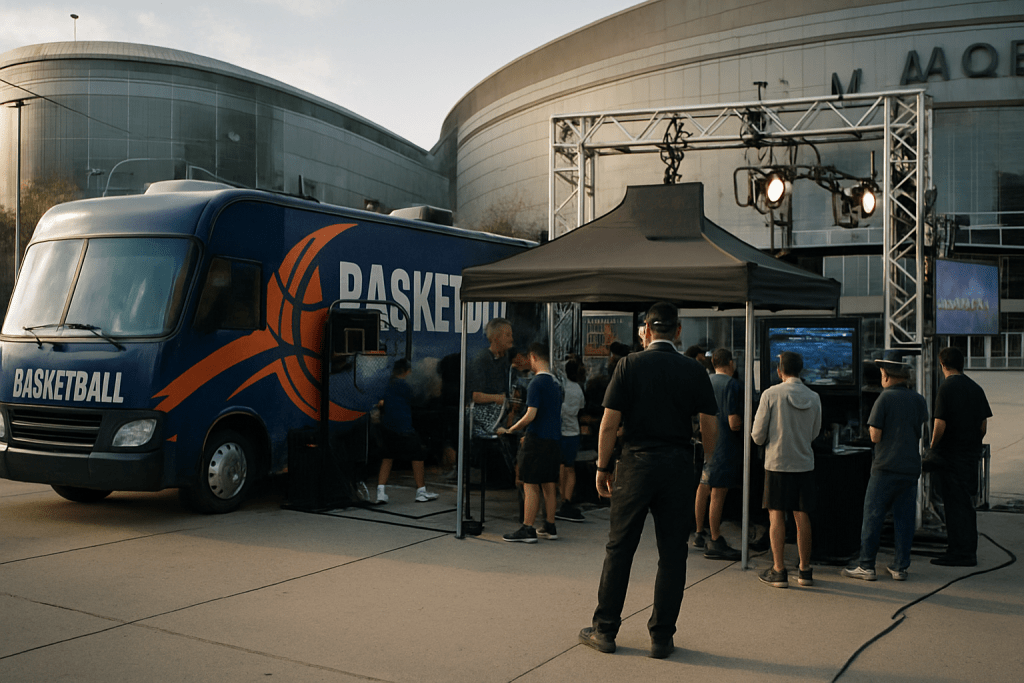
In this context, AT&T partnered with the NBA to develop a traveling fan experience informally known as the “Dunk Bus.” The project was designed to connect with basketball fans in multiple markets, offering a mix of physical challenges, gaming, and digital content in a self-contained, mobile environment.
Key announcement
The Dunk Bus toured several U.S. cities, including stops in Miami and Oklahoma City, as part of a wider effort to extend NBA-related engagement beyond game nights and major tentpole events. The activation converted a bus and adjacent footprint into a compact fan zone.
Inside and around the vehicle, visitors encountered a range of touchpoints:
- Basketball-themed activities, such as dunk-style experiences and shooting challenges
- Video gaming stations featuring basketball titles and casual play
- Merchandise and giveaways connected to the league and partners
- Scheduled appearances and meet-and-greets with current or former NBA players, varying by market
The build aimed to be modular and repeatable, so the same core setup could be deployed in different cities with relatively short turnaround times. Local elements, such as team references or regional content, could be layered on to make each stop feel specific to that market.
According to AT&T, the activation aligns with its broader strategy of linking connectivity and digital experiences with live sports. More information about the company’s sports and event initiatives can be found via its official site at att.com.
Industry impact
For event producers and experiential agencies, the Dunk Bus illustrates how a single mobile unit can function as a touring micro-venue. Instead of building large-scale fan zones from scratch in every city, a customized vehicle allows a brand to carry its core experience from market to market.
The model reflects several current trends in event technology and fan engagement:
- Hybrid physical-digital interaction: Combining live basketball elements with console or PC gaming creates multiple entry points for different age groups and interests.
- Compact, repeatable production design: Modular staging, AV, and power distribution inside the bus reduce setup complexity and support consistent delivery.
- Community-level reach: By parking in high-traffic urban areas or near local events, the activation taps into spontaneous footfall rather than relying solely on ticketed audiences.
Technically, the concept leans on reliable mobile power, compact audiovisual systems, and robust connectivity to support gaming, content playback, and social media sharing. These requirements are increasingly common in brand activations, where visitors expect smooth digital interactions even in temporary setups.
Why this matters
For the live events sector, AT&T’s Dunk Bus underscores the growing importance of portable, tech-enabled experiences that can scale across regions. As rights holders and sponsors look for new ways to show value, mobile activations provide measurable touchpoints in markets that may not host major games or large fan festivals.
Event organizers can view this approach as a template: a carefully branded vehicle, outfitted with flexible AV, interactive stations, and space for talent appearances, can extend a campaign’s lifespan and geographic reach. It also offers a way to test new formats—such as mixed reality content or app-driven challenges—on a smaller footprint before committing to larger builds.
While the Dunk Bus is specific to basketball, the model is adaptable to other sports, entertainment franchises, and touring properties. As experiential budgets shift toward programs that demonstrate ongoing engagement rather than single-day peaks, mobile activations of this kind are likely to become a more routine part of the event technology landscape.