Finsbury Park switches to mains power for major festivals
London’s Finsbury Park has become the first major outdoor festival site in the UK to be fitted with a permanent mains power supply for large-scale concerts and events, in a move that could significantly cut diesel generator use at live shows.
The project, led by Festival Republic in partnership with Haringey Council and National Grid, replaces much of the temporary power infrastructure traditionally brought on site for summer festivals. By connecting the park directly to the electricity grid, organisers aim to support the use of renewable energy and reduce the environmental footprint of high-capacity music events.
Background: powering large-scale festivals
Outdoor festivals and stadium-scale concerts have historically relied on temporary diesel and hybrid generators to meet high peak power demands for stages, sound, lighting, broadcast, catering and back-of-house operations. These systems are flexible and mobile but can be carbon-intensive, noisy and costly to operate, especially across multi-day events.
In recent years, pressure has grown across the live events sector to address emissions associated with on-site power. Organisers, artists, local authorities and audiences are increasingly focused on sustainability, prompting trials of hybrid generators, battery storage, biofuels and on-site renewables. However, one of the most persistent challenges has been how to provide reliable, high-capacity power in urban parks and greenfield sites without extensive use of diesel.
Finsbury Park is a key fixture on the UK festival circuit, hosting major concerts and summer events each year. The new grid connection is designed to serve those large productions while aligning with broader climate and air-quality objectives in London.
Key developments in the Finsbury Park project
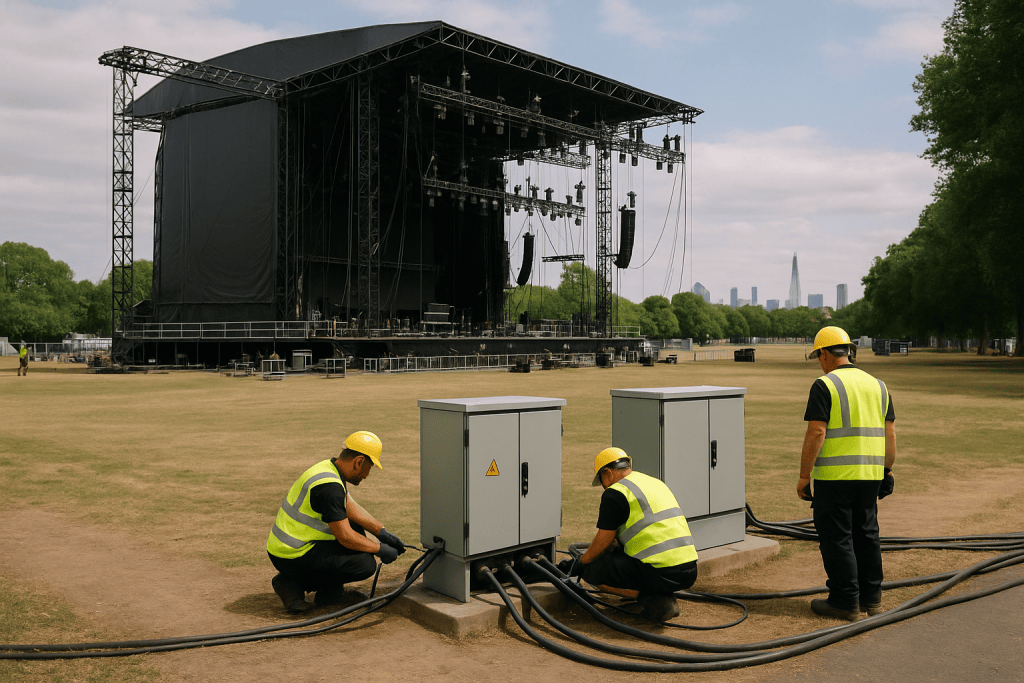
Festival Republic has overseen the installation of permanent electrical infrastructure at Finsbury Park, working closely with Haringey Council as the site owner and with National Grid to design and deliver the new connection. The scheme brings mains electricity directly onto the event site, enabling production teams to plug into the grid rather than installing banks of diesel generators for core show power.
The development marks the first time a UK festival site of this type has been equipped with a dedicated mains power solution specifically for major events. While many arenas and purpose-built venues have long benefited from grid connections, large outdoor parks used intermittently for concerts have typically not had the necessary power capacity available in situ.
The mains installation is designed to carry the substantial electrical loads required for headliner stages and associated production infrastructure. It is expected to be used for future concerts and multi-day festivals in the park, reducing the scale and runtime of temporary generator fleets deployed on-site.
By connecting to the national electricity network, the site can take advantage of the UK’s growing share of renewable generation on the grid, supporting wider decarbonisation goals. The project also positions Finsbury Park as a test case for how permanent power infrastructure could be integrated into other high-profile event locations.
Potential impact on the events and festival industry
The Finsbury Park upgrade introduces a new model for powering large outdoor events in city parks, with implications for both sustainability strategy and event operations. If the scheme performs as intended, it may encourage other local authorities and promoters to explore similar grid-based solutions at major sites.
For the festival and concert sector, key areas of potential impact include:
- Reduced diesel dependence: Direct access to mains electricity can significantly cut the volume of diesel burned on site, particularly for stage power and core technical infrastructure.
- Lower emissions and noise: Fewer large generators can help reduce greenhouse gas emissions and cut operational noise levels, which is relevant for both environmental reporting and community relations.
- Operational consistency: Mains power can provide a more stable and predictable power profile, removing some of the logistical complexity associated with large generator farms, refuelling and redundancy planning.
- Infrastructure precedent: Demonstrating a successful permanent connection at a high-traffic park offers a reference point for discussions with other councils, utilities and event operators.
At the same time, implementing permanent power at public parks requires alignment between municipal authorities, energy providers and event organisers. Issues such as capital investment, ongoing maintenance, access management and load planning for different event formats all need to be addressed.
Why this matters for event professionals and technology providers
For production managers, technical directors and sustainability leads, the Finsbury Park initiative highlights how long-term infrastructure decisions can reshape power strategies for major events.
Event professionals may need to reconsider:
- Power design and redundancy: With a grid connection in place, technical teams can re-balance how they use generators, batteries and distribution, potentially shifting generators to backup or supplementary roles.
- Supplier collaboration: Power contractors, rental companies and technology providers will need to integrate mains connections into their planning, metering and monitoring, and adapt equipment specs for hybrid grid-and-generator setups.
- Data and reporting: Access to metered mains power may simplify collecting accurate energy-use and emissions data, supporting ESG reporting and carbon-reduction targets requested by artists, sponsors and regulators.
- Long-term site planning: For other venues and councils, the project offers a live example to inform feasibility studies, business cases and stakeholder engagement around investing in permanent power for events.
Technology vendors developing load management systems, smart distribution, metering tools and energy-optimisation software may also find new opportunities as more sites move towards blended power models that combine grid access with temporary infrastructure.
Conclusion
The installation of mains power at Finsbury Park represents a notable shift in how large outdoor events in the UK can be powered, moving away from exclusive reliance on temporary diesel systems. While the long-term performance and economics will be closely watched, the project sets a practical benchmark for integrating permanent energy infrastructure into major festival locations.
For the wider event technology ecosystem, it underscores a broader trend: power is becoming a central part of sustainability and operational strategy, not just a backstage logistics issue. As more sites explore similar schemes, collaboration between promoters, local authorities, utilities and power-technology providers is likely to become an increasingly important part of planning the next generation of large-scale live events.