Three Days Grace adopts digital wireless system for global tour
Background and context
Canadian rock band Three Days Grace has built its reputation on high-energy, high-volume live shows. As the group tours internationally, its production team faces familiar challenges: complex RF environments, tight changeovers at festivals, and the need for reliable audio at consistently high sound pressure levels.
For this current touring cycle, the band’s crew has moved to a fully digital wireless approach for both vocals and instruments. The decision reflects a wider trend in touring audio, where engineers are seeking greater spectrum efficiency and stability as more events compete for limited wireless frequencies.
Key announcement
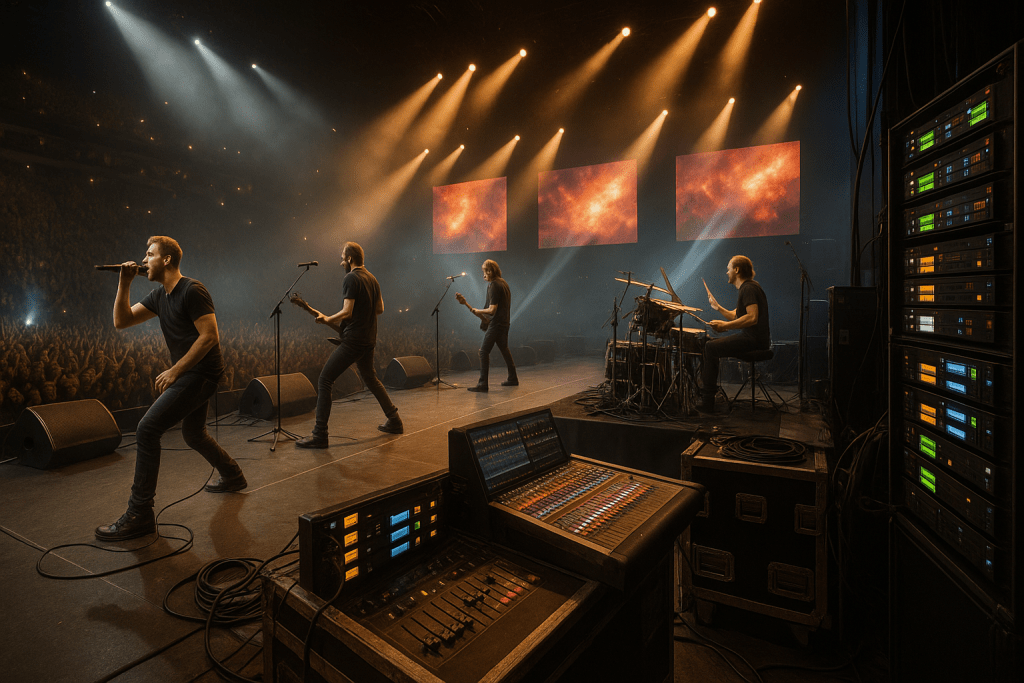
Three Days Grace is using Sennheiser’s EW-DX digital wireless system as the backbone of its RF setup on the world tour. The system is deployed for vocal microphones and for guitar and bass, replacing a mix of older analog solutions.
According to the production team, the key reasons for the switch include the need for clean performance at high SPL, streamlined frequency coordination across multiple territories, and simplified deployment for festival dates where the band has limited time for soundchecks.
The EW-DX platform is being used with handheld transmitters for the lead and backing vocals and bodypack transmitters for instruments. Receivers are racked at front of house and integrated into the existing networked audio infrastructure, allowing remote monitoring and control. The tour is also making use of rechargeable battery packs to reduce the amount of disposable batteries consumed across the run of shows.
Sennheiser positions EW-DX as part of its Evolution Wireless Digital range, designed for professional live sound, broadcast, and corporate events. Product information is available on the company’s official website.
Industry impact
The adoption of a digital UHF wireless system on a high-SPL rock tour underscores a broader shift in the live sound market. Digital RF platforms are becoming increasingly common not only in arenas and stadiums, but also in mid-size touring environments where spectrum competition and international frequency regulations create additional complexity.
For event technology providers, this move by a high-profile act illustrates how digital systems can serve both musical and logistical needs. Engineers gain more channels in the same spectrum, better tools for coordination, and tighter integration with networked audio workflows that are now standard in many large-scale productions.
It also highlights an ongoing focus on reliability under challenging conditions. Loud stage volumes, fast turnarounds, and long signal paths between stage and front of house all put pressure on RF setups. Tours that can demonstrate stable performance with digital systems in those conditions will likely influence choices made by rental companies, venues, and other touring productions.
Why this matters
For audio professionals and event organizers, Three Days Grace’s touring setup is a practical case study in how digital wireless can be deployed in demanding rock and metal environments. It shows that frequency-efficient systems are not limited to corporate or broadcast use, but can handle aggressive dynamics, long tours, and changing RF landscapes across multiple countries.
As more regions adjust spectrum allocations and more devices compete for bandwidth, production teams are under pressure to make better use of available frequencies. Systems like EW-DX point to a future where networked control, coordinated RF planning, and rechargeable power are standard expectations rather than premium features.
For the broader event technology sector, the tour reinforces a key message: investment in modern wireless infrastructure is increasingly tied not just to sound quality, but to operational efficiency, sustainability, and regulatory compliance across international touring schedules.