Smart Venue Design: How IoT-Enabled Furniture and Lighting Automatically Adjust to Attendee Flow
4 months ago Timothy Myres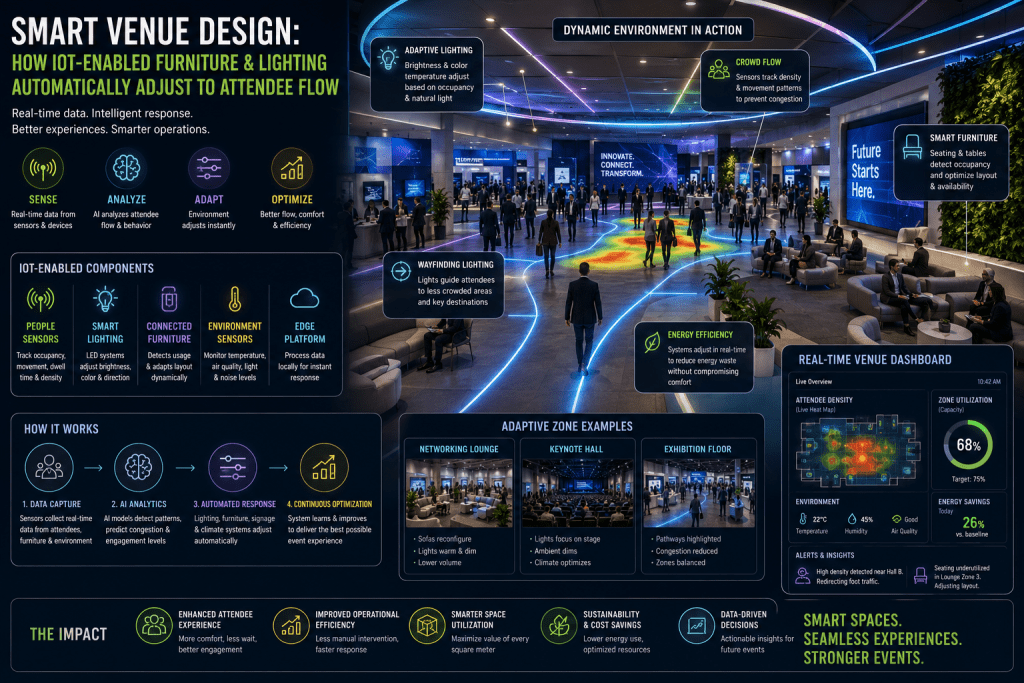
Modern event venues are evolving from static physical environments into responsive, data-driven ecosystems. As conferences, exhibitions, corporate summits, and hybrid experiences become increasingly dependent on real-time operational intelligence, venue infrastructure itself is becoming part of the event technology stack.
One of the most significant developments in this transformation is the rise of smart venue design powered by IoT-enabled furniture, adaptive lighting systems, occupancy sensors, and AI-driven environmental automation. Rather than relying on fixed layouts and manually controlled venue settings, next-generation event spaces are beginning to dynamically adjust to attendee movement, crowd density, behavioral patterns, and engagement activity in real time.
This shift reflects a broader industry transition toward intelligent spatial orchestration. Organizers are no longer designing venues solely for aesthetics or capacity optimization. Increasingly, they are designing responsive environments capable of improving attendee comfort, operational efficiency, energy management, and crowd flow through continuous environmental adaptation.
Smart venue infrastructure is turning physical event spaces into programmable environments.
Why Static Venue Design No Longer Works
Table of Contents
ToggleTraditional event venue design follows largely static operational models. Furniture placement, lighting intensity, room configurations, and traffic routing are typically established before attendee arrival and adjusted manually if problems emerge during the event.
However, modern events operate under increasingly dynamic conditions:
- Rapid attendee movement between sessions
- Fluctuating crowd density
- Hybrid participation patterns
- Interactive sponsor activations
- Flexible networking spaces
- Real-time scheduling changes
- Mobile-first attendee behavior
These factors make static environments inefficient and often unresponsive to actual attendee behavior.
Common operational challenges include:
- Congested networking zones
- Underutilized seating areas
- Poor traffic distribution
- Inconsistent lighting conditions
- Overcrowded entrances
- Energy waste in low-occupancy areas
- Attendee discomfort during peak movement periods
IoT-enabled venue systems aim to address these issues by continuously monitoring and adapting environmental conditions.
The Technology Foundation of Smart Venue Design
Smart venue environments rely on interconnected layers of sensors, connected infrastructure, edge computing systems, and AI-based analytics platforms.
At the core of these systems is the Internet of Things (IoT), which enables physical objects within the venue to collect, transmit, and respond to operational data.
A typical smart venue architecture may include:
- Occupancy sensors
- LiDAR crowd tracking
- Computer vision systems
- Smart lighting networks
- Connected furniture
- Environmental monitoring devices
- Edge AI processors
- Building management systems
- Digital twin platforms
These systems work together to create responsive physical environments that adapt continuously throughout the event lifecycle.
IoT-Enabled Furniture Systems
Connected furniture is becoming an important component of intelligent venue infrastructure.
Unlike traditional event furniture, IoT-enabled systems incorporate embedded sensors and connectivity modules that monitor usage patterns and environmental conditions.
Occupancy-Aware Seating
Smart seating systems can detect:
- Seat occupancy
- Dwell time
- Traffic concentration
- Utilization frequency
- Movement patterns
This data allows venue management systems to identify overcrowded or underutilized areas in real time.
For example, during networking breaks, AI systems may detect excessive congestion near coffee stations while identifying unused collaboration zones elsewhere in the venue. Digital signage or event apps can then redirect attendee flow toward less crowded areas.
Some advanced systems are also capable of automatically reconfiguring modular furniture layouts using robotic or motorized components, particularly in flexible meeting environments.
Environmental Response Integration
Connected furniture can also integrate with environmental controls.
Examples include:
- Smart tables adjusting power availability based on occupancy
- Connected workstations activating lighting when attendees arrive
- Lounge furniture monitoring temperature and comfort conditions
- Seating systems tracking utilization heatmaps
These capabilities improve both attendee comfort and operational efficiency.
Behavioral Analytics
IoT furniture systems generate spatial intelligence data that helps organizers understand how attendees interact with physical environments.
Analytics may include:
- Networking hotspot identification
- Session overflow detection
- Average engagement duration
- Traffic bottlenecks
- Collaboration zone performance
This information increasingly influences future venue planning and sponsorship optimization strategies.
Adaptive Smart Lighting Systems
Lighting has traditionally been treated as a fixed design element within event spaces. Smart venue environments are changing this model through adaptive lighting infrastructure powered by IoT sensors and AI orchestration systems.
Occupancy-Based Lighting Adjustment
Smart lighting systems continuously analyze crowd density and movement patterns to adjust:
- Brightness levels
- Color temperature
- Directional illumination
- Ambient intensity
- Zone-specific lighting profiles
For example:
- High-traffic corridors may automatically brighten during attendee surges
- Networking lounges may transition to warmer lighting during evening sessions
- Underutilized areas may reduce lighting intensity to conserve energy
- Session rooms may dynamically adjust illumination based on presentation formats
This creates more responsive and energy-efficient environments.
Circadian Lighting Optimization
Some venues are implementing circadian lighting systems designed to reduce attendee fatigue and improve cognitive comfort during long event days.
These systems modify lighting color temperature and intensity throughout the day to align with natural biological rhythms.
Applications include:
- Cooler lighting during morning sessions to improve alertness
- Warmer tones during networking periods
- Reduced blue-light exposure in evening environments
This is becoming increasingly relevant as wellness-focused event design gains importance.
Dynamic Experience Enhancement
Lighting systems are also being integrated into real-time engagement experiences.
AI-driven lighting orchestration can react to:
- Crowd movement
- Session transitions
- Stage activity
- Audience participation
- Environmental conditions
This creates more immersive and responsive attendee experiences while improving traffic guidance across venues.
Crowd Flow Intelligence and Spatial Automation
One of the most powerful capabilities of smart venue infrastructure is real-time crowd flow management.
Sensor-Based Crowd Tracking
Venues increasingly use:
- Computer vision systems
- LiDAR mapping
- Bluetooth beacons
- Wi-Fi analytics
- RFID tracking
- Thermal occupancy sensors
to monitor attendee movement patterns continuously.
AI systems analyze this data to identify:
- Congestion risks
- Traffic bottlenecks
- Queue formation
- Unsafe density levels
- Underutilized zones
This enables dynamic environmental adjustments before operational problems escalate.
Automated Traffic Redistribution
Smart venues can respond to crowd conditions automatically by adjusting:
- Digital signage directions
- Lighting guidance pathways
- Escalator routing
- Entry point activation
- Space accessibility configurations
For example, illuminated floor pathways may redirect attendees toward alternate entrances when congestion levels increase near primary access points.
Integration with Digital Twins
Some advanced venues now integrate IoT infrastructure with digital twin environments.
Digital twins create real-time virtual models of venue operations using live sensor data.
This allows organizers to simulate:
- Crowd movement scenarios
- Emergency evacuation patterns
- Traffic redistribution strategies
- Space utilization performance
before implementing physical operational changes.
Operational and Business Benefits
The adoption of IoT-enabled venue infrastructure creates several measurable advantages.
Improved Attendee Experience
Responsive environments improve comfort by reducing:
- Overcrowding
- Navigation confusion
- Environmental discomfort
- Queue frustration
- Lighting inconsistency
This contributes to higher engagement and retention levels.
Better Space Utilization
Real-time occupancy analytics help organizers optimize venue usage dynamically rather than relying on static assumptions.
This is particularly valuable in high-cost convention environments where efficient space utilization directly affects profitability.
Energy Efficiency
Adaptive lighting and environmental systems significantly reduce unnecessary energy consumption.
Automated adjustment based on occupancy helps venues lower operational costs while supporting sustainability initiatives.
Enhanced Safety and Risk Management
Crowd analytics systems improve operational awareness during high-density events.
Real-time monitoring enables faster responses to:
- Congestion risks
- Emergency situations
- Restricted access violations
- Unsafe crowd accumulation
Challenges and Implementation Barriers
Despite growing adoption, smart venue infrastructure presents several challenges.
Integration Complexity
Smart venue systems require interoperability between:
- Building management platforms
- Event technologies
- IoT devices
- AV systems
- analytics engines
Integration across fragmented vendor ecosystems remains difficult.
Privacy Concerns
Occupancy tracking and behavioral analytics raise important privacy questions regarding:
- Data collection transparency
- Attendee consent
- Facial recognition usage
- Location tracking
- Data retention policies
Venues must establish strong governance frameworks to maintain attendee trust.
Infrastructure Costs
Deploying IoT-enabled venue systems requires significant investment in:
- Sensor infrastructure
- Connectivity networks
- AI platforms
- Edge computing
- Smart lighting hardware
Smaller venues may face slower adoption due to budget limitations.
The Future of Responsive Venue Design
Over the next several years, smart venue environments are expected to become increasingly autonomous and predictive.
Emerging developments include:
- AI-driven self-optimizing venue systems
- Autonomous furniture reconfiguration
- Predictive crowd movement modeling
- Emotion-responsive lighting
- Personalized environmental experiences
- Integrated robotics and smart infrastructure
As venues become more software-defined, physical environments may eventually function similarly to adaptive digital platforms.
Conclusion
Smart venue design is fundamentally changing how event environments operate. IoT-enabled furniture, adaptive lighting systems, occupancy analytics, and AI-driven environmental automation are transforming venues from static physical spaces into responsive operational ecosystems.
These technologies improve attendee comfort, optimize space utilization, reduce energy waste, and strengthen operational awareness in increasingly complex event environments.
More importantly, they signal a broader evolution in event infrastructure philosophy. Future venues will not simply host events — they will actively participate in shaping attendee movement, engagement, and experience quality through continuous environmental adaptation.
As smart infrastructure adoption accelerates, responsive venue design is likely to become a defining characteristic of next-generation event environments.