Audio Solutions in Events: Designing End-to-End Sound Systems for Complex Environments
5 months ago Timothy Myres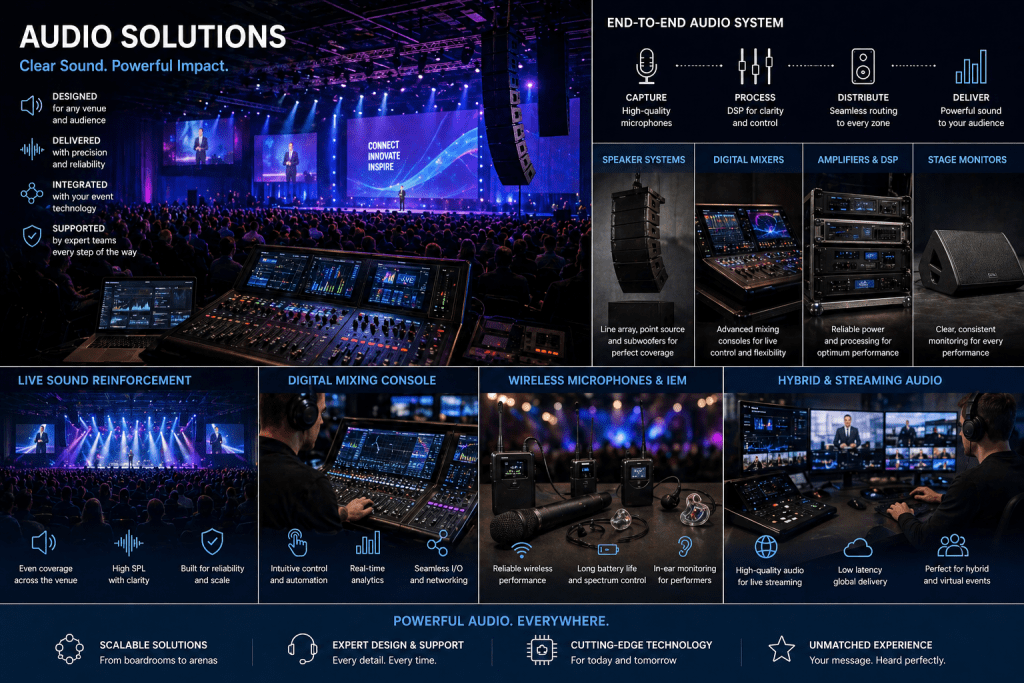
Introduction: Audio as Critical Infrastructure
Table of Contents
ToggleIn event environments, audio is not merely a support function—it is the primary medium through which content is delivered, interpreted, and experienced. While visual systems may attract attention, it is audio that determines comprehension, engagement, and accessibility.
Modern events—especially hybrid, multilingual, and large-scale formats—require audio systems that operate as integrated infrastructures rather than isolated components. These systems must capture, process, distribute, and adapt sound in real time across multiple environments and channels.
Audio solutions, therefore, represent a coordinated ecosystem of hardware, software, and control systems designed to deliver consistent, high-quality sound under dynamic conditions.
Core Components of Event Audio Systems
Input Layer: Capture and Acquisition
Audio systems begin with input devices that capture sound from various sources.
These include:
- Microphones (conference, wireless, lavalier, boundary)
- Instrument inputs for performances
- Playback systems for media content
The quality of capture at this stage directly affects all downstream processing.
Processing Layer: Digital Signal Processing (DSP)
Once captured, audio signals are processed using DSP systems to optimize clarity and stability.
Key processing functions include:
- Equalization to balance frequencies
- Compression to manage dynamic range
- Noise reduction and echo cancellation
- Automatic mixing for multiple inputs
DSP ensures that audio remains intelligible and consistent across different environments.
Mixing Layer: Control and Balancing
Audio mixing consoles—either hardware or software-based—allow operators to control levels, routing, and effects.
Mixing is critical in live environments where multiple sources must be balanced in real time. Engineers adjust:
- Volume levels for individual channels
- Spatial positioning in stereo or surround setups
- Effects such as reverb or delay
Advanced consoles integrate with digital networks, enabling remote and automated control.
Distribution Layer: Routing Across Channels
Processed audio is distributed to multiple destinations simultaneously.
These include:
- Public address (PA) systems for in-venue amplification
- Broadcast and streaming platforms for remote audiences
- Interpretation systems for multilingual delivery
- Recording systems for archival and analytics
Routing must be synchronized and latency-controlled to maintain coherence.
Output Layer: Amplification and Delivery
The final stage involves delivering sound to audiences through speakers or headphones.
Speaker systems vary based on venue size and requirements:
- Line array systems for large venues
- Point-source speakers for smaller spaces
- Distributed systems for even coverage
Personal audio systems, such as in-ear monitors, are used for performers and speakers.
Architectural Models: Centralized vs Distributed Audio
Centralized Audio Systems
Traditional setups rely on a central control room where all audio processing and mixing occur.
Advantages include:
- Simplified control and monitoring
- Consistent signal management
However, centralized systems may face scalability and latency challenges in large or distributed environments.
Distributed Audio Systems
Modern event environments increasingly use distributed architectures.
In this model:
- Processing occurs closer to the source (edge processing)
- Audio is transmitted over IP networks
- Systems are interconnected through digital audio protocols
This approach improves scalability, flexibility, and resilience.
Integration with Event Technology Ecosystems
Audio systems are deeply integrated with other event technologies.
In hybrid events, audio must synchronize with video streams to ensure alignment. In multilingual environments, audio feeds are routed into interpretation pipelines.
Integration with event data platforms enables:
- Real-time transcription and captioning
- Content indexing and searchability
- Analytics on engagement and participation
Audio systems also interact with orchestration platforms, enabling automated adjustments based on real-time conditions.
Operational Considerations
Acoustic Environment Design
Venue acoustics significantly impact audio quality. Factors such as reverberation, reflections, and ambient noise must be managed through:
- Acoustic treatment
- Speaker placement optimization
- Sound zoning
Latency Management
In hybrid and distributed systems, latency must be minimized to maintain synchronization across channels.
Redundancy and Reliability
Audio systems must be designed with failover mechanisms to ensure uninterrupted operation.
Scalability
Large events require systems that can handle multiple sessions, zones, and simultaneous audio streams.
Experience and Business Impact
High-quality audio solutions directly influence event outcomes.
For attendees, clear and consistent sound enhances comprehension and engagement. For remote participants, audio quality often defines the overall experience.
For organizers, reliable audio systems reduce operational risk and ensure smooth execution.
For sponsors and stakeholders, professional audio delivery contributes to brand perception and event credibility.
Challenges in Modern Audio Systems
Despite advancements, several challenges remain:
- Managing complex signal routing across multiple systems
- Ensuring compatibility between diverse hardware and software
- Handling wireless interference in crowded environments
- Balancing quality with cost and scalability
Addressing these challenges requires careful planning and expertise.
Future Outlook: Intelligent and Adaptive Audio
The future of event audio lies in intelligent systems that adapt in real time.
AI-driven audio processing will enable:
- Automatic speaker detection and tracking
- Dynamic noise suppression
- Context-aware mixing
Integration with spatial audio technologies will create more immersive experiences, particularly in hybrid and XR environments.
As audio systems become more data-driven, they will evolve from passive delivery mechanisms into active components of event intelligence.
Conclusion: Engineering Sound as a System
Audio solutions in events are no longer مجرد technical setups—they are complex, integrated systems that underpin communication and experience.
From capture to delivery, every component must operate cohesively to ensure clarity, reliability, and scalability.
For event technology leaders, investing in advanced audio solutions is essential to delivering high-quality, inclusive, and impactful event experiences in increasingly complex environments.