Live Nation details progress on festival accessibility reforms
Introduction
Live Nation has reported significant progress in improving accessibility at its major UK festivals, two years after entering into a legal agreement with the national equality watchdog. The live entertainment group, which operates events such as Wireless, Latitude and Reading Festival, has outlined a range of measures implemented as part of a multi-year programme to better serve disabled audiences and comply with equality legislation.
Background or industry context
Accessibility at large-scale music festivals has been under increased scrutiny from regulators, advocacy groups and audiences. In the UK, the Equality Act places duties on event organisers and venue operators to make reasonable adjustments so that disabled people are not disadvantaged in accessing services. In recent years, disabled festivalgoers and campaigners have drawn attention to challenges around ticketing, site access, viewing areas, communication of information and on-site support.
Live Nation, as one of the largest promoters of festivals and outdoor events in the UK, has been a focal point in this debate. The organisation entered into a formal agreement with the Equality and Human Rights Commission (EHRC) after concerns were raised about the experiences of disabled attendees. That agreement required Live Nation to review its policies and practices and to deliver concrete improvements across its festival portfolio within a specified timeframe.
The developments at Live Nation are part of a broader shift across the live events sector, where accessibility is moving from being treated as a compliance obligation to being recognised as a core part of audience strategy and event design. This has implications not only for festival operators, but also for ticketing platforms, production companies and event technology providers that support accessibility features.
Key developments or announcement
According to the latest update, Live Nation has completed a series of changes designed to improve how disabled festivalgoers discover, book and experience its events. The reported measures span pre-event planning, on-site infrastructure and staff training.
Key developments include:
- Improved accessibility information and communication: Live Nation has expanded and standardised accessibility information across its festival websites, including clearer details on site layouts, accessible facilities, and support services. This aims to enable disabled customers to assess suitability before purchasing tickets.
- Revised ticketing and access schemes: The company has refined its processes for disabled customers to request reasonable adjustments, such as accessible viewing platforms, personal assistant tickets and step-free access. Online forms and documentation requirements have been reviewed to reduce friction and provide more predictable responses.
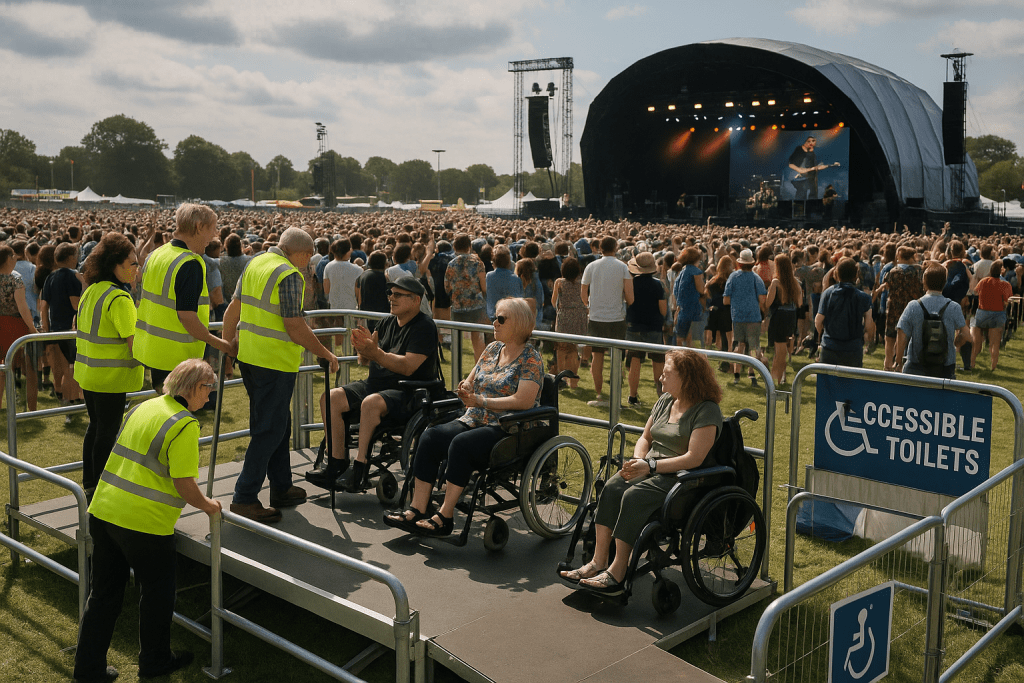
- On-site infrastructure enhancements: Across flagship events like Wireless, Latitude and Reading, the operator has deployed additional viewing platforms, accessible toilets, step-free routes and designated access entrances. Temporary infrastructure has been redesigned in some cases to improve navigation and reduce congestion for those with mobility needs.
- Staff training and operational protocols: Live Nation has expanded disability awareness training for festival staff and contractors, including front-of-house teams and security. Updated protocols are intended to ensure more consistent handling of access requests, queue management and emergency procedures involving disabled attendees.
- Feedback and monitoring mechanisms: The group has placed greater emphasis on collecting feedback from disabled customers post-event, working with advocacy organisations and access consultants to review performance and identify further adjustments.
Live Nation has positioned these developments as the outcome of a structured, multi-year programme created in response to the EHRC’s intervention, rather than a set of isolated changes. While detailed metrics have not been fully disclosed, the company has indicated that uptake of accessibility services has grown and that satisfaction among disabled festivalgoers has improved compared with previous seasons.
Industry impact
The scale of Live Nation’s UK festival operations means that its accessibility programme is likely to influence broader industry practice. Large, multi-day outdoor events face distinct challenges around terrain, temporary infrastructure, crowd management and variable weather. The solutions rolled out at festivals like Wireless, Latitude and Reading provide reference points for other promoters and venues considering similar changes.
Regulatory interest in accessibility is also unlikely to diminish. The EHRC’s involvement in this case signals that enforcement of equality legislation in live events is an ongoing priority. Other organisers may look to Live Nation’s agreement as an indicator of expectations around proactive planning, documentation, and demonstrable improvements over time.
The impact extends into the event technology ecosystem as well. Ticketing platforms may need to support more nuanced access requests, companion tickets and verification processes without creating additional barriers. Wayfinding apps, digital maps and event management tools are being evaluated for how effectively they surface accessibility information and respond to real-time conditions on site.
Suppliers of staging, crowd control systems, temporary structures and sanitation facilities are similarly affected. Specifications for accessible viewing platforms, ramps, handrails, toilet units and signage are increasingly detailed, and organisers are seeking partners who can document compliance and adapt quickly to different site conditions.
Why this matters for event professionals and technology providers
For event professionals, the developments at Live Nation highlight that accessibility is becoming a strategic operational focus, not a peripheral concern. The Live Nation–EHRC agreement underscores several practical considerations:
- Early integration in planning: Accessibility requirements need to be integrated into site design, crowd planning, supplier contracts and staff training from the outset, rather than addressed ad hoc late in the cycle.
- Data-driven improvements: Structured feedback collection from disabled attendees can inform iterative changes across multiple editions of an event, supporting a continuous improvement model rather than one-off fixes.
- Cross-team coordination: Delivering consistent accessibility outcomes requires coordination between operations, ticketing, digital teams, customer service and external vendors.
- Risk and reputation management: Regulatory scrutiny and public expectations mean that accessibility shortcomings can quickly turn into legal and reputational risks, especially for high-profile events.
For technology providers, the shift presents both challenges and product opportunities:
- Accessible digital journeys: Ticketing and registration systems must handle companion tickets, access requests and documentation in a way that is compliant, secure and user-friendly.
- Information delivery: Event apps, mobile websites and digital signage are central to sharing live updates on accessible routes, facilities status and assistance points.
- Analytics and reporting: Platforms that can capture, segment and report on accessibility-related data – such as service usage and response times – will be valuable for organisers needing to demonstrate progress.
- Integration with on-site operations: Connecting digital tools with access control, staffing systems and incident management can help ensure that promised adjustments are delivered reliably in the field.
Conclusion
Live Nation’s update on its accessibility programme marks a significant milestone in how large-scale festivals address the needs of disabled audiences. Driven in part by regulatory oversight from the equality watchdog, the company has introduced changes that span information provision, ticketing processes, physical infrastructure and staff training.
For the wider events industry, the developments reinforce that accessibility is an operational, technological and strategic issue. As regulators, audiences and partners continue to raise expectations, organisers and suppliers across the festival and live events ecosystem are likely to face growing pressure to document, measure and continually enhance accessibility provisions. The experience of major operators such as Live Nation will be closely watched as a reference point for what comprehensive, multi-year accessibility improvements look like in practice.