Event Video Solutions: Infrastructure, Capture Strategy, and Distribution in Modern Event Technology

Event video solutions form a critical layer of contemporary event technology. From live streaming and on-site display to recording, archiving, and post-event distribution, video systems now support operational continuity, audience expansion, and measurable engagement.
This article examines event video solutions through a technical and strategic lens, focusing on infrastructure design, production workflows, signal management, and integration with broader event technology ecosystems.
Defining Event Video Solutions
Event video solutions encompass the hardware, software, and network components required to capture, process, transmit, and distribute video content during live events.
Core components typically include:
-
Professional video cameras and camera control units
-
Video switchers and production consoles
-
Encoding hardware or software
-
LED walls or projection systems
-
Streaming platforms
-
Recording and storage systems
-
Content distribution networks
These elements operate within a structured signal chain that supports both in-venue display and remote audience access.
Video Capture and Production Infrastructure
Multi-Camera Production Systems
Multi-camera setups allow organizers to produce broadcast-quality event coverage. Cameras may be positioned for:
-
Wide-angle stage shots
-
Close-up speaker framing
-
Audience reaction capture
-
Sponsor branding visibility
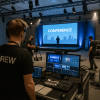
Video switchers combine multiple camera feeds into a single program output. Live transitions, overlays, and graphics are managed in real time by production teams.
Multi-camera production enhances audience engagement, particularly for conferences, product launches, and large-scale corporate events.
Audio and Video Synchronization
Clear video without synchronized audio reduces content quality. Event video systems must ensure:
-
Proper audio routing through mixing consoles
-
Latency control between audio and video feeds
-
Redundant recording channels
-
Real-time monitoring
Synchronization is particularly critical for live streaming and hybrid events.
Live Streaming and Hybrid Event Video
Streaming Infrastructure and Encoding
For hybrid and virtual events, video feeds must be encoded into digital formats suitable for internet distribution.
Streaming workflows typically involve:
-
Real-time encoding hardware
-
Adaptive bitrate streaming configuration
-
Integration with event platforms
-
Redundant internet connectivity
Reliable bandwidth planning is essential. Organizers should provision primary and backup internet lines to avoid broadcast disruption.
Platform Integration
Event video solutions must integrate with:
-
Registration systems for access control
-
Virtual event platforms
-
CRM systems for attendee analytics
-
On-demand content libraries
Access permissions, viewing analytics, and attendee engagement metrics depend on seamless system integration.
In-Venue Video Display Systems
LED Walls and Projection Mapping
On-site visual display plays a central role in audience experience. Large-format LED walls and projection systems are used for:
-
Stage backdrops
-
Speaker support slides
-
Sponsor branding
-
Live feed reinforcement
Display planning requires careful consideration of venue dimensions, viewing angles, ambient lighting, and pixel pitch.
Signal Distribution and Control
Signal routing across multiple displays demands structured AV control systems. Distribution may involve:
-
SDI or HDMI signal paths
-
Fiber optic transmission for long distances
-
Redundant signal routing
-
Centralized video control racks
Proper cable management and signal testing reduce failure risk during live sessions.
Event Video Recording and Content Repurposing
High-Quality Recording and Archiving
Professional recording systems capture event sessions for:
-
On-demand access
-
Training documentation
-
Compliance records
-
Marketing reuse
Recording formats should align with post-production requirements. Redundant recording ensures content preservation in case of primary system failure.
Post-Event Content Strategy
Recorded event video can be segmented into:
-
Highlight reels
-
Speaker clips
-
Social media snippets
-
Educational modules
This extends event value beyond the live date and supports long-term audience engagement.
Security and Data Protection in Event Video
Secure Access Control
For restricted events, access to live streams and recordings must be controlled through:
-
Password-protected portals
-
Role-based permissions
-
Encrypted streaming protocols
-
Secure cloud storage
Unauthorized access can compromise proprietary information or sponsor confidentiality.
Data Governance and Compliance
Video recordings may contain personal data or proprietary material. Organizers should implement:
-
Attendee consent policies
-
Clear recording disclosures
-
Secure storage and retention policies
-
Compliance with applicable data protection regulations
Structured governance reduces legal and reputational risk.
Operational Considerations and Risk Mitigation
Redundancy Planning
Event video systems require backup planning for:
-
Camera failures
-
Power interruptions
-
Network instability
-
Hardware malfunctions
Redundant equipment and standby technical personnel minimize operational disruption.
Technical Rehearsals and Load Testing
Pre-event rehearsals validate:
-
Signal integrity
-
Camera framing
-
Audio-video synchronization
-
Streaming stability
Testing under simulated peak loads improves reliability during live broadcast.
Integration with Broader Event Technology Ecosystems
Event video solutions increasingly connect with:
-
RFID or NFC credential systems for session tracking
-
Event mobile applications for content access
-
Audience polling and engagement tools
-
Analytics dashboards for performance reporting
Video data can contribute to comprehensive engagement metrics, linking session attendance to content consumption patterns.
Strategic Importance of Event Video Solutions
Event video has evolved from a supplementary feature to a core operational component. It enables hybrid participation, increases event reach, strengthens sponsor visibility, and generates measurable digital engagement.
For organizers operating in a hybrid-first environment, investing in structured, scalable, and secure event video solutions ensures both technical reliability and strategic content value.