Veuve Clicquot brings experiential art collaboration to New York City streets
Background and context
Veuve Clicquot recently brought an art-led experiential campaign to New York City, tying a limited-edition product release to a series of public-facing brand moments. The champagne house collaborated with British-Nigerian artist Yinka Ilori on a collection of colorful accessories, using the city as a backdrop to extend the partnership beyond traditional retail or gallery spaces.
The initiative reflects a growing trend in experiential marketing, where beverage and lifestyle brands increasingly rely on citywide activations, installations, and pop-ups to reach consumers in informal, high-footfall environments. Rather than centering on a single event, the New York program unfolded across multiple touchpoints designed to be photographed, shared, and discovered in everyday urban settings.
Key announcement
At the core of the activity is Veuve Clicquot’s limited-edition range created with Yinka Ilori, known for his bold use of color and pattern. The collection includes branded accessories that reinterpret the champagne house’s visual identity through Ilori’s graphic style.
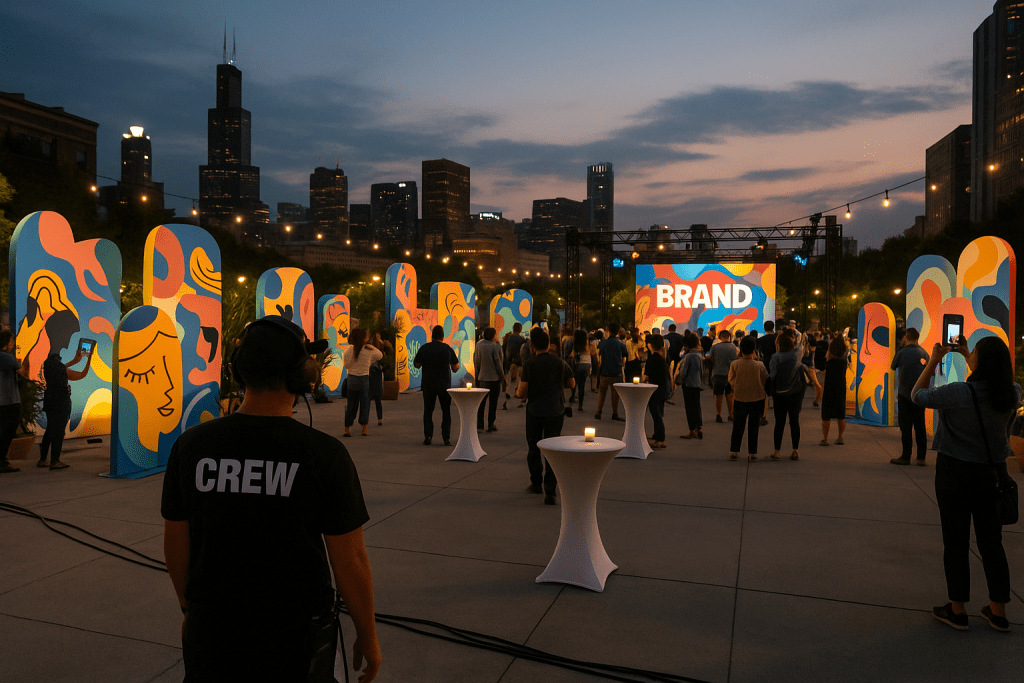
To introduce the designs to the public, the brand organized a series of installations and experiences across New York. These included art-inspired displays and interactive elements that highlighted the collaboration’s themes of joy and optimism. The creative treatments drew on Ilori’s signature palette and geometric motifs, reimagined within the context of hospitality and social gatherings.
Information about the collaboration and the limited-edition pieces is available through Veuve Clicquot’s official channels, including its main website, where the collection is positioned as a seasonal design statement linked to the artist’s practice.
Industry impact
For event and experiential professionals, the campaign underscores several ongoing shifts in how brands approach live engagement in dense urban markets. First, it illustrates how limited-edition product drops can be amplified through short-term public interventions rather than traditional launch parties alone.
Second, the collaboration demonstrates the value of working with artists who already have a strong visual language that can translate across multiple formats—packaging, temporary structures, and social content. By treating the city as an open canvas, the brand aligned physical design with digital storytelling, encouraging passersby to turn installations into user-generated content.
Finally, the approach shows how heritage brands continue to experiment with contemporary collaborators to stay visible among younger, design-conscious audiences. The use of accessible outdoor and semi-public spaces provides a model for reaching people who may not attend more formal, invite-only activations.
Why this matters
From an event technology and production standpoint, campaigns like this highlight the growing importance of portable, modular builds, adaptable lighting, and photo-friendly set design that can be deployed quickly in city environments. Producers are being asked to support brand storytelling that is as much about visuals and shareability as it is about on-site hospitality.
The Veuve Clicquot and Yinka Ilori collaboration also emphasizes the role of multidisciplinary teams—combining art direction, fabrication, permitting, and on-the-ground event staffing—to deliver coordinated experiences across multiple locations. As more brands look to connect cultural partnerships with experiential rollouts, similar citywide campaigns are likely to become more common in major markets.
For planners and agencies, the New York initiative offers a case study in using public art aesthetics to extend a product launch, creating a bridge between design collaboration and live engagement that can be adapted to different cities and audiences.